The following release about gene activity pattern discovery was
sent to reporters under embargo on Wednesday. The embargo
lifted today:
Department of Health and Human Services
National Institutes of Health
National Cancer Institute
CONTACT:
NCI Media Relations Branch
(301) 496-6641
ncipressofficers@mail.nih.gov
Monday, August 14, 2006
5 pm EDT
Tumors Use ‘Hijacking’ Trick to Evade Attack by Immune Cells
Researchers have identified a potential mechanism by which tumors
in miceescape attack from antitumor immune cells. This escape is
facilitated when tumors produce a molecule called adenosine that
inactivates antitumor immune cells by binding to receptors on
their cell surfaces, the researchers found. Consequently, the
immune cells behave as though the tumors are normal tissue, and
an attack is averted. This research was conducted by scientists
at the National Cancer Institute (NCI) and the National Institute
of Allergy and Infectious Diseases (NIAID), both part of the
National Institutes of Health (NIH), and their collaborators.
Theresults are reported in the August 14, 2006, online issue of
Proceedings of the National Academy of Sciences*.
“This work may be complementary to efforts of cancer
immunologists who have developed many clever ways to improve the
development of antitumor T cells,” said NIH Director Elias A.
Zerhouni, M.D. “The cross-fertilization of research between the
field of immunology and cancer is a fruitful one that is paying
dividends with this new finding.”
“Tumors have hijacked a mechanism that evolved to protect
normal tissues from collateral damage that occurs when the body
mounts a defense against infection,” said lead researcher Misha
Sitkovsky, Ph.D., who until recently was at NIAID. Sitkovsky is
now at the New England Inflammation and Tissue Protection Institute,
a consortium at Northeastern University in Boston, Mass.
The findings extend research published in Nature in 2001 by
Sitkovsky and colleagues into the role of adenosine in regulating
inflammation. Inflammatory chemicals produced by the immune
system in response to infection or injury must eventually be
switched off so that excessive tissue damage can be avoided.
Sitkovsky and his colleagues have shown that one consequence of
inflammation -- a drop in oxygen levels in the inflamed
tissues -- triggers the release of adenosine from surrounding
cells and serves as atissue-protecting stop signal. This is because
when adenosine binds to so-called A2A adenosine receptors on
immune cells in the inflamed region, the production of
damaging inflammatory molecules is slowed.
In the new study, the researchers tested whether the same
mechanism protects cancerous tissues from antitumor T cells
by evaluating the effects of genetically deleting A2A adenosine
receptors in mice. The experiments showed that antitumor T cells
that lack A2A adenosine receptors can overcome tumor defenses and
eradicate tumor cells.
“We showed that if antitumor T cells do not express A2A
adenosine receptors due to a genetic deletion, then these antitumor
T cells can overcome adenosine-based tumor defense mechanisms.
As a result, the majority of these mice rejected their tumors and
survived significantly longer,” said co-researcher Scott Abrams,
Ph.D., of NCI’s Center for Cancer Research. By comparison, normal
mice that had antitumor T cells with intact A2A adenosine receptors
experienced uncontrolled tumor growth and died. Abrams added,
“These proof-of-concept experiments also raise the idea that this
type of tumor escape mechanism may serve as a target for
therapeutic intervention.”
To begin to explore that idea, the researchers pharmacologically
inactivated the A2A adenosine receptor using substances such as
caffeine and others to make antitumor T cells less susceptible
to inhibition by tumor-produced adenosine. The majority of mice
in these experiments had much better antitumor immune responses
and delayed tumor growth.
The genetic inactivation strategy was not effective in about 40
percent of the mice, however. The researchers suggest that one
reason may be the existence of other adenosine receptors in these
mice, and identifying these molecules will be a focus of future
research.
“Now we may be able to prevent a hostile tumor microenvironment
from inhibiting the antitumor T cells. I have been extremely
fascinated and puzzled by the paradoxical coexistence of tumors
and anti-tumor immune cells in the same cancer patient,” added
Sitkovsky. “I have been considering this contradiction for the
past 30 years.”
“Greater understanding of the tumor microenvironment and its
relationship to other cells in the body is not just enhancing
our knowledge of cancer; it could eventually lead to new treatments
and better ways to monitor those treatments,” said NCI Acting
Director John E. Niederhuber, M.D.
###
* Ohta A, Gorelik E, Ronchese F, Lukashev D, Prasad SJ, Wong MKK,
Huan X, Caldwell S, Liu K, Smith P, Chen JF, Jackson EK, Apasov S,
Abrams S, and Sitkovsky M. A2A adenosine receptor protects tumors
from anti-tumor T cells. PNAS. Online August 14, 2006.
The NIH -- The Nation's Medical Research Agency -- includes
27 Institutes and Centers and is a component of the U.S. Department
of Health and Human Services. It is the primary federal agency for
conducting and supporting basic, clinical and translational medical
research, and it investigates the causes, treatments, and cures
for both common and rare diseases. For more information about NIH
and its programs, visit www.nih.gov.
For more information about cancer, please visit the NCI Web site at
http://www.cancer.gov, or call NCI’s Cancer Information Service at
1-800-4-CANCER (1-800-422-6237).
NIAID supports basic and applied research to prevent, diagnose
and treat infectious diseases such as HIV/AIDS and other sexually
transmitted infections, influenza, tuberculosis, malaria and
illness from potential agents of bioterrorism. NIAID also supports
research on basic immunology, transplantation and immune-related
disorders, including autoimmune diseases, asthma and allergies.
Monday, August 14, 2006
Thursday, August 10, 2006
Dessert! Yum!
This picture shows a cous cous cake with a blueberry topping, a green tea mousse with an azuki bean topping and mochi dumplings, and a strawberry parfait with tofu whipped cream.


Recent meals
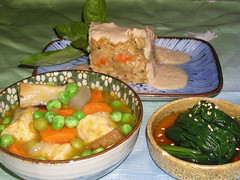
Here are some of the things I've cooked lately: red lentil loaf with sesame gravy, tempeh stew, and spinach ohitashi
Tuesday, August 08, 2006
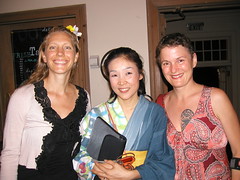
Leslie, Mie, and Reni
Reni and I got to see our respected teachers Mie and Hiroyuki Naka at the KI Summer Conference. Here's beautiful and talented Mie. Does she look about 16 years old? She's 43!
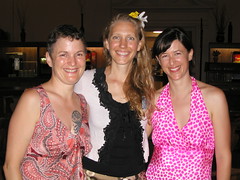
Reni, Leslie, Paige
I'm so lucky to have two such wonderful macrobiotic friends. Thanks, Reni, for coming to visit, and thanks, Paige, for all the time we worked together!
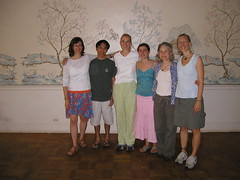
Cooking Class Team
Paige (left) and I (right) co-managed a team of 8 cooking class volunteers. These were a few of our great team members, Kevin, Ceri, Barbara, and Anita. They helped us a lot doing a really demanding job.
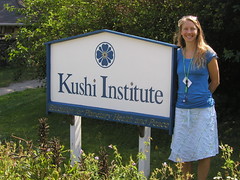
Leslie at the Kushi Institute in Becket
This was my first ever trip to the KI. I was super exhausted after a week of working 12 to 17 hour days non-stop as the KI Summer Conference Cooking Class Team Leader. The reason for going up was to help put away the cooking utensils and food from the 5-day conference. It was great to be in Becket and to finally see what the KI is like. The food is sooo yummy!
A message from the KI Summer Conference
“Macrobios Global”
spoken by Michio Kushi on 7/29/2006 at the Kushi Institute Summer Conference
Michio’s Goals
1) Health recovery in the next 2 years. His ascending colon was 98% blocked which caused a water control problem for him. Since they removed part of the upward colon, where it was attached to his small intestine and appendix, this has been causing trembling and weakness in his legs. Left untreated, his condition could have led to a heart attack. His B-12 synthesis has been reduced and sometimes he requires shots. In the next couple of years, he’ll remain on a reduced schedule and try to recover his health. He said he’s been getting better and better all the time.
2) He’d like a comprehensive book of “Macrobios Whole View” or infinity from beginning of time to the end
3) He’d like a World Macrobiotic Federation with about 100 senior macrobiotic leaders from all over the world. The goals of this WMF would be to:
a. have 2 – 3 days of special studies with group tours between countries
b. hold more international events
c. have the countries/centers do their events (e.g., summer conferences) at different times to enable people to attend everything
d. make borders obsolete
e. create a world Constitution (i.e., Declaration of Independence-like document) and present to current world leaders in 2 to 3 years.
4) He’d like the current form of energy to change or to have another Industrial Revolution. At the moment, we’re using too much energy, digging too many minerals and oil, and burning too much oil, causing extensive pollution. The additional developing countries are now adding to this pollution. We need to avoid more global warming, and he makes this a 10-year goal. We need a new energy source such as:
a. the energy of Earth’s rotation
b. the transmutation of atoms from the 8 light elements into heavier elements
5) We need to recognize our ultimate purpose of having a spiritual and peaceful human kind, and practice self-love and love towards others. Religion, in his estimation, is not making a definite contribution to peace. The focus should be removed from the physical and instead should be refocused on more developed spiritual and mental states. He estimates this will take approximately 2000 years to accomplish. Health should overcome violence, sickness, and conflict, creating a new civilization.
While Michio is still alive, he plans to teach more. One example of this would be to teach a new type of visual diagnosis. For example, currently, each part of the face represents a different organ. Another way to do this is to take the whole face to read each organ. Specifically, if you’re looking at a woman’s face and wanting to diagnose the reproductive system, the eyes represent the ovaries, and the area around the eye represents the fallopian tubes. The nose is the uterus, and just below the nose is the cervix, the lips the vagina, and around the mouth is the endometrium. Another example is the lungs; the right side of the face is the right lung, and the left side the left lung, respectively. He’d like to be able to teach several styles of visual diagnosis to us all.
He wants a teacher’s health curriculum.
He thanks everyone for the work they have been doing and though he may not remember names, he remembers faces.
spoken by Michio Kushi on 7/29/2006 at the Kushi Institute Summer Conference
Michio’s Goals
1) Health recovery in the next 2 years. His ascending colon was 98% blocked which caused a water control problem for him. Since they removed part of the upward colon, where it was attached to his small intestine and appendix, this has been causing trembling and weakness in his legs. Left untreated, his condition could have led to a heart attack. His B-12 synthesis has been reduced and sometimes he requires shots. In the next couple of years, he’ll remain on a reduced schedule and try to recover his health. He said he’s been getting better and better all the time.
2) He’d like a comprehensive book of “Macrobios Whole View” or infinity from beginning of time to the end
3) He’d like a World Macrobiotic Federation with about 100 senior macrobiotic leaders from all over the world. The goals of this WMF would be to:
a. have 2 – 3 days of special studies with group tours between countries
b. hold more international events
c. have the countries/centers do their events (e.g., summer conferences) at different times to enable people to attend everything
d. make borders obsolete
e. create a world Constitution (i.e., Declaration of Independence-like document) and present to current world leaders in 2 to 3 years.
4) He’d like the current form of energy to change or to have another Industrial Revolution. At the moment, we’re using too much energy, digging too many minerals and oil, and burning too much oil, causing extensive pollution. The additional developing countries are now adding to this pollution. We need to avoid more global warming, and he makes this a 10-year goal. We need a new energy source such as:
a. the energy of Earth’s rotation
b. the transmutation of atoms from the 8 light elements into heavier elements
5) We need to recognize our ultimate purpose of having a spiritual and peaceful human kind, and practice self-love and love towards others. Religion, in his estimation, is not making a definite contribution to peace. The focus should be removed from the physical and instead should be refocused on more developed spiritual and mental states. He estimates this will take approximately 2000 years to accomplish. Health should overcome violence, sickness, and conflict, creating a new civilization.
While Michio is still alive, he plans to teach more. One example of this would be to teach a new type of visual diagnosis. For example, currently, each part of the face represents a different organ. Another way to do this is to take the whole face to read each organ. Specifically, if you’re looking at a woman’s face and wanting to diagnose the reproductive system, the eyes represent the ovaries, and the area around the eye represents the fallopian tubes. The nose is the uterus, and just below the nose is the cervix, the lips the vagina, and around the mouth is the endometrium. Another example is the lungs; the right side of the face is the right lung, and the left side the left lung, respectively. He’d like to be able to teach several styles of visual diagnosis to us all.
He wants a teacher’s health curriculum.
He thanks everyone for the work they have been doing and though he may not remember names, he remembers faces.
Tuesday, June 27, 2006
An Inconvenient Truth
Roger Ebert, perhaps the country's premier movie reviewer,
said in his review of this film [An Inconvenient Truth]:
"In 39 years, I have never written these
words in a movie review, but here they are: You owe it to yourself to
see this film. If you do not, and you have grandchildren, you should
explain to them why you decided not to."
This is one of the most powerful and well-made movies to come along in a while. It's deeply profound and frightening to see what Al Gore presents. Please see this movie, and go to www.climatecrisis.net so that you can find out what you can do to reduce your carbon footprint on the earth.
Macrobiotic people are already doing some of these things, but we can always do more.
said in his review of this film [An Inconvenient Truth]:
"In 39 years, I have never written these
words in a movie review, but here they are: You owe it to yourself to
see this film. If you do not, and you have grandchildren, you should
explain to them why you decided not to."
This is one of the most powerful and well-made movies to come along in a while. It's deeply profound and frightening to see what Al Gore presents. Please see this movie, and go to www.climatecrisis.net so that you can find out what you can do to reduce your carbon footprint on the earth.
Macrobiotic people are already doing some of these things, but we can always do more.
Thursday, June 15, 2006
Macrobiotic "yajna": eco spirituality
Whenever I read my yoga magazines, I find so much overlap with what I learned in my macrobiotic studies. I loved this excerpt from Yoga International's March 2006 issue called Re-enchantment by Sandra Anderson. It said:
The Ritual of Life
"Yajna is ritual fire sacrifice on the one hand, but it's more general meaning is that which contributes to the beauty and well-being of creation. Yajna is that which sustains and nourishes the matrix of life. Swami Rama writes in his translation of the Bhagavad Gita, "In the universe, every action is a ritual, and the ritual is performed for the sake of sacrifice. The raindrop sacrifices itself to become part of the plant, the sun gives up its energy to give light and life to all beings." He was fond of saying "Giving is the law of the universe." Selfless actions, he would tell us, unconditional love, the offering of inner vitalities to the Lord of Life, working with less attachment to the outcome and more attention to our highest values -- these are yajnas."
Fragrant yajna offerings are burnt and the smoke ascends to the subtle realms "to nourish and propitiate the forces of nature. Acknowledging this interdependent matrix of life, the Bhagavad Gita says, "Beings are born from food; food is produced from the rain; rain is produced from sacrifice (yajna), and yajna arises from action." The actions of humans living in harmony with the environment nourish the atmosphere, keeping the rain in balance, and protecting the soil, plants, and entire food chain."
I feel good knowing that my dietary choices attempt to realign with nature and that somehow I am doing what I can to help nourish not just myself and the people that I cook for, but also the planet. Practicing macrobiotics is a form of yajna. I have a choice not to eat meat, dairy, sugar, and other extreme foods that would not only hurt my health, but in doing so also harm others.
The Ritual of Life
"Yajna is ritual fire sacrifice on the one hand, but it's more general meaning is that which contributes to the beauty and well-being of creation. Yajna is that which sustains and nourishes the matrix of life. Swami Rama writes in his translation of the Bhagavad Gita, "In the universe, every action is a ritual, and the ritual is performed for the sake of sacrifice. The raindrop sacrifices itself to become part of the plant, the sun gives up its energy to give light and life to all beings." He was fond of saying "Giving is the law of the universe." Selfless actions, he would tell us, unconditional love, the offering of inner vitalities to the Lord of Life, working with less attachment to the outcome and more attention to our highest values -- these are yajnas."
Fragrant yajna offerings are burnt and the smoke ascends to the subtle realms "to nourish and propitiate the forces of nature. Acknowledging this interdependent matrix of life, the Bhagavad Gita says, "Beings are born from food; food is produced from the rain; rain is produced from sacrifice (yajna), and yajna arises from action." The actions of humans living in harmony with the environment nourish the atmosphere, keeping the rain in balance, and protecting the soil, plants, and entire food chain."
I feel good knowing that my dietary choices attempt to realign with nature and that somehow I am doing what I can to help nourish not just myself and the people that I cook for, but also the planet. Practicing macrobiotics is a form of yajna. I have a choice not to eat meat, dairy, sugar, and other extreme foods that would not only hurt my health, but in doing so also harm others.
Monday, May 29, 2006
Quinoa, cranberry, and pecan pilaf
I LOVE quinoa. How did life get so far along without knowing about this? I tried it for the first time about 3 years ago. It's becoming more popular these days, and I often read about this being a good grain for people who want to lose weight because it's so high in protein so it's satisying and gives you energy. One of my students told me that her 70ish uncle fathered two children in his sunset years, and the US made him take a paternity test to enter the US. They thought he was lying, but he told them, "What do you think I eat? I'm not like Americans eating hamburgers. I'm CHILEAN. I eat QUINOA."
Grain pilafs with tart fruit, pungent green onions, crunchy nuts and veges, and a lemon dressing really turn me on!
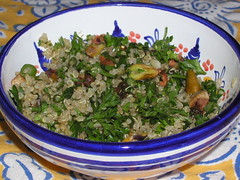
Grain pilafs with tart fruit, pungent green onions, crunchy nuts and veges, and a lemon dressing really turn me on!
Tempeh curry
I've been looking for macro things to make for non-macro people and this was one of the yummy ones. It's great with brown rice.
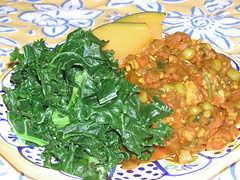
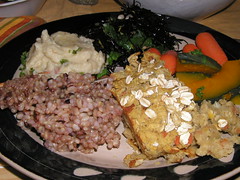
Delcious dinner
Let's see, what did we have...? It was lentil loaf, millet mashed potatoes and gravy, arame with apple juice, brown rice, and steamed carrots and squash. Yum!
Azuki Bean Face Lift
If you read Macrobiotics Today, then you might have seen Ilanit Tof's recipe for the Azuki Bean Scrub. Well, I want to tell you that if you haven't tried it yet, you SHOULD. It's really amazing. I went out to buy a coffee grinder especially for this, and it was worth it. Your face feels super soft and even after doing it just once, it seems to improve you complexion. You can purchase Ilanit's entire full colour kitchen friendly book of great vegan macrobiotic healing recipes here:
https://littletree.securehost3.com/seasonal_variation.htm or at cybermacro.com
if you live in the USA
I purchased her book, and am excited to try the recipes :-)
Here's the azuki bean recipe:
Oriental Skin Polishing Pore Refresher
Ingredients
✓ ¼ - ½ cup raw adzuki beans
✓ 1 clean strong coffee bean grinder
Procedure
❦ Grind 1- 2 tablespoons of raw adzuki beans at a time
❦ If the grinder has a pulse mechanism you may like to use this
❦ Wait 20 - 30 seconds before opening lid to allow to settle and prevent a face-full of adzuki bean powder dust
❦ Place powder in an airtight glass jar
❦ Transfer several tablespoons into a small plastic container with a good seal for use in the bathroom/shower
Variations
• use chickpeas for a more moistening mix
Usage Suggestions
• mix with water to a paste after cleansing face
• use as a scrub and rinse off immediately (good for daily – 3 times a week use)
• or allow to remain on face until it dries and rinse off in the shower (use once a week and follow with a few drops of pure jojoba or rosehip oil on damp skin or leave skin bare overnight to rejuvenate and cleanse)
• can be used as a whole body scrub
All About Adzuki Beans
✱ Revered as an indispensable beauty aid both internally and externally in the Orient
✱ Powerfully rejuvenate the kidneys and heart when eaten or made into a kidney tonifying tea
✱ The bean’s astringent action is heightened in the raw state which is utilised in this pore refining treatment that will beat expensive lotions and potions hands down!
Ms Ilanit Tof
B.A. (Psychophysiology/Psychology)
Advanced Diploma Healing with Wholefoods
PhD Holistic Nutrition (candidate)
Little Tree Oriental Healing Arts
Helping you grow to new heights of wellbeing
with Oriental Traditions and Modern Nutrition
ilanit@littletree.com.au
www.littletree.com.au
https://littletree.securehost3.com/seasonal_variation.htm or at cybermacro.com
if you live in the USA
I purchased her book, and am excited to try the recipes :-)
Here's the azuki bean recipe:
Oriental Skin Polishing Pore Refresher
Ingredients
✓ ¼ - ½ cup raw adzuki beans
✓ 1 clean strong coffee bean grinder
Procedure
❦ Grind 1- 2 tablespoons of raw adzuki beans at a time
❦ If the grinder has a pulse mechanism you may like to use this
❦ Wait 20 - 30 seconds before opening lid to allow to settle and prevent a face-full of adzuki bean powder dust
❦ Place powder in an airtight glass jar
❦ Transfer several tablespoons into a small plastic container with a good seal for use in the bathroom/shower
Variations
• use chickpeas for a more moistening mix
Usage Suggestions
• mix with water to a paste after cleansing face
• use as a scrub and rinse off immediately (good for daily – 3 times a week use)
• or allow to remain on face until it dries and rinse off in the shower (use once a week and follow with a few drops of pure jojoba or rosehip oil on damp skin or leave skin bare overnight to rejuvenate and cleanse)
• can be used as a whole body scrub
All About Adzuki Beans
✱ Revered as an indispensable beauty aid both internally and externally in the Orient
✱ Powerfully rejuvenate the kidneys and heart when eaten or made into a kidney tonifying tea
✱ The bean’s astringent action is heightened in the raw state which is utilised in this pore refining treatment that will beat expensive lotions and potions hands down!
Ms Ilanit Tof
B.A. (Psychophysiology/Psychology)
Advanced Diploma Healing with Wholefoods
PhD Holistic Nutrition (candidate)
Little Tree Oriental Healing Arts
Helping you grow to new heights of wellbeing
with Oriental Traditions and Modern Nutrition
ilanit@littletree.com.au
www.littletree.com.au
Tuesday, May 02, 2006
Emotions in and out of balance
Healthy conditions of the liver and gallbladder are connected with patience and endurance, while unhealthy conditions produce short temper and anger
Healthy conditions of the heart and small intestine are connected with gentleness,
tranquility, intuitive comprehension, spiritual oneness, and merry, humorous expression, while unhealthy conditions produce separateness excitement, and excessive laughter
Healthy conditions of the spleen, pancreas, and stomach, are connected with sympathy
wisdom, consideration, and understanding, while unhealthy conditions produce irritability skepticism, criticism, and worry
Healthy conditions of the lungs and large intestine are connected with a feeling of happiness, security, and wholeness, while unhealthy conditions produce sadness, depression, and melancholy
Healthy conditions of the kidneys and bladder are connected with confidence, courage
and inspiration while their unhealthy conditions produce fear, lack of self- esteem, and hopelessness
Healthy conditions of the heart and small intestine are connected with gentleness,
tranquility, intuitive comprehension, spiritual oneness, and merry, humorous expression, while unhealthy conditions produce separateness excitement, and excessive laughter
Healthy conditions of the spleen, pancreas, and stomach, are connected with sympathy
wisdom, consideration, and understanding, while unhealthy conditions produce irritability skepticism, criticism, and worry
Healthy conditions of the lungs and large intestine are connected with a feeling of happiness, security, and wholeness, while unhealthy conditions produce sadness, depression, and melancholy
Healthy conditions of the kidneys and bladder are connected with confidence, courage
and inspiration while their unhealthy conditions produce fear, lack of self- esteem, and hopelessness
Thursday, March 16, 2006
Environmental and Health News
CONGRESS BLINDFOLDS CONSUMERS- REMOVING RIGHT TO KNOW WHAT'S IN YOUR FOOD
On March 8, despite massive public opposition, including 50,000 calls and letters from supporters of the Organic Consumers Association, the House of Representatives passed the controversial "national food uniformity" labeling law, which would eliminate over 200 state food safety labeling laws. The law basically takes away local government and states' power to require food safety labels such as those required in California and other states on foods or beverages that are likely to cause cancer, birth defects, allergic reactions, or mercury poisoning. The bill would also prevent local municipalities and states from passing laws requiring that genetically engineered foods and ingredients be labeled. Under the bill, hundreds of state laws and regulations would be eliminated, including those relating to the safety of milk, fish, and shellfish. In order to become law, the bill will now have to go to the Senate for a vote. Because of the enormous public backlash against the bill, Washington analysts believe the bill will have great difficulty passing in the Senate. OCA and other public interest organizations have vowed to go "all out" to stop this anti-democratic, anti-consumer bill in the Senate. Take action here: http://www.organicconsumers.org/rd/labeling.cfm
FACT OF THE WEEK
In the 2006 election cycle, big agribusiness has already given $14,562,681 in campaign contributions to members of Congress. Source: http://www.opensecrets.org/industries/indus.asp?Ind=A
__________________________________
U.S. VOTES AGAINST 132 NATIONS ON GENETICALLY ENGINEERED FOOD
Biotech corporations are facing off against developing nations and most of the world this week in Brazil in a debate over the United Nation's Biosafety Protocol. The precedent-setting treaty is an international agreement signed in January 2000 by 132 of the world's nations. But the three main countries that grow genetically modified crops (the United States, Argentina and Canada) refuse to sign it, because the international law would require that countries be notified if the grains they are importing are genetically modified. Biotech companies want that language removed from the treaty, saying that developing nations and anti-GMO consumers in industrialized nations are not entitled to know whether their food is genetically engineered or not.
http://www.organicconsumers.org/ge/goliath060313.cfm
CANCER CAUSING CHEMICAL FOUND IN SOME SOFT DRINKS
The U.S., U.K. and China have launched investigations into benzene in soft drinks. Results of independent laboratory tests in New York, show a couple of soft drinks in the U.S. contain as much as four times above the legal benzene limit for drinking water. Benzene, a known carcinogen, is formed when two ingredients in the beverage react with each other: sodium benzoate (a preservative) and ascorbic acid (vitamin C). The FDA will not released the names of the beverages with high benzene levels but says the companies are being asked to change their ingredients. http://www.organicconsumers.org/foodsafety/benzene060303.cfm
On March 8, despite massive public opposition, including 50,000 calls and letters from supporters of the Organic Consumers Association, the House of Representatives passed the controversial "national food uniformity" labeling law, which would eliminate over 200 state food safety labeling laws. The law basically takes away local government and states' power to require food safety labels such as those required in California and other states on foods or beverages that are likely to cause cancer, birth defects, allergic reactions, or mercury poisoning. The bill would also prevent local municipalities and states from passing laws requiring that genetically engineered foods and ingredients be labeled. Under the bill, hundreds of state laws and regulations would be eliminated, including those relating to the safety of milk, fish, and shellfish. In order to become law, the bill will now have to go to the Senate for a vote. Because of the enormous public backlash against the bill, Washington analysts believe the bill will have great difficulty passing in the Senate. OCA and other public interest organizations have vowed to go "all out" to stop this anti-democratic, anti-consumer bill in the Senate. Take action here: http://www.organicconsumers.org/rd/labeling.cfm
FACT OF THE WEEK
In the 2006 election cycle, big agribusiness has already given $14,562,681 in campaign contributions to members of Congress. Source: http://www.opensecrets.org/industries/indus.asp?Ind=A
__________________________________
U.S. VOTES AGAINST 132 NATIONS ON GENETICALLY ENGINEERED FOOD
Biotech corporations are facing off against developing nations and most of the world this week in Brazil in a debate over the United Nation's Biosafety Protocol. The precedent-setting treaty is an international agreement signed in January 2000 by 132 of the world's nations. But the three main countries that grow genetically modified crops (the United States, Argentina and Canada) refuse to sign it, because the international law would require that countries be notified if the grains they are importing are genetically modified. Biotech companies want that language removed from the treaty, saying that developing nations and anti-GMO consumers in industrialized nations are not entitled to know whether their food is genetically engineered or not.
http://www.organicconsumers.org/ge/goliath060313.cfm
CANCER CAUSING CHEMICAL FOUND IN SOME SOFT DRINKS
The U.S., U.K. and China have launched investigations into benzene in soft drinks. Results of independent laboratory tests in New York, show a couple of soft drinks in the U.S. contain as much as four times above the legal benzene limit for drinking water. Benzene, a known carcinogen, is formed when two ingredients in the beverage react with each other: sodium benzoate (a preservative) and ascorbic acid (vitamin C). The FDA will not released the names of the beverages with high benzene levels but says the companies are being asked to change their ingredients. http://www.organicconsumers.org/foodsafety/benzene060303.cfm
Wednesday, February 22, 2006
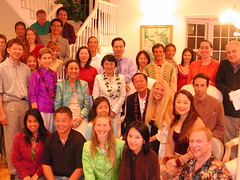
Emoto Party
Here are many of the people who attended the party the night that I got to meet Dr. Emoto. They are all invested in alternative health, healing, and spreading love and aloha in their own ways.
Sunday, February 12, 2006
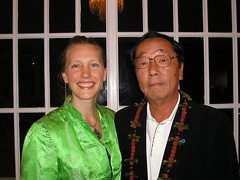
Leslie and Dr. Emoto
I was so blessed to be able to meet Dr. Emoto when he was in Honolulu. We enjoyed a wonderful party at Dr. Sandra Rose Michael's house (check out her Energy Enhancement System based on scalar waves on the web) filled with healers from all over Hawaii, China, and Japan. It was thrilling to have him stamp my book "Messages From Water" with "Love and Two Parts Gratitude" in Japanese.
Tuesday, January 24, 2006
Macrobiotic Cooking for Relationships and Sex
The energies of earth's force (yin) and heaven's force (yang) naturally seek balance. When couples make love, they find oneness and balance. The degree or quality of each determines attraction, love, repulsion, or dislike. Learn about what foods create a smooth flow of energy through the body and contribute to healthy and vital partners creating soulful, mindful, and loving sex. You won't hear "Not tonight honey, I'm too tired" any more!
February 11th 2006 Kapiolani Community College, $45 808-734-9211
February 18th, 2006 University of Hawaii, Hemenway Leisure Center, Hemenway Hall Rm 101, 956-6468 $45 students, $50 community
February 11th 2006 Kapiolani Community College, $45 808-734-9211
February 18th, 2006 University of Hawaii, Hemenway Leisure Center, Hemenway Hall Rm 101, 956-6468 $45 students, $50 community
Veg News about American "choice"
From Jan/Feb Veg News
Big Vegan Business
another reason to avoid processed foods is that many vegan companies
have been bought out by mega corporations that have less than
stellar reputations. Here are a few examples that might surprise
you:
Lightlife:
owned by ConAgra who is one of the nations top beef producers. In
2002, the company recalled almost 19 million pounds of beef due to
potential E.coli contamination. Also ConAgra is the parent company
of numerous meat-containing brands including: Hebrew National Beef
Franks, Chef Boyardee, Butterball Turkey, Hunt's Manwich and Slim
Jim.
Cascadian Farms and Muir Glen
Owned by General Mills who makes many nutritionally-deficient
cereals aimed at children. Also, the company's main shareholders
include Phillip Morris, Exxon-Mobil, General Electric, Chevron,
Nike, McDondald's, Monsanto, Dow Chemical and PepsiCo
Boca owned by Kraft. Kraft is owned by Altria, formerly known as
Phillip Morris. Do you really wnat your food dollars supporting
such a notoriously deceptive tobacco company? Also, most Boca
burgers are made with genetically-modified soy.
Odwala owned by Coca-Cola is notorious for contaminating the water
supply in developing countries such as India. Coca-Cola has also
been implicated in the murder of labor activists in Colombia. If
that's not enough, the company hooks children on its sugary,
nutrionally deficient beverages by forming exclusive contracts with
desperate school districts.
White Wave (Silk soy products) owned by Dean Foods. Dean Foods is
one of the nation's largest dairy companies and makes several
misleading claims about the health benefits of dairy, including
extolling its weight-loss benefits. Also, Dean Foods' main
investors include Pfizer, Phillip Morris, Exxon-Mobil, Coca-Cola,
Wal-Mart and PepsiCo
Finally, quite a few vegan products are now under the umbrella group
called "The Hain Celestial Group" including Terra Chips, Garden of
Eatin' Health Vally, WestSoy, Earth's Best, Westbrae Natural,
Imagine (Soy and Rice Dream) and Yves Veggie Cuisine. H.J. Heinz
owns about 20% of Hain, and other investors include Phillip Morris,
Monsanto, Exxon-Mobil and Wal-Mart.
In contrast, when you purchase organic, locally grown whole foods,
you support your local markets and farmers, thereby contributing to
the health and wellbeing of yourself, the environment and the local
economy all at once.
Big Vegan Business
another reason to avoid processed foods is that many vegan companies
have been bought out by mega corporations that have less than
stellar reputations. Here are a few examples that might surprise
you:
Lightlife:
owned by ConAgra who is one of the nations top beef producers. In
2002, the company recalled almost 19 million pounds of beef due to
potential E.coli contamination. Also ConAgra is the parent company
of numerous meat-containing brands including: Hebrew National Beef
Franks, Chef Boyardee, Butterball Turkey, Hunt's Manwich and Slim
Jim.
Cascadian Farms and Muir Glen
Owned by General Mills who makes many nutritionally-deficient
cereals aimed at children. Also, the company's main shareholders
include Phillip Morris, Exxon-Mobil, General Electric, Chevron,
Nike, McDondald's, Monsanto, Dow Chemical and PepsiCo
Boca owned by Kraft. Kraft is owned by Altria, formerly known as
Phillip Morris. Do you really wnat your food dollars supporting
such a notoriously deceptive tobacco company? Also, most Boca
burgers are made with genetically-modified soy.
Odwala owned by Coca-Cola is notorious for contaminating the water
supply in developing countries such as India. Coca-Cola has also
been implicated in the murder of labor activists in Colombia. If
that's not enough, the company hooks children on its sugary,
nutrionally deficient beverages by forming exclusive contracts with
desperate school districts.
White Wave (Silk soy products) owned by Dean Foods. Dean Foods is
one of the nation's largest dairy companies and makes several
misleading claims about the health benefits of dairy, including
extolling its weight-loss benefits. Also, Dean Foods' main
investors include Pfizer, Phillip Morris, Exxon-Mobil, Coca-Cola,
Wal-Mart and PepsiCo
Finally, quite a few vegan products are now under the umbrella group
called "The Hain Celestial Group" including Terra Chips, Garden of
Eatin' Health Vally, WestSoy, Earth's Best, Westbrae Natural,
Imagine (Soy and Rice Dream) and Yves Veggie Cuisine. H.J. Heinz
owns about 20% of Hain, and other investors include Phillip Morris,
Monsanto, Exxon-Mobil and Wal-Mart.
In contrast, when you purchase organic, locally grown whole foods,
you support your local markets and farmers, thereby contributing to
the health and wellbeing of yourself, the environment and the local
economy all at once.
Tuesday, January 17, 2006
Macrobiotic Guilt-Free Dessert Class in Honolulu
Jan 21st, 2006
Guilt-Free Desserts
When we eat a good diet, we take the frontline to prevent disease, improve vitality, enjoy deeper sleep, support a healthy weight, and enable our brain to function smoothly. In short, we have a deep sense of well-being. Americans are reported to eat up to 20 teaspoons of sugar every day, and 150 pounds of sugar every year. Refined foods such as white flour and sugar in modern desserts take a tremendous toll on us. These simple sugars enter our bloodstream immediately and are metabolized quickly raising blood glucose levels and overworking our pancreas in an attempt to rebalance. Simple sugars equal quick energy followed by exhaustion. Whole grains support our health.
We'll discuss:
Effects of sugar and refined foods on the body
Why we have sugar and fat cravings
How to promote good health
Standard Macrobiotic Diet – what is it?
Balancing yin and yang in our diet – avoiding extremes
We'll make:
Cous Cous Chocolate Cake
Chocolate Mousse Parfait
Apple Compote with Almond Cream Sauce.
University of Hawaii, Hemenway Leisure Center, Hemenway Hall Rm 111, 956-6468 $45 students, $50 community
Guilt-Free Desserts
When we eat a good diet, we take the frontline to prevent disease, improve vitality, enjoy deeper sleep, support a healthy weight, and enable our brain to function smoothly. In short, we have a deep sense of well-being. Americans are reported to eat up to 20 teaspoons of sugar every day, and 150 pounds of sugar every year. Refined foods such as white flour and sugar in modern desserts take a tremendous toll on us. These simple sugars enter our bloodstream immediately and are metabolized quickly raising blood glucose levels and overworking our pancreas in an attempt to rebalance. Simple sugars equal quick energy followed by exhaustion. Whole grains support our health.
We'll discuss:
Effects of sugar and refined foods on the body
Why we have sugar and fat cravings
How to promote good health
Standard Macrobiotic Diet – what is it?
Balancing yin and yang in our diet – avoiding extremes
We'll make:
Cous Cous Chocolate Cake
Chocolate Mousse Parfait
Apple Compote with Almond Cream Sauce.
University of Hawaii, Hemenway Leisure Center, Hemenway Hall Rm 111, 956-6468 $45 students, $50 community
Tuesday, January 10, 2006
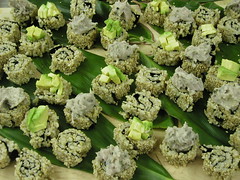
Ura Ura Rolls from Macro Seminar
Look at these luscious brown rice sushi rolls! Our dinner was soooo delicious!
Krishna Das and Kirtan
On Dec. 17th, Krishna Das was in Honolulu. I've been reading about him in Yoga Journal, and was thrilled to find out about his being here. He does "kirtan" which is a sing and response type of chanting. Every time I've read about it, it sounds like the whole group connects and great levels of joy and meditation are reached. During one chant, I was overcome with emotion and started to cry. I looked around at everyone chanting, and saw in them the same desire I have: a peaceful and happy world. They all seemed to care about the future of the planet and the people on it. It was a great way to celebrate the holiday season. I felt relieved and resolved to be in a spiritual place for the holidays, rather than one in the material realm going to parties, drinking alcohol, and eating sweets. There are other more important things in the world to attend to.
Invisible worlds, friends and enemies
This weekend, Hiroyuki and Mie Naka were in Honolulu to do a seminar about macrobiotic cooking and they gave some amazing lectures as well. Hiroyuki was talking extensively about the invisible world. I'm still reflecting on their visit, their lectures, and my talks with them. Meanwhile, I've also just downloaded the current version of Macrobiotic Today, and Carl Ferre has a wonderful article in it about friends and enemies being examples of yin and yang. He replaces yin and yang with these two words and then explains them in some detail. Friends and enemies all originate from the same source: infinity, and are first nurtured in the invisible world before they manifest in the visible. I started again thinking about our invisible world and how a person can nuture it, if this is possible? Meditating? Praying? I put on a CD that my great friend Reni gave to me -- it has she and several friends chanting in a samurai shinto temple in the foothills of Fukuyama, Japan. It felt like she was sitting next to me in my car as I drove to work.... I got out, and as I walked to my destination, I could hear the same sound in my ears (om), as though it was coming from everywhere at once. I am resolved to thinking more about the invisible world and energy.
Interesting quote about $
I finished reading a book called "Secrets of the Millionaire Mind" by T Harv Eker. He's (not?) macrobiotic per say, but his text describes macrobiotic principles of energy in relation to money and business. It's an excellent read, with exercises to do. The point is that before something in one's life can change, one must change ones thoughts. Here is one tidbit:
If you want to change the fruits, you will first have to change the roots. If you want to change the visible, you must first change the invisible.
T Harv Eker
If you want to change the fruits, you will first have to change the roots. If you want to change the visible, you must first change the invisible.
T Harv Eker
Sunday, January 08, 2006
Macrobiotic Seminar
Our macrobiotic seminar was sooo much fun. The Naka's are really incredible people. We had so much support from the students, and Mie and Hiroyuki mentioned that all the students were all really nice people and very interested, so they were so happy. All the meals that we cooked were extremely delicious. We're looking forward to doing a lot more in the future, and they plan to come back every 6 months or so.
My mission
My mission is to make the world a better place in some way by teaching macrobiotic principles. I'd like to share a sense of hope with students and tools to achieve how the body and mind can heal without surgeries and drugs. In addition, I'd like to share that we can gain radiant health, beauty and well-being by changing our diets. Long term health is a daily journey integrating spiritual values, diet, and lifestyle. Changing one's diet can change one's life and destiny for the positive, helping us seek and discover the divinity and oneness within and to feel this in all facets of our lives and in the world around us. In doing so, we'll build a community in the Honolulu area sharing similar goals, values, and dreams.
Friday, December 16, 2005
Daily Insight
I was reading Yoga Journal's special daily insight. This seems true
not just of yoga, but also with one's macrobiotic practice too. It's
one thing I love about staying true to eating a healthy diet. If
you don't do yoga, just insert the word macrobiotics for yoga!
In much of conventional medicine, patients are passive recipients of
care. In yoga, it's what you do for yourself that matters. Yoga gives
you the tools to help you change, and you might start to feel better
the first time you try practicing. You may also notice that the more
you commit to practice, the more you benefit. This results in three
things: You get involved in your own care, you discover that your
involvement gives you the power to effect change, and seeing that you
can effect change gives you hope. And hope itself can be healing.
not just of yoga, but also with one's macrobiotic practice too. It's
one thing I love about staying true to eating a healthy diet. If
you don't do yoga, just insert the word macrobiotics for yoga!
In much of conventional medicine, patients are passive recipients of
care. In yoga, it's what you do for yourself that matters. Yoga gives
you the tools to help you change, and you might start to feel better
the first time you try practicing. You may also notice that the more
you commit to practice, the more you benefit. This results in three
things: You get involved in your own care, you discover that your
involvement gives you the power to effect change, and seeing that you
can effect change gives you hope. And hope itself can be healing.
Monday, November 28, 2005
Kevin -- stroganoff for you!
Seitan Stroganoff over Udon Noodles
1 c onions, cut into crescents
2 cups mushrooms, sliced
2 cups water or broth (from shiitake, kombu, or seitan cooking broth)
1 to 2 cups seitan, sliced
2 or 3 T nut butter (such as almond or tahini)
2 to 3 T kuzu or arrowroot diluted in cold water
Shoyu or sea salt to taste
2 tsp sesame oil for sautéing
1 to 1 ½ cups tofu sour cream (recipe follows)
Parsley, to garnish
1 package of udon noodles
Cook noodles according to package directions. Drain and set aside. Sauté onions in a small amount of sesame oil until they are limp and smell sweet (approximately 5 to 8 minutes on medium low heat). Push the onion to the side and add mushrooms. Sauté until the juice comes out, approximately 3 to 5 minutes. Place lid on the pan and simmer for 5 to 10 minutes, or until the onions and mushrooms are limp. Add seitan and broth or water and adjust the seasoning. Simmer for 20 minutes. Add nut butter and kuzu/arrowroot. Cook for 1 to 2 more minutes. Add 1 to 1 ½ cups tofu sour cream just before serving.
Tofu Sour Cream
1 block tofu
3 T lemon juice, umeboshi vinegar OR brown rice vinegar
1 to 2 T umeboshi paste
Minced chives or parsley, optional
Boil a pot of water. Take the tofu out of the package and blanch for 2 to 3 minutes. Drain well. Add the juice or vinegar, and the umeboshi paste. Blend well. Place tofu mixture into a bowl. Mince the chives or parsley and gently fold into the tofu mixture.
1 c onions, cut into crescents
2 cups mushrooms, sliced
2 cups water or broth (from shiitake, kombu, or seitan cooking broth)
1 to 2 cups seitan, sliced
2 or 3 T nut butter (such as almond or tahini)
2 to 3 T kuzu or arrowroot diluted in cold water
Shoyu or sea salt to taste
2 tsp sesame oil for sautéing
1 to 1 ½ cups tofu sour cream (recipe follows)
Parsley, to garnish
1 package of udon noodles
Cook noodles according to package directions. Drain and set aside. Sauté onions in a small amount of sesame oil until they are limp and smell sweet (approximately 5 to 8 minutes on medium low heat). Push the onion to the side and add mushrooms. Sauté until the juice comes out, approximately 3 to 5 minutes. Place lid on the pan and simmer for 5 to 10 minutes, or until the onions and mushrooms are limp. Add seitan and broth or water and adjust the seasoning. Simmer for 20 minutes. Add nut butter and kuzu/arrowroot. Cook for 1 to 2 more minutes. Add 1 to 1 ½ cups tofu sour cream just before serving.
Tofu Sour Cream
1 block tofu
3 T lemon juice, umeboshi vinegar OR brown rice vinegar
1 to 2 T umeboshi paste
Minced chives or parsley, optional
Boil a pot of water. Take the tofu out of the package and blanch for 2 to 3 minutes. Drain well. Add the juice or vinegar, and the umeboshi paste. Blend well. Place tofu mixture into a bowl. Mince the chives or parsley and gently fold into the tofu mixture.
Saturday, November 26, 2005
Special Macrobiotic Event in Honolulu
RECOVERING YOUR NATURAL ABILITY AND ENHANCING HAWAIIAN CULTURE THROUGH MACROBIOTICS
FAMOUS JAPANESE HEALERS AND MACROBIOTIC TEACHERS COMING TO HAWAII: HIROYUKI AND MIE NAKA FROM MACROBI GARDEN IN OSAKA, JAPAN ARE MAKING A SPECIAL TRIP TO HONOLULU ONLY, JANUARY 5-7, TO TEACH MACROBIOTIC COOKING CLASSES AND SEMINARS, AND TO PROVIDE CONSULTATIONS. SPECIAL GOURMET DINNER SERVED ON SATURDAY NIGHT. HELD AT CHURCH OF THE CROSSROADS ON UNIVERSITY AVE.
Following a macrobiotic way of life brings us back into harmony with nature, with oneself, with other people on the islands, and helps restore the vitality and beauty of the culture. Eating foods grown for this climate achieves these goals.
Learn more about macrobiotic theory during lectures, taste Polynesian, Asian, and American-fusion recipes during cooking demonstrations, and receive private consultations specific to your own health goals.
WHO: HIROYUKI AND MIE NAKA, PREMIER MACROBIOTIC SENIOR INSTRUCTORS AND HEALERS FROM OSAKA, JAPAN DIRECTLY UNDERNEATH MICHIO KUSHI COMING ONLY TO HONOLULU FOR A SPECIAL SEMINAR.
WHAT: LECTURES, COOKING CLASSES, GOURMET DINNER
WHEN: JANUARY 5-7
THURSDAY LECTURE, 7 TO 9 PM, $20
FRIDAY COOKING CLASS, 6 TO 9 PM, $35
SATURDAY COOKING CLASS 9 AM TO 12 PM $35
SATURDAY LECTURE 1 TO 3 PM $20
SATURDAY CONSULTATIONS 3 TO 6 PM, $200/HR
SATURDAY GOURMET DINNER 6:30 TO ~ $35 ADULTS, $25 STUDENTS
OTHER DAYS OPEN FOR CLASSES OR CONSULTATIONS BY APPOINTMENT
Please call to register now.
Prices subject to change. Please check for most current information.
WHERE:
Church of the Crossroads
1212 University Avenue
Honolulu, Hawaii
URL: WWW.MACROBIOTICHAWAII.BRAVEHOST.COM
CONTACT: LESLIE ASHBURN
808-398-2695
MACROBIOTICHAWAII@HOTMAIL.COM
FAMOUS JAPANESE HEALERS AND MACROBIOTIC TEACHERS COMING TO HAWAII: HIROYUKI AND MIE NAKA FROM MACROBI GARDEN IN OSAKA, JAPAN ARE MAKING A SPECIAL TRIP TO HONOLULU ONLY, JANUARY 5-7, TO TEACH MACROBIOTIC COOKING CLASSES AND SEMINARS, AND TO PROVIDE CONSULTATIONS. SPECIAL GOURMET DINNER SERVED ON SATURDAY NIGHT. HELD AT CHURCH OF THE CROSSROADS ON UNIVERSITY AVE.
Following a macrobiotic way of life brings us back into harmony with nature, with oneself, with other people on the islands, and helps restore the vitality and beauty of the culture. Eating foods grown for this climate achieves these goals.
Learn more about macrobiotic theory during lectures, taste Polynesian, Asian, and American-fusion recipes during cooking demonstrations, and receive private consultations specific to your own health goals.
WHO: HIROYUKI AND MIE NAKA, PREMIER MACROBIOTIC SENIOR INSTRUCTORS AND HEALERS FROM OSAKA, JAPAN DIRECTLY UNDERNEATH MICHIO KUSHI COMING ONLY TO HONOLULU FOR A SPECIAL SEMINAR.
WHAT: LECTURES, COOKING CLASSES, GOURMET DINNER
WHEN: JANUARY 5-7
THURSDAY LECTURE, 7 TO 9 PM, $20
FRIDAY COOKING CLASS, 6 TO 9 PM, $35
SATURDAY COOKING CLASS 9 AM TO 12 PM $35
SATURDAY LECTURE 1 TO 3 PM $20
SATURDAY CONSULTATIONS 3 TO 6 PM, $200/HR
SATURDAY GOURMET DINNER 6:30 TO ~ $35 ADULTS, $25 STUDENTS
OTHER DAYS OPEN FOR CLASSES OR CONSULTATIONS BY APPOINTMENT
Please call to register now.
Prices subject to change. Please check for most current information.
WHERE:
Church of the Crossroads
1212 University Avenue
Honolulu, Hawaii
URL: WWW.MACROBIOTICHAWAII.BRAVEHOST.COM
CONTACT: LESLIE ASHBURN
808-398-2695
MACROBIOTICHAWAII@HOTMAIL.COM
Friday, November 11, 2005
10 Steps to a Healthier Holiday
From the Natural Epicurean Website:
>> 10 TIPS FOR STAYING HEALTHY FOR THE HOLIDAYS <<
-------------------------------------------------------
1. Take a healthy and delicious dish to share with everyone at holiday
gatherings.
2. Stop eating when you are 80% full. There are always plenty of
leftovers during the holidays. You'll probably get a chance to taste it again.
3. Fill your plate with smaller portions of each dish. Overeating is one
of the culprits of holiday sluggishness and extra holiday pounds.
4. CHEW each bite 20-25 times or more (no matter what you eat). This can
keep you from overeating and give you more time to enjoy mealtimes
with friends and family. It also leaves you more satisfied with what you
eat.
5. Eat a healthy meal before going to holiday parties, and take a
healthy dessert with you. It makes all that decadent (and fattening) holiday
food easier to resist. (Have you seen that Casa now offers take-out
items?)
4. If you eat snacks at parties, SIT DOWN to eat your food. Our bodies process and digest food better when we are sitting down.
5. Use rice syrup, barley malt, maple syrup or agave nectar to replace
the sugar in your holiday desserts.
6. Set holiday GOALS for your health with a friend or family member. It
is always easier to resist temptations when you have a buddy and someone
to whom you can be accountable.
7. Take time to tell someone how much you appreciate them.
8. Holidays are usually busy and stressful. Treat yourself to a shiatsu or healing massage to help you relax.
9. Make a list of things for which you are thankful.
10. Take time to reflect on what is really important to you in your
life. (And make sure you are spending at least some time doing these
things)
Enjoy your holidays! And remember the rule:
If you eat something that you know is not the best for you....
SAVOR and ENJOY every bite, and leave the guilt out of it.
>> 10 TIPS FOR STAYING HEALTHY FOR THE HOLIDAYS <<
-------------------------------------------------------
1. Take a healthy and delicious dish to share with everyone at holiday
gatherings.
2. Stop eating when you are 80% full. There are always plenty of
leftovers during the holidays. You'll probably get a chance to taste it again.
3. Fill your plate with smaller portions of each dish. Overeating is one
of the culprits of holiday sluggishness and extra holiday pounds.
4. CHEW each bite 20-25 times or more (no matter what you eat). This can
keep you from overeating and give you more time to enjoy mealtimes
with friends and family. It also leaves you more satisfied with what you
eat.
5. Eat a healthy meal before going to holiday parties, and take a
healthy dessert with you. It makes all that decadent (and fattening) holiday
food easier to resist. (Have you seen that Casa now offers take-out
items?)
4. If you eat snacks at parties, SIT DOWN to eat your food. Our bodies process and digest food better when we are sitting down.
5. Use rice syrup, barley malt, maple syrup or agave nectar to replace
the sugar in your holiday desserts.
6. Set holiday GOALS for your health with a friend or family member. It
is always easier to resist temptations when you have a buddy and someone
to whom you can be accountable.
7. Take time to tell someone how much you appreciate them.
8. Holidays are usually busy and stressful. Treat yourself to a shiatsu or healing massage to help you relax.
9. Make a list of things for which you are thankful.
10. Take time to reflect on what is really important to you in your
life. (And make sure you are spending at least some time doing these
things)
Enjoy your holidays! And remember the rule:
If you eat something that you know is not the best for you....
SAVOR and ENJOY every bite, and leave the guilt out of it.
Yummy Yams
This is a recipe from The Natural Epicurean. I tried it the other night, and our knees got wobbly because it was so unbelievably delicious. I used the least amount of sweetener called for in the recipe, and it still was succulently sweet.
SWEET POTATO CASSEROLE WITH MAPLE PECAN TOPPING
by Dawn Pallavi Serves: 8–10
When making my Thanksgiving menu, I can’t forget the Sweet Potato
Casserole. This traditional Thanksgiving dish is a favorite that you can
make more or less sweet depending on the amount of sweetener you use. I
find that for my taste, the casserole is sweet enough without the extra
barley malt. If you are cooking for family or friends who are used to a
lot of brown sugar, follow the recipe exactly, and you may even want to
double the pecans for the topping. This is a recipe that even my
meat-eating relatives ask me to bring for our annual family Thanksgiving
feast.
— Filling —
4 organic yams or sweet potatoes
1 cup spring or filtered water
1 pinch unrefined sea salt, SI brand recommended
3/4 cup organic barley malt or agave nectar
(optional for a sweeter casserole)
2 tablespoons organic kuzu, dissolved in the apple juice
3 tablespoons organic apple juice
zest of 1 organic orange or tangerine
1 teaspoon organic vanilla extract
1 teaspoon organic cinnamon
.
— Topping —
1 cup whole organic pecans
1/4–1/2 cup organic maple syrup
Directions
Filling
Preheat oven to 375° F. Cut sweet potatoes into 1-inch squares. Bring to
a boil in spring water with sea salt, turn flame to medium low, and cook
until tender. Place cooked sweet potatoes in a blender or food
processor, or mash with a potato masher. Dissolve the kuzu in room
temperature apple juice. Add dissolved kuzu, barley malt (if desired),
and blend until smooth. Stir in orange zest, cinnamon and vanilla. Pour
mixture into casserole dish.
Topping
Prepare topping by mixing pecans and maple syrup together in a bowl.
Pour over casserole or arrange pecan halves on top of the casserole and
bake at 375° F for 1 hour.
SWEET POTATO CASSEROLE WITH MAPLE PECAN TOPPING
by Dawn Pallavi Serves: 8–10
When making my Thanksgiving menu, I can’t forget the Sweet Potato
Casserole. This traditional Thanksgiving dish is a favorite that you can
make more or less sweet depending on the amount of sweetener you use. I
find that for my taste, the casserole is sweet enough without the extra
barley malt. If you are cooking for family or friends who are used to a
lot of brown sugar, follow the recipe exactly, and you may even want to
double the pecans for the topping. This is a recipe that even my
meat-eating relatives ask me to bring for our annual family Thanksgiving
feast.
— Filling —
4 organic yams or sweet potatoes
1 cup spring or filtered water
1 pinch unrefined sea salt, SI brand recommended
3/4 cup organic barley malt or agave nectar
(optional for a sweeter casserole)
2 tablespoons organic kuzu, dissolved in the apple juice
3 tablespoons organic apple juice
zest of 1 organic orange or tangerine
1 teaspoon organic vanilla extract
1 teaspoon organic cinnamon
.
— Topping —
1 cup whole organic pecans
1/4–1/2 cup organic maple syrup
Directions
Filling
Preheat oven to 375° F. Cut sweet potatoes into 1-inch squares. Bring to
a boil in spring water with sea salt, turn flame to medium low, and cook
until tender. Place cooked sweet potatoes in a blender or food
processor, or mash with a potato masher. Dissolve the kuzu in room
temperature apple juice. Add dissolved kuzu, barley malt (if desired),
and blend until smooth. Stir in orange zest, cinnamon and vanilla. Pour
mixture into casserole dish.
Topping
Prepare topping by mixing pecans and maple syrup together in a bowl.
Pour over casserole or arrange pecan halves on top of the casserole and
bake at 375° F for 1 hour.
Wednesday, November 02, 2005
Current Goals
My current goals are to:
1) Get more sleep. I've set a goal to be in bed by 10:30 to 11:00 pm every night. I've been burning the candle at both ends and paying for it. It's amazing how much better I feel with 8 as opposed to 6 hours of sleep, and I don't feel as hungry all the time too.
2) Exercise more. I've been putting aside taking care of my own needs to meet the needs of others. I plan to recommit myself to my yoga practice (which has been going well) and to manage my time better so I can go for a walk, go to the gym and take a kick boxing class, or to spend time in my living room stretching to a yoga DVD.
3) Take what I have developed thus far with macrobiotic classes, and to improve upon it in whatever way possible. Now more people in Honolulu have learned about macrobiotics, and I'd love to bring more classes to them in better locations. I've been enjoying all the classes at both Kaiser Highschool and also at UH in particular for different reasons. The main thing I love is that the classes are affordable for adults in the community and for students at UH.
4) Learn more about macrobiotics. While in Japan, I had lots of time to study, but I have had less time to study here. I guess I'm learning other aspects of things surrounding macrobiotics, such as figuring food costs, interacting with organizations, brainstorming creative ways to bring more into the community, and in believing that anything is possible.
5) On a practical level, I'd love to get back to my body scrub. In Japan, I had a regular practice since the showers there are so high tech. I could dry off, and then reset the temperature for my water to a higher level, and in about 2 minutes, refill my bucket. Here, I have to get out of the shower, and boil water to get it hot enough. For some reason, I haven't felt totally comfortable working out a new system. It's a goal to recommit to that, since I feel so much better.
6) Eat less. I have such a powerful appetite! Geez!
This should be enough to keep my working for a while.
1) Get more sleep. I've set a goal to be in bed by 10:30 to 11:00 pm every night. I've been burning the candle at both ends and paying for it. It's amazing how much better I feel with 8 as opposed to 6 hours of sleep, and I don't feel as hungry all the time too.
2) Exercise more. I've been putting aside taking care of my own needs to meet the needs of others. I plan to recommit myself to my yoga practice (which has been going well) and to manage my time better so I can go for a walk, go to the gym and take a kick boxing class, or to spend time in my living room stretching to a yoga DVD.
3) Take what I have developed thus far with macrobiotic classes, and to improve upon it in whatever way possible. Now more people in Honolulu have learned about macrobiotics, and I'd love to bring more classes to them in better locations. I've been enjoying all the classes at both Kaiser Highschool and also at UH in particular for different reasons. The main thing I love is that the classes are affordable for adults in the community and for students at UH.
4) Learn more about macrobiotics. While in Japan, I had lots of time to study, but I have had less time to study here. I guess I'm learning other aspects of things surrounding macrobiotics, such as figuring food costs, interacting with organizations, brainstorming creative ways to bring more into the community, and in believing that anything is possible.
5) On a practical level, I'd love to get back to my body scrub. In Japan, I had a regular practice since the showers there are so high tech. I could dry off, and then reset the temperature for my water to a higher level, and in about 2 minutes, refill my bucket. Here, I have to get out of the shower, and boil water to get it hot enough. For some reason, I haven't felt totally comfortable working out a new system. It's a goal to recommit to that, since I feel so much better.
6) Eat less. I have such a powerful appetite! Geez!
This should be enough to keep my working for a while.
Tuesday, October 25, 2005
Yoga and the Roots of Vegetarianism
The Roots of Vegetarianism
Modern yogis who struggle with the question of whether to eat meat can look to ancient wisdom for the answer.
By Jennifer Barrett
Ask any number of yogis to describe their diets and you'll likely get responses as varied as the styles they practice. Many traditionalists see yoga as being inextricably linked with the meatless path, citing numerous ancient Indian texts to prove their conviction. Others put less stock in centuries-old warnings like "the slaughter of animals obstructs the way to heaven" (from the Dharma Sutras) than in what their bodies have to say. If eating flesh begets health and energy, they argue, it must be the right choice for them--and their yoga.
Today's range of dietary habits might seem like a recent development, but delve back into the historical record and you'll find a long tradition of ethical wrangling with respect to animals. Indeed, the different stances yogis now take on vegetarianism reflect just the latest turn in a debate that started thousands of years ago.
The Past-Life Argument
The history of vegetarianism in India began in the Vedic period, an era that dawned sometime between 4000 and 1500 b.c.e., depending on whom you ask. Four sacred texts known as the Vedas were the bedrock of early Hindu spiritual thought. Among those texts' hymns and songs that described with reverence the wondrous power of the natural world, we find a nascent idea that sets the stage for vegetarianism in later centuries. "The concept of the transmigration of souls... first dimly appears in the Rig Veda," explains Colin Spencer in Vegetarianism: A History (Four Walls, Eight Windows, 2002). "In the totemistic culture of the pre-Indus civilization, there was already a sense of oneness with creation." A fervent belief in this idea, he contends, would give rise to vegetarianism later on.
In subsequent ancient texts, including the Upanishads, the idea of rebirth emerged as a central point. In these writings, according to Kerry Walters and Lisa Portmess, editors of Religious Vegetarianism (State University of New York Press, 2001), "gods take animal form, human beings have had past animal lives, [and] animals have had past human lives." All creatures harbored the Divine, so that rather than being fixed in time, life was fluid. (A cow alone, notes Spencer, held 330 million gods and goddesses. To kill one set you back 86 transmigrations of the soul.) Again, the idea that the meat on a dinner plate once lived in a different--and possibly human--form made it all the less palatable.
Dietary guidelines became explicit centuries later in the Laws of Manu, written between 200 b.c.e. and 100 c.e., say Walters and Portmess. In this text, we discover that the sage Manu doesn't find fault just with those who eat meat. "He who permits the slaughter of an animal," he wrote, "he who cuts it up, he who kills it, he who buys or sells meat, he who cooks it, he who serves it up, and he who eats it, must all be considered as the slayers of the animal."
The Bhagavad Gita, arguably the most influential text of the Hindu tradition (written sometime between the fourth and first centuries b.c.e.), added to the vegetarian argument with its practical dietary guidelines. It specifies that sattvic foods (milk, butter, fruit, vegetables, and grains) "promote vitality, health, pleasure, strength, and long life." Bitter, salty, and sour rajasic foods (including meat, fish, and alcohol) "cause pain, disease, and discomfort." At the bottom rung lies the tamasic category: "stale, overcooked, contaminated" and otherwise rotten or impure foods. These explanations have endured, becoming the guidelines by which many modern yogis eat.
Spiritual Contradiction
The case for vegetarianism mounted as centuries passed, while another practice--animal sacrifice--persisted alongside it. The same Vedas that extolled the virtues of the natural world also emphasized the need for animal sacrifice to the gods. The uneasy coexistence between India's emerging inclination toward vegetarianism and its history of animal sacrifice continued over hundreds of years, says Edwin Bryant, professor of Hinduism at Rutgers University. Oftentimes the conflict played out in the pages of the same text.
The sage Manu, for instance, condemned recreational meat eating, stating, "There is no greater sinner than that man who...seeks to increase the bulk of his own flesh by the flesh of other beings." But orthodox followers of Vedic culture--including Manu--were "forced to allow the performance of animal sacrifice," Bryant notes. Ultimately, the discomfort that many in ancient India felt about animal sacrifice helped fuel the demise of the practice.
Some orthodox traditionalists, for instance, felt uncomfortable challenging the ancient texts on the issue out of respect for what they believed were the writings' divine origins. However, they did condemn everyday meat eating, adding a number of conditions to animal sacrifice so that "the practice accrued ghastly karmic results that far outweighed any benefits gained," explains Professor Bryant in A Communion of Subjects: Animals in Religion and Ethics, edited by Kimberly Patton and Paul Waldau (to be published in 2004).
Others simply deemed the ancient texts outdated, and went on to form groups such as the Jainas and the Buddhists. No longer bound by Vedic authority, Bryant says, they "could scorn the whole sacrificial culture and preach an unencumbered ahimsa," or doctrine of nonviolence. This concept of ahimsa, championed by Mahavira in the sixth century, has emerged at the core of the vegetarian argument in modern times.
Some later Indian sages strengthened the case for vegetarianism. Swami Vivekananda, writing a hundred years ago, pointed out the communality we have with other animals: "The amoeba and I are the same. The difference is only one of degree; and from the standpoint of the highest life, all differences vanish." Swami Prabhupada, scholar and founder of the International Society for Krishna Consciousness, offered a more stark pronouncement: "If you want to eat animals, then [God] will give you... the body of a tiger in your next life so that you can eat flesh very freely."
In most cultures today, the rights of animals have at least prevailed over the ritual of sacrifice, if not meat eating. Scores of yogis live and eat with the understanding, as expressed by B.K.S. Iyengar, that a vegetarian diet is "a necessity" to the practice of yoga. But other, equally dedicated yogis find flesh a necessary fuel, without which their practice suffers. Those yoga enthusiasts still on the fence when it comes to the meat question should take heart, however. It seems that a thoughtful, deliberate, and at times even challenging consideration of vegetarianism is very much in the spirit of the Indian spiritual tradition.
Contributing Editor Jennifer Barrett is editor of The Herb Quarterly. She lives in Connecticut.
July/August 2003
This article can be found online at http://www.yogajournal.com/wisdom/999_1.cfm
Modern yogis who struggle with the question of whether to eat meat can look to ancient wisdom for the answer.
By Jennifer Barrett
Ask any number of yogis to describe their diets and you'll likely get responses as varied as the styles they practice. Many traditionalists see yoga as being inextricably linked with the meatless path, citing numerous ancient Indian texts to prove their conviction. Others put less stock in centuries-old warnings like "the slaughter of animals obstructs the way to heaven" (from the Dharma Sutras) than in what their bodies have to say. If eating flesh begets health and energy, they argue, it must be the right choice for them--and their yoga.
Today's range of dietary habits might seem like a recent development, but delve back into the historical record and you'll find a long tradition of ethical wrangling with respect to animals. Indeed, the different stances yogis now take on vegetarianism reflect just the latest turn in a debate that started thousands of years ago.
The Past-Life Argument
The history of vegetarianism in India began in the Vedic period, an era that dawned sometime between 4000 and 1500 b.c.e., depending on whom you ask. Four sacred texts known as the Vedas were the bedrock of early Hindu spiritual thought. Among those texts' hymns and songs that described with reverence the wondrous power of the natural world, we find a nascent idea that sets the stage for vegetarianism in later centuries. "The concept of the transmigration of souls... first dimly appears in the Rig Veda," explains Colin Spencer in Vegetarianism: A History (Four Walls, Eight Windows, 2002). "In the totemistic culture of the pre-Indus civilization, there was already a sense of oneness with creation." A fervent belief in this idea, he contends, would give rise to vegetarianism later on.
In subsequent ancient texts, including the Upanishads, the idea of rebirth emerged as a central point. In these writings, according to Kerry Walters and Lisa Portmess, editors of Religious Vegetarianism (State University of New York Press, 2001), "gods take animal form, human beings have had past animal lives, [and] animals have had past human lives." All creatures harbored the Divine, so that rather than being fixed in time, life was fluid. (A cow alone, notes Spencer, held 330 million gods and goddesses. To kill one set you back 86 transmigrations of the soul.) Again, the idea that the meat on a dinner plate once lived in a different--and possibly human--form made it all the less palatable.
Dietary guidelines became explicit centuries later in the Laws of Manu, written between 200 b.c.e. and 100 c.e., say Walters and Portmess. In this text, we discover that the sage Manu doesn't find fault just with those who eat meat. "He who permits the slaughter of an animal," he wrote, "he who cuts it up, he who kills it, he who buys or sells meat, he who cooks it, he who serves it up, and he who eats it, must all be considered as the slayers of the animal."
The Bhagavad Gita, arguably the most influential text of the Hindu tradition (written sometime between the fourth and first centuries b.c.e.), added to the vegetarian argument with its practical dietary guidelines. It specifies that sattvic foods (milk, butter, fruit, vegetables, and grains) "promote vitality, health, pleasure, strength, and long life." Bitter, salty, and sour rajasic foods (including meat, fish, and alcohol) "cause pain, disease, and discomfort." At the bottom rung lies the tamasic category: "stale, overcooked, contaminated" and otherwise rotten or impure foods. These explanations have endured, becoming the guidelines by which many modern yogis eat.
Spiritual Contradiction
The case for vegetarianism mounted as centuries passed, while another practice--animal sacrifice--persisted alongside it. The same Vedas that extolled the virtues of the natural world also emphasized the need for animal sacrifice to the gods. The uneasy coexistence between India's emerging inclination toward vegetarianism and its history of animal sacrifice continued over hundreds of years, says Edwin Bryant, professor of Hinduism at Rutgers University. Oftentimes the conflict played out in the pages of the same text.
The sage Manu, for instance, condemned recreational meat eating, stating, "There is no greater sinner than that man who...seeks to increase the bulk of his own flesh by the flesh of other beings." But orthodox followers of Vedic culture--including Manu--were "forced to allow the performance of animal sacrifice," Bryant notes. Ultimately, the discomfort that many in ancient India felt about animal sacrifice helped fuel the demise of the practice.
Some orthodox traditionalists, for instance, felt uncomfortable challenging the ancient texts on the issue out of respect for what they believed were the writings' divine origins. However, they did condemn everyday meat eating, adding a number of conditions to animal sacrifice so that "the practice accrued ghastly karmic results that far outweighed any benefits gained," explains Professor Bryant in A Communion of Subjects: Animals in Religion and Ethics, edited by Kimberly Patton and Paul Waldau (to be published in 2004).
Others simply deemed the ancient texts outdated, and went on to form groups such as the Jainas and the Buddhists. No longer bound by Vedic authority, Bryant says, they "could scorn the whole sacrificial culture and preach an unencumbered ahimsa," or doctrine of nonviolence. This concept of ahimsa, championed by Mahavira in the sixth century, has emerged at the core of the vegetarian argument in modern times.
Some later Indian sages strengthened the case for vegetarianism. Swami Vivekananda, writing a hundred years ago, pointed out the communality we have with other animals: "The amoeba and I are the same. The difference is only one of degree; and from the standpoint of the highest life, all differences vanish." Swami Prabhupada, scholar and founder of the International Society for Krishna Consciousness, offered a more stark pronouncement: "If you want to eat animals, then [God] will give you... the body of a tiger in your next life so that you can eat flesh very freely."
In most cultures today, the rights of animals have at least prevailed over the ritual of sacrifice, if not meat eating. Scores of yogis live and eat with the understanding, as expressed by B.K.S. Iyengar, that a vegetarian diet is "a necessity" to the practice of yoga. But other, equally dedicated yogis find flesh a necessary fuel, without which their practice suffers. Those yoga enthusiasts still on the fence when it comes to the meat question should take heart, however. It seems that a thoughtful, deliberate, and at times even challenging consideration of vegetarianism is very much in the spirit of the Indian spiritual tradition.
Contributing Editor Jennifer Barrett is editor of The Herb Quarterly. She lives in Connecticut.
July/August 2003
This article can be found online at http://www.yogajournal.com/wisdom/999_1.cfm
Living Ethically
Beginning the Journey
Living ethically, according to Patanjali's Yoga Sutra, is the first step on the true path of yoga.
By Judith Lasater
When our children were young, my husband and I would occasionally summon up the courage to take them out for dinner. Before entering the restaurant, one of us would remind them to "be good" or we would leave. This warning was only mildly successful, but then one day my husband reasoned out a more effective approach. On our next outing we stopped outside the restaurant and reminded them specifically to "stay in your chair, don't throw food, and don't yell. If you do any of these things, one of us will take you out of the restaurant at once." We had stumbled upon a very effective technique, and it worked like a charm.
Interestingly, Patanjali, the author of the Yoga Sutra written some two centuries after the life of Jesus, demonstrates a similar approach to the study of yoga. In the second chapter of his book he presents five specific ethical precepts called yamas, which give us basic guidelines for living a life of personal fulfillment that will also benefit society. He then makes clear the consequence of not following these teachings: It is simply that we will continue to suffer.
Arranged in four chapters, or padas, the Yoga Sutra elucidates the basic teachings of yoga in short verses called sutras. In the second chapter Patanjali presents the ashtanga, or eight-limbed system, for which he is so famous. While Westerners may be most familiar with the asana, the third limb (posture), the yamas are really the first step in a practice that addresses the whole fabric of our lives, not just physical health or solitary spiritual existence. The rest of the limbs are the niyamas, more personal precepts; pranayama, breathing exercises; pratyahara, conscious withdrawal of energy away from the senses; dharana, concentration; dhyana, meditation; and samadhi, self-actualization.
The Yoga Sutra is not presented in an attempt to control behavior based on moral imperatives. The sutras don't imply that we are "bad" or "good" based upon our behavior, but rather that if we choose certain behavior we get certain results. If you steal, for example, not only will you harm others, but you will suffer as well.
The first yama is perhaps the most famous one: ahimsa, usually translated as "nonviolence." This refers not only to physical violence, but also to the violence of words or thoughts. What we think about ourselves or others can be as powerful as any physical attempt to harm. To practice ahimsa is to be constantly vigilant, to observe ourselves in interaction with others and to notice our thoughts and intentions. Try practicing ahimsa by observing your thoughts when a smoker sits next to you. Your thoughts may be just as damaging to you as his cigarette is to him.
It is often said that if one can perfect the practice of ahimsa, one need learn no other practice of yoga, for all the other practices are subsumed in it. Whatever practices we do after the yamas must include ahimsa as well. Practicing breathing or postures without ahimsa, for example, negates the benefits these practices offer.
There is a famous story about ahimsa told in the Vedas, the vast collection of ancient philosophical teachings from India. A certain sadhu, or wandering monk, would make a yearly circuit of villages in order to teach. One day as he entered a village he saw a large and menacing snake who was terrorizing the people. The sadhu spoke to the snake and taught him about ahimsa. The following year when the sadhu made his visit to the village, he again saw the snake. How changed he was. This once magnificent creature was skinny and bruised. The sadhu asked the snake what had happened. He replied that he had taken the teaching of ahimsa to heart and had stopped terrorizing the village. But because he was no longer menacing, the children now threw rocks and taunted him, and he was afraid to leave his hiding place to hunt. The sadhu shook his head. "I did advise against violence," he said to the snake, "but I never told you not to hiss."
Protecting ourselves and others does not violate ahimsa. Practicing ahimsa means we take responsibility for our own harmful behavior and attempt to stop the harm caused by others. Being neutral is not the point. Practicing true ahimsa springs from the clear intention to act with clarity and love.
Patanjali lists satya, or truth, as the next yama. But telling the truth may not be as easy as it sounds. Researchers have found that eyewitnesses to an event are notoriously unreliable. The more adamant the witnesses are, the more inaccurate they tend to be. Even trained scientists, whose job it is to be completely objective, disagree on what they see and on the interpretation of their results.
So what does telling the truth mean? To me it means that I speak with the intention of being truthful, given that what I call the "truth" is filtered through my own experience and beliefs about the world. But when I speak with that intention, I have a better chance of not harming others.
Another aspect of satya has to do with inner truth or integrity, a deeper and more internal practice. Honesty is what we do when others are around and might judge our actions or words, but to have integrity is to act in an honest manner when others are not around and will never know about our actions.
In Sanskrit, sat means the eternal, unchanging truth beyond all knowing; ya is the activating suffix which means "do it." So satya means "actively expressing and being in harmony with the ultimate truth." In this state we cannot lie or act untruthful, because we are unified with pure truth itself.
The third yama is asteya, nonstealing. While commonly understood as not taking what is not ours, it can also mean not taking more than we need. We fail to practice asteya when we take credit that is not ours or take more food than we can eat. We fail also when we steal from ourselves—by neglecting a talent, or by letting a lack of commitment keep us from practicing yoga. In order to steal, one has to be mired in avidya, or ignorance about the nature of reality, a term introduced by Patanjali in his second chapter. Avidya is the opposite of yoga, which connects us with all that is.
The next yama is brahmacharya, one of the most difficult for Westerners to understand. The classical translation is "celibacy," but Brahma is the name of a deity, char means "to walk," and ya means "actively," so brahmacharya means "walking with God."
For some people, sexual love holds no great attraction. Others sacrifice this part of life to live as a monk or nun and thus consecrate their sexuality to God. Brahmacharya does not just mean giving up sex; it also means to transmute the energy of sex into something else, principally, devotion to God.
But for the average person who has taken up the study of yoga, brahmacharya might mean simply to remain faithful within a monogamous relationship. Dr. Usharbudh Arya, author of an extensive translation of the Yoga Sutra, once gave this simple explanation of brahmacharya: When you are having sex, have sex; when you're not, don't. Remain in the present and focus on what is happening right now without obsession.
Another approach is to use sexual energy, like all life energies, in accord with the practice of ahimsa. This means that we respect ourselves and our partner when we are in a sexual relationship and do not use others or have sex mindlessly. Remembering the divinity of self and other, we can allow sexuality to be part of the wider practice of yoga.
The final yama in Patanjali's list is aparigraha, or nongreed. This is a very difficult one to practice, surrounded as we are with advertisements that attempt to whip up our desire for more. In some ways our society's economic system is based on greed.
When my husband was in law school we lived a simple life; we wore jeans, drove an old Volvo, and rarely had money for such luxuries as new clothes, fancy dinners, or vacations. After he graduated and started working, things changed. One day he invited me downtown for lunch, and I met him in a richly appointed hotel lobby. As I waited for him to arrive, I couldn't help noticing the beautiful people who passed by in their elegant clothes, glancing at their expensive watches. I was filled with a strange and powerful longing. When I explained my feelings to my husband, his response was simple: "That's greed."
But greed is not just confined to material goods. We may hunger after enlightenment, difficult asanas, spiritual powers, or perfect bliss. One way to sidestep the trap of greed is to follow the advice of the sages: Be happy with what you have. This spirit of true renunciation will diminish the power of aparigraha.
In verse 30 of Chapter 2 of the Yoga Sutra, Patanjali calls the yamas "the great vow," to be practiced at all times. This is a difficult assignment, but if we follow this vow, the power released in our lives and the lives of others will be stunning. One way to do this is to choose one yama to focus on for a length of time. Then reflect upon how this practice has affected your life. Don't worry if you forget to practice your yama, or even if you can't follow through in each situation. Your effort and awareness will be the victory.
Judith Lasater is an internationally known yoga teacher and author of Living Your Yoga and Relax and Renew: Restful Yoga for Stressful Times (Rodmell Press).
November/December 1998
This article can be found online at http://www.yogajournal.com/wisdom/462_1.cfm
Living ethically, according to Patanjali's Yoga Sutra, is the first step on the true path of yoga.
By Judith Lasater
When our children were young, my husband and I would occasionally summon up the courage to take them out for dinner. Before entering the restaurant, one of us would remind them to "be good" or we would leave. This warning was only mildly successful, but then one day my husband reasoned out a more effective approach. On our next outing we stopped outside the restaurant and reminded them specifically to "stay in your chair, don't throw food, and don't yell. If you do any of these things, one of us will take you out of the restaurant at once." We had stumbled upon a very effective technique, and it worked like a charm.
Interestingly, Patanjali, the author of the Yoga Sutra written some two centuries after the life of Jesus, demonstrates a similar approach to the study of yoga. In the second chapter of his book he presents five specific ethical precepts called yamas, which give us basic guidelines for living a life of personal fulfillment that will also benefit society. He then makes clear the consequence of not following these teachings: It is simply that we will continue to suffer.
Arranged in four chapters, or padas, the Yoga Sutra elucidates the basic teachings of yoga in short verses called sutras. In the second chapter Patanjali presents the ashtanga, or eight-limbed system, for which he is so famous. While Westerners may be most familiar with the asana, the third limb (posture), the yamas are really the first step in a practice that addresses the whole fabric of our lives, not just physical health or solitary spiritual existence. The rest of the limbs are the niyamas, more personal precepts; pranayama, breathing exercises; pratyahara, conscious withdrawal of energy away from the senses; dharana, concentration; dhyana, meditation; and samadhi, self-actualization.
The Yoga Sutra is not presented in an attempt to control behavior based on moral imperatives. The sutras don't imply that we are "bad" or "good" based upon our behavior, but rather that if we choose certain behavior we get certain results. If you steal, for example, not only will you harm others, but you will suffer as well.
The first yama is perhaps the most famous one: ahimsa, usually translated as "nonviolence." This refers not only to physical violence, but also to the violence of words or thoughts. What we think about ourselves or others can be as powerful as any physical attempt to harm. To practice ahimsa is to be constantly vigilant, to observe ourselves in interaction with others and to notice our thoughts and intentions. Try practicing ahimsa by observing your thoughts when a smoker sits next to you. Your thoughts may be just as damaging to you as his cigarette is to him.
It is often said that if one can perfect the practice of ahimsa, one need learn no other practice of yoga, for all the other practices are subsumed in it. Whatever practices we do after the yamas must include ahimsa as well. Practicing breathing or postures without ahimsa, for example, negates the benefits these practices offer.
There is a famous story about ahimsa told in the Vedas, the vast collection of ancient philosophical teachings from India. A certain sadhu, or wandering monk, would make a yearly circuit of villages in order to teach. One day as he entered a village he saw a large and menacing snake who was terrorizing the people. The sadhu spoke to the snake and taught him about ahimsa. The following year when the sadhu made his visit to the village, he again saw the snake. How changed he was. This once magnificent creature was skinny and bruised. The sadhu asked the snake what had happened. He replied that he had taken the teaching of ahimsa to heart and had stopped terrorizing the village. But because he was no longer menacing, the children now threw rocks and taunted him, and he was afraid to leave his hiding place to hunt. The sadhu shook his head. "I did advise against violence," he said to the snake, "but I never told you not to hiss."
Protecting ourselves and others does not violate ahimsa. Practicing ahimsa means we take responsibility for our own harmful behavior and attempt to stop the harm caused by others. Being neutral is not the point. Practicing true ahimsa springs from the clear intention to act with clarity and love.
Patanjali lists satya, or truth, as the next yama. But telling the truth may not be as easy as it sounds. Researchers have found that eyewitnesses to an event are notoriously unreliable. The more adamant the witnesses are, the more inaccurate they tend to be. Even trained scientists, whose job it is to be completely objective, disagree on what they see and on the interpretation of their results.
So what does telling the truth mean? To me it means that I speak with the intention of being truthful, given that what I call the "truth" is filtered through my own experience and beliefs about the world. But when I speak with that intention, I have a better chance of not harming others.
Another aspect of satya has to do with inner truth or integrity, a deeper and more internal practice. Honesty is what we do when others are around and might judge our actions or words, but to have integrity is to act in an honest manner when others are not around and will never know about our actions.
In Sanskrit, sat means the eternal, unchanging truth beyond all knowing; ya is the activating suffix which means "do it." So satya means "actively expressing and being in harmony with the ultimate truth." In this state we cannot lie or act untruthful, because we are unified with pure truth itself.
The third yama is asteya, nonstealing. While commonly understood as not taking what is not ours, it can also mean not taking more than we need. We fail to practice asteya when we take credit that is not ours or take more food than we can eat. We fail also when we steal from ourselves—by neglecting a talent, or by letting a lack of commitment keep us from practicing yoga. In order to steal, one has to be mired in avidya, or ignorance about the nature of reality, a term introduced by Patanjali in his second chapter. Avidya is the opposite of yoga, which connects us with all that is.
The next yama is brahmacharya, one of the most difficult for Westerners to understand. The classical translation is "celibacy," but Brahma is the name of a deity, char means "to walk," and ya means "actively," so brahmacharya means "walking with God."
For some people, sexual love holds no great attraction. Others sacrifice this part of life to live as a monk or nun and thus consecrate their sexuality to God. Brahmacharya does not just mean giving up sex; it also means to transmute the energy of sex into something else, principally, devotion to God.
But for the average person who has taken up the study of yoga, brahmacharya might mean simply to remain faithful within a monogamous relationship. Dr. Usharbudh Arya, author of an extensive translation of the Yoga Sutra, once gave this simple explanation of brahmacharya: When you are having sex, have sex; when you're not, don't. Remain in the present and focus on what is happening right now without obsession.
Another approach is to use sexual energy, like all life energies, in accord with the practice of ahimsa. This means that we respect ourselves and our partner when we are in a sexual relationship and do not use others or have sex mindlessly. Remembering the divinity of self and other, we can allow sexuality to be part of the wider practice of yoga.
The final yama in Patanjali's list is aparigraha, or nongreed. This is a very difficult one to practice, surrounded as we are with advertisements that attempt to whip up our desire for more. In some ways our society's economic system is based on greed.
When my husband was in law school we lived a simple life; we wore jeans, drove an old Volvo, and rarely had money for such luxuries as new clothes, fancy dinners, or vacations. After he graduated and started working, things changed. One day he invited me downtown for lunch, and I met him in a richly appointed hotel lobby. As I waited for him to arrive, I couldn't help noticing the beautiful people who passed by in their elegant clothes, glancing at their expensive watches. I was filled with a strange and powerful longing. When I explained my feelings to my husband, his response was simple: "That's greed."
But greed is not just confined to material goods. We may hunger after enlightenment, difficult asanas, spiritual powers, or perfect bliss. One way to sidestep the trap of greed is to follow the advice of the sages: Be happy with what you have. This spirit of true renunciation will diminish the power of aparigraha.
In verse 30 of Chapter 2 of the Yoga Sutra, Patanjali calls the yamas "the great vow," to be practiced at all times. This is a difficult assignment, but if we follow this vow, the power released in our lives and the lives of others will be stunning. One way to do this is to choose one yama to focus on for a length of time. Then reflect upon how this practice has affected your life. Don't worry if you forget to practice your yama, or even if you can't follow through in each situation. Your effort and awareness will be the victory.
Judith Lasater is an internationally known yoga teacher and author of Living Your Yoga and Relax and Renew: Restful Yoga for Stressful Times (Rodmell Press).
November/December 1998
This article can be found online at http://www.yogajournal.com/wisdom/462_1.cfm
Monday, October 24, 2005
Feeling Grateful
Last weekend, I found out that a friend of someone close to me had a stroke. This woman is somewhere in her mid-40's with 2 beautiful daughters. We went to visit her in the hospital and were shocked to see her partially paralyzed with slurred speech. She's a pretty spunky lady, so we expect she'll recover, and we hope she'll adjust her lifestyle to prevent future problems.
As we left, I stood in the lobby of the ICU and just observed everything happening. Plenty of people got wheeled by, unconscious, with tubes and machines, and nurses dressed all in blue carting them off somewhere. Not only the patients, but also the visitors of various patients, appeared quite overweight. At that very moment, I felt intensely blessed for my health, and blessed that the people I love are in generally great health too. If we could all just take better care of ourselves on a day to day basis, we could prevent so many illnesses.
I can't imagine what it would be like to have my mother in the hospital from a stroke, especially if I had to go through that as a woman entering my 20's. It would be devastating. Thank God my parents are both well. I'm sending my prayers for this other mom's speedy recovery.
As we left, I stood in the lobby of the ICU and just observed everything happening. Plenty of people got wheeled by, unconscious, with tubes and machines, and nurses dressed all in blue carting them off somewhere. Not only the patients, but also the visitors of various patients, appeared quite overweight. At that very moment, I felt intensely blessed for my health, and blessed that the people I love are in generally great health too. If we could all just take better care of ourselves on a day to day basis, we could prevent so many illnesses.
I can't imagine what it would be like to have my mother in the hospital from a stroke, especially if I had to go through that as a woman entering my 20's. It would be devastating. Thank God my parents are both well. I'm sending my prayers for this other mom's speedy recovery.
Namaste
"The goddess in me greets and honors the Goddess in you"
"I salute the divine qualities in you"
"I salute the God within you"
"My soul bows to your soul"
"I honor the place in you in which the entire universe dwells"
"I salute the divine qualities in you"
"I salute the God within you"
"My soul bows to your soul"
"I honor the place in you in which the entire universe dwells"
Thursday, September 29, 2005
I'm rich beyond belief
Monday night, Sept. 26th, 2005 changed me in a profound way. I went to give a private cooking lesson for a family whose patriarch is suffering from cancer. We had our cooking lesson, and I left the house really in a daze. Suddenly, I realized that I have everything that I could possibly need. I have my health, my boyfriend, my friends, my family, enough money to pay my bills and get by. I have a roof over my head and a job with good people. I have people who trusted me for no reason and invited me to teach at their schools or to work in their homes. The stars were brighter, the musical notes more articulated, and the air more quenching. The next morning, I woke up and felt ALIVE. I felt grateful for everything and everyone around me and in my life. There is so much to be thankful for. Thank you to the people in my life who have given so much to me. Thank you to this family for their beauty and lifeforce.
Things that have been happening lately
I can't believe how long it has been since posting my last message. I have emails to send to people that I've neglected.... One of those people, if she's out there reading, is in Europe! I think about her often, and will write soon!
Where does the time go? Since my last posting, I have been working really hard. I've been doing lots of cooking lessons, which seem to be going very well. I'm so encourgaged by the turn out. For example, one that I did in Kailua, HI brought in close to 70 people. I nearly fainted when I "went on stage". It's only through macrobiotics that I have come out of my shy clamshell to find less fear about public speaking. I have more confidence, and I also have genuine passion about this topic that I want to share with everyone.
My other cooking classes have been filling up too. These have been more hands-on instead of demonstrations, so the students really get a lot more out of it. Even as an English teacher, I've had a strong inclination towards experiential learning.
One of the weekly classes is through the local Adult Education program. The local highschools open up at night for a variety of courses with things like Magic, yoga, Italian, French, ukelele lessons, Tai Chi, crocheting, faberge egg decorating, and pretty much anything else under the sun that you can think of. I love that it's affordable and accessible to people who can REALLY benefit from wholefoods and macrobiotic principles. Tonight we had our second class, and so far, the students (with all varying ages, ethnicities, and life experiences)again remarked on the ingredients, the changes they made in just one week, how easy the food is to cook, and how delicious they feel the food is. I'm so pleased!
One of my other fun things has been bringing vegan and vegan-macro potlucks to the community. We have the Veg Society of HI and the UH Veg club people attending and a handful of macrobiotic people too. Recently, a sweet and lovely woman named Kaori came from Japan for a short work-related visit. She's a student of my teacher's, the Naka's, and so I got to meet her and spend time at a party. She's so sweet and wonderful!
The potlucks fill a gap felt by many. Several people remarked to me through the evening how they opt not to go to social events because they can't fathom the thought of being around meat cooking on the grill.... Or that they find themselves withdrawing from friends they had before and making new friends who share a similar lifestyle. I'm glad that I can offer an opportunity for others to network and share something that we all feel passionate about.
I've been making some waves in Honolulu with macrobiotics. People overall have been extremely willing to listen.... Even those who are not so interested wnat to come to the potlucks and partake in the gourmet vegan food made with love and friendly conversation. Like Hiroyuki taught me, a strong headwind (obstacle) can suddenly change and become a tailwind!
Where does the time go? Since my last posting, I have been working really hard. I've been doing lots of cooking lessons, which seem to be going very well. I'm so encourgaged by the turn out. For example, one that I did in Kailua, HI brought in close to 70 people. I nearly fainted when I "went on stage". It's only through macrobiotics that I have come out of my shy clamshell to find less fear about public speaking. I have more confidence, and I also have genuine passion about this topic that I want to share with everyone.
My other cooking classes have been filling up too. These have been more hands-on instead of demonstrations, so the students really get a lot more out of it. Even as an English teacher, I've had a strong inclination towards experiential learning.
One of the weekly classes is through the local Adult Education program. The local highschools open up at night for a variety of courses with things like Magic, yoga, Italian, French, ukelele lessons, Tai Chi, crocheting, faberge egg decorating, and pretty much anything else under the sun that you can think of. I love that it's affordable and accessible to people who can REALLY benefit from wholefoods and macrobiotic principles. Tonight we had our second class, and so far, the students (with all varying ages, ethnicities, and life experiences)again remarked on the ingredients, the changes they made in just one week, how easy the food is to cook, and how delicious they feel the food is. I'm so pleased!
One of my other fun things has been bringing vegan and vegan-macro potlucks to the community. We have the Veg Society of HI and the UH Veg club people attending and a handful of macrobiotic people too. Recently, a sweet and lovely woman named Kaori came from Japan for a short work-related visit. She's a student of my teacher's, the Naka's, and so I got to meet her and spend time at a party. She's so sweet and wonderful!
The potlucks fill a gap felt by many. Several people remarked to me through the evening how they opt not to go to social events because they can't fathom the thought of being around meat cooking on the grill.... Or that they find themselves withdrawing from friends they had before and making new friends who share a similar lifestyle. I'm glad that I can offer an opportunity for others to network and share something that we all feel passionate about.
I've been making some waves in Honolulu with macrobiotics. People overall have been extremely willing to listen.... Even those who are not so interested wnat to come to the potlucks and partake in the gourmet vegan food made with love and friendly conversation. Like Hiroyuki taught me, a strong headwind (obstacle) can suddenly change and become a tailwind!
Sunday, August 07, 2005
The cooks in the kitchen
Kathy, in her petite and powerful glory, was the cooking class coordinator, and I was one of her assistants. We worked sooo hard, and we all did a great job. There were several other volunteers who made the experience very memorable for me. Hope to see everyone next year.
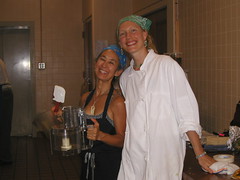
My dear friend
My long-time friend, Reni, came all the way from Japan to Poultney, VT for our conference. It was so great to be in her aura again. I love her so much! When life gets rough, and people look at me like a counter culture weirdo, I can count on her to bring me back to reality. We share the same language, yin and yang.
Thanks for your friendship, Reni.
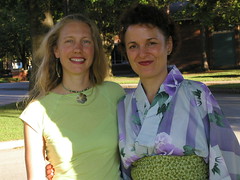
Thanks for your friendship, Reni.
Paige and Sean
While at the conference, I got to meet Paige and Sean. They were such COOL people and made the conference an amazing experience for me.
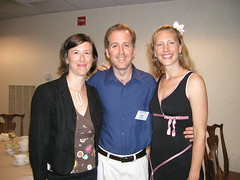
My teachers
At the Kushi Summer Conference, I got to see my amazing, generous, beautiful teachers, Hiroyuki and Mie Naka. They are coming to Hawaii in January to teach us all macrobiotics and give consultations.
Zen Retreat Leader
When I was in Japan, I met Danjou-san, the amazing and incredible monk who tends Saijouji temple near Hiroshima, Japan. He came to the American Macrobiotic Summer Conference and he blew me away. This man is magical and talented. He played guitar with the band, chanted for all, danced to his heart's content, and despite language barriers, talked with whomever he could. He's such a wonderful person.
Monday, August 01, 2005
Summer Conference 2005
I just got back on Sunday,July 31st, from the 21st Annual Kushi Summer Macrobiotic Conference. My flight landed in Albany, and my wonderful friend Julie picked me up and took me back to her house where we hung out for a couple of days. It was so great seeing her, spending time on her property, and also with her family. She has two boys that are loving and affectionate, so I got lots of hugs, which was wonderful. One day we spent at the lake BBQing, swimming, boating, and eating lots of summer foods. It was a perfect summer day. They are always really kind about trying to accomodate my macrobiotic diet. Julie even made brown rice and veggies for me for breakfast. I was so happy.
Upstate NY is just gorgeous with vast amounts of space that blew me away. After living in Japan and Hawaii, seeing all this space and the huge homes was novel and exciting. The planter baskets, corn fields, and long stretches of empty road on a hot day were breathtaking.
She dropped me back off at the airport in Albany, where I took a shuttle to Poultney, VT. This was my second conference, and my first experience as a volunteer. My job was to work in the cooking classes as an assistant which meant lots of prepping veggies and making sure that the teacher had everything he or she needed. There was a lot of work, so there was little time to attend sessions. One great part of the cooking classes was meeting and assisting Michael Marcus, the owner of Bizen, a restaurant in MA. He's a sushi chef, and makes wonderful creative sushi. Other good teachers who I assisted were Warren Kramer, Dawn Black, and Chef Sato. All had interesting information to teach the students, and made delicious foods. There were many other teachers, but I wasn't able to work with them directly. Someone taught the most delicious steamed cake I have ever eaten. One would never have guessed that it wasn't baked. Steaming cakes and cookies is much better for one's health than baking. Baked flour wreaks havoc on our intestines! (I'm happy to say that I avoided the baked flour in the cafe successfully. That place has wonderful baked goods and food in general. It's a true highlight of the conference.)
When I did have time outside of the work, I spent it going to the teacher's conference, where I got to network with a lot of people, ask questions, and feel inspired by the great people there.
I also got to know several people just through volunteering and also through meeting them at meal times. I made some great new friends. That was wonderful too. Paige and I took one free afternoon to swim in a nearby lake. We had such a dynamic conversation. She is a dynamic, intelligent, beautiful person who reminds me of a cousin of mine (also dynamic, intelligent, and beautiful)!
The food they served all the 500 attendees was quite good and now that I am back home, I feel relaxed, my skin is clear, and other bodily functions are running smoothly. A macro diet is just amazing! It transformed me in just about one week and brought me back to center again.
Who knows whether the conference will be at the same place next year or not, but the town itself is very quaint, comfortable, and fun. The main street has everything you need, from the post office, to the pharmacy, wine shop and deli, used book store, laundromat, library, gas station, grocery store, antique shops, etc. It's all green and lush, and people have flowers overflowing from planters lining the entire street.
If you have a chance to go to next summer's conference, I highly recommend it. I can't wait!
Upstate NY is just gorgeous with vast amounts of space that blew me away. After living in Japan and Hawaii, seeing all this space and the huge homes was novel and exciting. The planter baskets, corn fields, and long stretches of empty road on a hot day were breathtaking.
She dropped me back off at the airport in Albany, where I took a shuttle to Poultney, VT. This was my second conference, and my first experience as a volunteer. My job was to work in the cooking classes as an assistant which meant lots of prepping veggies and making sure that the teacher had everything he or she needed. There was a lot of work, so there was little time to attend sessions. One great part of the cooking classes was meeting and assisting Michael Marcus, the owner of Bizen, a restaurant in MA. He's a sushi chef, and makes wonderful creative sushi. Other good teachers who I assisted were Warren Kramer, Dawn Black, and Chef Sato. All had interesting information to teach the students, and made delicious foods. There were many other teachers, but I wasn't able to work with them directly. Someone taught the most delicious steamed cake I have ever eaten. One would never have guessed that it wasn't baked. Steaming cakes and cookies is much better for one's health than baking. Baked flour wreaks havoc on our intestines! (I'm happy to say that I avoided the baked flour in the cafe successfully. That place has wonderful baked goods and food in general. It's a true highlight of the conference.)
When I did have time outside of the work, I spent it going to the teacher's conference, where I got to network with a lot of people, ask questions, and feel inspired by the great people there.
I also got to know several people just through volunteering and also through meeting them at meal times. I made some great new friends. That was wonderful too. Paige and I took one free afternoon to swim in a nearby lake. We had such a dynamic conversation. She is a dynamic, intelligent, beautiful person who reminds me of a cousin of mine (also dynamic, intelligent, and beautiful)!
The food they served all the 500 attendees was quite good and now that I am back home, I feel relaxed, my skin is clear, and other bodily functions are running smoothly. A macro diet is just amazing! It transformed me in just about one week and brought me back to center again.
Who knows whether the conference will be at the same place next year or not, but the town itself is very quaint, comfortable, and fun. The main street has everything you need, from the post office, to the pharmacy, wine shop and deli, used book store, laundromat, library, gas station, grocery store, antique shops, etc. It's all green and lush, and people have flowers overflowing from planters lining the entire street.
If you have a chance to go to next summer's conference, I highly recommend it. I can't wait!
Wednesday, July 06, 2005
A typical macrobiotic day
I finally got down to reading this wonderful book. I learned a lot from it, and discovered new recipes to try out too. Thanks Jessica! I especially enjoyed the following, from page 170.
A Typical Macrobiotic Day
From the Hip Chicks Guide to Macrobiotics by Jessica Porter
Wake up with the sun.
Feel sublime.
Be thankful for every single blade of grass that has ever been grown
under the sun.
Chew rice four thousand times.
Plant new rice in backyard rice paddy.
Make homemade clothes for twelve children.
Homeschool the children.
Smile.
Appreciate life.
Cook nineteen course meal.
Chew rice nine thousand times.
Harvest rice.
Write letters to loved ones around the world, thanking them for just
being.
Call Gwyenth and gossip.
Put twelve children to bed.
Make love to soul mate.
ZZZZzzzzzzz.
A Typical Macrobiotic Day
From the Hip Chicks Guide to Macrobiotics by Jessica Porter
Wake up with the sun.
Feel sublime.
Be thankful for every single blade of grass that has ever been grown
under the sun.
Chew rice four thousand times.
Plant new rice in backyard rice paddy.
Make homemade clothes for twelve children.
Homeschool the children.
Smile.
Appreciate life.
Cook nineteen course meal.
Chew rice nine thousand times.
Harvest rice.
Write letters to loved ones around the world, thanking them for just
being.
Call Gwyenth and gossip.
Put twelve children to bed.
Make love to soul mate.
ZZZZzzzzzzz.
Thursday, June 09, 2005
Macrobiotic Pregnancy and morning sickness
It seems like all my female friends and family are preganant. That is so thrilling for them. I can't wait to see their sweet keikis! My cousin was asking about what to eat on the macrobiotic diet to have a smooth and healthy pregnancy, and another friend was telling me that she has morning sickness. Here are are few ideas for them:
For a healthy pregnancy, eat the standard macrobiotic diet. See www.macrobiotichawaii.bravehost.com/standarddiet.html for exactly what this is. The main point is that it's important to avoid extremes.
For morning sickness (nausea, queasiness, and lack of desire for certain foods, or foods in general), in Macrobiotic Pregnancy and Care of the Newborn, Aveline Kushi says:
Yin morning sickness comes from the overintake of sugar, fruit, fruit juice, milk, and other dairy products, spices, tomatoes, and other more yin items. The standard diet, together with reducing extreme yin, will help offset the morning sickness. Stronger cooking methods are recommended in these cases.
Yang morning sickness comes from too much salt, baked food, animal products, and other more yang items. The stomach stomach and other organs become overly contracted. Women often lose their appetite for things like brown rice and cooked vegetables (yang repels yang). Relax your lifestyle and make your diet more yin. Soft cooked rice and other grains are helpful, as is mochi/sweet rice, umeboshi or sour pickles, grated raw daikon with tamari and nori. In addition, tempura can be taken a few times a week, and sweet vegetables are nice too , such as squash, daikon, carrot, parsnip and others. Other recommendations are to reduce salt, enjoy some yang berries in small quantities, amazake, or hot apple juice.
For a home remedy for low appetite, miso soup is good, and so is umeboshi , as with ume-sho-bancha or ume-sho-kuzu drinks.
This book says not to worry about morning sickness. It's not a serious problem, and will go away after the third month.
For a healthy pregnancy, eat the standard macrobiotic diet. See www.macrobiotichawaii.bravehost.com/standarddiet.html for exactly what this is. The main point is that it's important to avoid extremes.
For morning sickness (nausea, queasiness, and lack of desire for certain foods, or foods in general), in Macrobiotic Pregnancy and Care of the Newborn, Aveline Kushi says:
Yin morning sickness comes from the overintake of sugar, fruit, fruit juice, milk, and other dairy products, spices, tomatoes, and other more yin items. The standard diet, together with reducing extreme yin, will help offset the morning sickness. Stronger cooking methods are recommended in these cases.
Yang morning sickness comes from too much salt, baked food, animal products, and other more yang items. The stomach stomach and other organs become overly contracted. Women often lose their appetite for things like brown rice and cooked vegetables (yang repels yang). Relax your lifestyle and make your diet more yin. Soft cooked rice and other grains are helpful, as is mochi/sweet rice, umeboshi or sour pickles, grated raw daikon with tamari and nori. In addition, tempura can be taken a few times a week, and sweet vegetables are nice too , such as squash, daikon, carrot, parsnip and others. Other recommendations are to reduce salt, enjoy some yang berries in small quantities, amazake, or hot apple juice.
For a home remedy for low appetite, miso soup is good, and so is umeboshi , as with ume-sho-bancha or ume-sho-kuzu drinks.
This book says not to worry about morning sickness. It's not a serious problem, and will go away after the third month.
Macrobiotic Pregnancy Recommendations
1. Be happy about having a baby
2. Every day, pray for a safe pregnancy and for a happy and healthy baby
3. Avoid upsetting or overly stimulating movies, entertainment, or books
4. Keep all of your personal relationships smooth and happy
5. Wear clothing made from cotton and other natural vegetable fibers
6. Keep your home and surroundings clean and orderly
7. Keep active and busy
2. Every day, pray for a safe pregnancy and for a happy and healthy baby
3. Avoid upsetting or overly stimulating movies, entertainment, or books
4. Keep all of your personal relationships smooth and happy
5. Wear clothing made from cotton and other natural vegetable fibers
6. Keep your home and surroundings clean and orderly
7. Keep active and busy
Friday, June 03, 2005
Succulent BBQ Tempeh Dish
Now that I am back in the US, I get to play with all the yummy ingredients we have here that I couldn't find or that cost and arm and a leg in Japan. The weather in Hawaii has been scorching, and I can't help but have that summer feeling..... BBQ just popped into my mind.... This recipe is in Fresh from a Vegetarian Kitchen by Meredith McCarty. I cut the tempeh into bite-sized pieces, oven baked them in the sauce, and put into the pita bread with the fixin's like a gyro. Variety is the spice of life. This dish packs a lot of flavor and is fun for an occasional indulgence of the senses.
Barbecued Tempeh Cutlets in Pocket Pitas
8 oz tempeh, cut in 4 pieces or in bite sized cubes
1 c Red BBQ sauce (recipe follows)
2 whole wheat pita pocket breads
1/2 cup tofu mayonnaise (recipe follows)
lettuce, sprouts, onion, cucumber, or whatever you would like to stuff the pita bread with
Red BBQ Sauce
1 C Red Sauce
(6 carrots, 1 small beet, and celery pressure cooked for 10 minutes and blended. Use the leftovers for an Italian Pasta Sauce or Tofu Pizza. Yummy!)
1/4 C apple cider vinegar
1/4 cup natural soy sauce
2 T onion, minced
2 T brown rice syrup
1 T wet mustard
1 T sesame oil
1/4 t basil
1/4 t oregano
1/4 t cumin
1/16 t cayenne pepper powder
Mix ingredients well. Marinate tempeh in BBQ sauce for 30 min. Preheat BBQ, broiler, or oven while you make the rest. Cut each pita bread in half and steam for about 2 minutes to soften it. Spread some tofu mayo inside and stuff with veggies. BBQ tempeh, covered, for 5 to 7 min on each side, turning just once. To broil, cook on first side until toasted about 8 min, then turn it over, spoon on a bit more sauce, and cook 8 min more. To bake, cook for 15 minutes at 450 degrees, then turn the cutlets over, and bake 15 minutes more. Add cutlets to the pita sandwiches.
Tofu Mayonnaise
250 g tofu
1 T ume vinegar
1 T lemon juice
Dash of oil (optional)
1 t wweet white miso
pinch of salt
Blend all ingredients in the food processor, and adjust flavors to taste.
Barbecued Tempeh Cutlets in Pocket Pitas
8 oz tempeh, cut in 4 pieces or in bite sized cubes
1 c Red BBQ sauce (recipe follows)
2 whole wheat pita pocket breads
1/2 cup tofu mayonnaise (recipe follows)
lettuce, sprouts, onion, cucumber, or whatever you would like to stuff the pita bread with
Red BBQ Sauce
1 C Red Sauce
(6 carrots, 1 small beet, and celery pressure cooked for 10 minutes and blended. Use the leftovers for an Italian Pasta Sauce or Tofu Pizza. Yummy!)
1/4 C apple cider vinegar
1/4 cup natural soy sauce
2 T onion, minced
2 T brown rice syrup
1 T wet mustard
1 T sesame oil
1/4 t basil
1/4 t oregano
1/4 t cumin
1/16 t cayenne pepper powder
Mix ingredients well. Marinate tempeh in BBQ sauce for 30 min. Preheat BBQ, broiler, or oven while you make the rest. Cut each pita bread in half and steam for about 2 minutes to soften it. Spread some tofu mayo inside and stuff with veggies. BBQ tempeh, covered, for 5 to 7 min on each side, turning just once. To broil, cook on first side until toasted about 8 min, then turn it over, spoon on a bit more sauce, and cook 8 min more. To bake, cook for 15 minutes at 450 degrees, then turn the cutlets over, and bake 15 minutes more. Add cutlets to the pita sandwiches.
Tofu Mayonnaise
250 g tofu
1 T ume vinegar
1 T lemon juice
Dash of oil (optional)
1 t wweet white miso
pinch of salt
Blend all ingredients in the food processor, and adjust flavors to taste.
Macrobiotic Method to Stay Happy
Do you feel depressed, nervous, or that perhaps your condition is currently bad? One great way to move yourself through this energy is to surround yourself with happy things and happy people. Not only do we take in nourishment and energy from the food that we eat, but we also take in from the environment around us. Surround yourself with happy, healthy, successful people. For example, right now I am working on starting a business, so finding and reading success stories of others who have started from scratch, watching movies, or meeting people who have made it happen for themselves is what the macro doctor orders.
If you are feeling sad about love, romance, and relationships, find yourself a great story, book, or movie about a relationship that has a happy ending. If you are fighting with your loved ones, your own condition is not good, so work on improving your condition, and the rest will work itself out. If you think too much about the problem, and hang around depressed, sad, down people, or those with relationship problems, it will pull you down further. Find some positive energy and cheerful people. Sing a happy song!
Keep a positive image in your mind, and find how your macrobiotic life brings the miracle you want.
If you are feeling sad about love, romance, and relationships, find yourself a great story, book, or movie about a relationship that has a happy ending. If you are fighting with your loved ones, your own condition is not good, so work on improving your condition, and the rest will work itself out. If you think too much about the problem, and hang around depressed, sad, down people, or those with relationship problems, it will pull you down further. Find some positive energy and cheerful people. Sing a happy song!
Keep a positive image in your mind, and find how your macrobiotic life brings the miracle you want.
Thursday, June 02, 2005
Modern Macrobiotic/Vegan Cooking Lessons
Leslie’s whole food cooking classes are for people who seek a healthier lifestyle and a natural approach to diet and healing. Learn how to bring more balance, flexibility, and joy into your life through the power of food. Discover the importance and health benefits of a whole food diet consisting of grains, land and sea vegetables, beans and bean products, fruits, seeds, nuts and natural sweeteners. Recipes are low in fat and salt but high in fiber and complex carbohydrates, and contain no sugar, dairy, or other refined foods. Only the freshest, organic, seasonal ingredients are used in a variety of sumptuous and enticing ways. Learn macrobiotic cuisine, international cuisine, foods in healing, home remedies, sugar free desserts, seasonal gourmet dinners, and more.
Discover the healing potential for conditions such as weight gain, food allergies, candida, emotional imbalances like depression and stress, acne, PMS, cancer, osteoporosis, high cholesterol, high blood pressure, diabetes, arthritis and others.
Classes include an introductory lecture, demonstrations, hands-on experience, free recipes and educational material. We enjoy learning and cooking together, and sit down to enjoy a delicious meal, followed by cooperative kitchen cleanup. All questions welcomed during the cooking classes.
For more information, go to http://macrobiotichawaii.bravehost.com/cookingclasses.html
Discover the healing potential for conditions such as weight gain, food allergies, candida, emotional imbalances like depression and stress, acne, PMS, cancer, osteoporosis, high cholesterol, high blood pressure, diabetes, arthritis and others.
Classes include an introductory lecture, demonstrations, hands-on experience, free recipes and educational material. We enjoy learning and cooking together, and sit down to enjoy a delicious meal, followed by cooperative kitchen cleanup. All questions welcomed during the cooking classes.
For more information, go to http://macrobiotichawaii.bravehost.com/cookingclasses.html
Friday, May 20, 2005
Albert Einstein said this??
"Out of clutter, find simplicity. From discord, find harmony. In the middle of difficulty, lies opportunity." Three Rules of Work
Great, I have a lot of opportunity then!
Great, I have a lot of opportunity then!
David Kelman Inspired Me
There is a magazine I have never read before called Fit Yoga. I love yoga, so thought, "What the heck, let's check it out." Inside the May 05 issue is an article about David Kelman, and reading it gave me a lot of inspiration and comfort. After the 9/11 tragedy, he dropped his high powered career in investment banking to do something to improve the world, to serve people, and to show his kids a different model of being "American". For these reasons, he opened a huge and beautiful yoga studio with several types of yoga offered (ashtanga, iyengar, and one other....i can't remember). He talks about having days when he felt he was in a desperate nightmare because no one came to the studio at all. (Like my days of no income.) On good days, he oscillated between panic and euphoria (For me one day will be panic, the next euphoria.) He experienced a shift in friends since he no longer fit neatly into the box, but is more in the margins, or what he called a "counterculture weirdo." I can also relate to those feelings, but thank the Universe for my family and Reni who gives me regular Leslie Maintainance, and Kathy Maddux who offers me work out of the kindness in her heart, and is the only other macrobiotic woman I know here. Like my teachers, he says "I believe that the right intention coupled with right action can produce something special." It was comforting to read about another's journey, and to know I am not alone.
Thursday, May 12, 2005
A Ziggy Cartoon
Last night I saw a funny Ziggy cartoon. Ziggy said,
"I ate 7 Happy Meals, and I am still depressed."
"I ate 7 Happy Meals, and I am still depressed."
The Daniel Diet
Last night I met Dr. Shintani who wrote "The Hawaii Diet". He gave a faith based seminar at a local church here in Honolulu and the topic was the food Daniel ate during that particular time in biblical history. Now, I am not Christian, but I could really appreciate that there were so many people there at the seminar who were interested, genuinely interested, in how they could change their diets. The point was that the King wanted the peasants to eat King's food (imagine perhaps wine and other rich foods), believing it would make guards of the kingdom stronger and better able to protect the King. But Daniel refused, and would only accept food as God delivered it. That means it was fresh, local, organic, in season, and non processed -- essentially a macrobiotic diet. After 10 days of eating this way, Daniel was the strongest of them all, and the King would only ask Daniel for advice. That supports the idea that traditional cultures ate macrobiotically, and that changing one's diet can change one's life. This is just another way to look at the topic.
Dr. Shintani will be offering a program for those who would like to alter their diets. For a relatively small fee, they will come to eat for 10 days (like Daniel) and go through a series of blood work to make sure that all is well with medications. His goal is to get people off their meds and on the path to recovery with a natural whole foods diet.
I hope to cook with him. Perhaps I should say that I pray to cook with him on this project? I was very grateful to be there and be a part of everything, even though as I mentioned before, I am not Christian. A well balanced diet is so important for our health and well being.
Dr. Shintani will be offering a program for those who would like to alter their diets. For a relatively small fee, they will come to eat for 10 days (like Daniel) and go through a series of blood work to make sure that all is well with medications. His goal is to get people off their meds and on the path to recovery with a natural whole foods diet.
I hope to cook with him. Perhaps I should say that I pray to cook with him on this project? I was very grateful to be there and be a part of everything, even though as I mentioned before, I am not Christian. A well balanced diet is so important for our health and well being.
Wednesday, May 11, 2005
Recommendations?
Since I have been back here, I have been trying to generate interest in macrobiotics. This led me to make a business card, some flyers, and has me driving all around the island and on the web with outer islands trying to either give cooking lessons or offer services as a private cook. Hey, this is NOT EASY. Any suggestions out there? I have been to yoga studios, massage schools, culinary schools..... My teachers say, "Right action, or living for God, brings everything you need. Dont worry, students are coming, money is coming. Get one student and then more will come." This is a macrobiotic principle (works with money, lovers, etc so it should apply to work/business). Where are you my first cooking student??? I am waiting for you and trying to find you!
Rain and Diana Krall
The other night, I went to the Waikiki Shell to see Diana Krall with one of my good friends. The day had been so warm and beautiful, and I was so excited to go sit on the green grass, view the sunset, and listen to jazz with my friend. Suddenly, out of nowhere, the clouds blew in and the rain started gushing down on us. We were totally unprepared by this wet outburst, and cringed, huddling under our light jackets. As it came down harder and harder, and as the entire crowd groaned, I started laughing. Here again, I had a conscious choice what to feel. Here I was, with water not just raining from above, but also running down the hill toward me, no umbrella handy, so I was getting soaked. But I was with my friend who I didnt see regularly while I lived in Japan, I was back in Hawaii, and I was listening to great jazz music, and those things felt great. The water was warm and my feet were bare. I was wet, but so what? It would dry. It was more fun to enjoy the sensation of the moment.
green*light
Hello everyone,
There is a new magazine on the market called green*light that seems geared toward people who are interested in health and natural living. If you go to their website, you can order 4 free copies.
Aloha, Leslie
There is a new magazine on the market called green*light that seems geared toward people who are interested in health and natural living. If you go to their website, you can order 4 free copies.
Aloha, Leslie
Friday, April 29, 2005
Always two ways to see the world
The other day I was out looking for an apartment. I was driving my car around and noticed the thermostat was suddenly all the way up to H for HOT! Hmmmm..... That had never happened to me before, and when my friend had this same car, it had never done that -- as far as I knew. I wondered to myself what it meant, and how to fix it, and decided to turn off the AC even though it was a really hot day. Well, my question got answered in short order when the car started smoking. I was in shock and panic. Seems to be a theme with this panic lately. What is going on with my kidneys I wonder? Anyway, I was a total damsel in distress not knowing what to do or who to call. (Note to self: Get AAA right away.) By the grace of the Universe, I had the number for a mechanic, because I had been planning on getting my car tuned up anyway. He suggested getting the car towed so that I didnt cause any further damage, and as I hung up, I wanted to cry. Why me? Why me? Why me? What does this mean? Oh, existential pain! Then I caught myself, and tried to see things in a different way. We always have a choice to see things in a different way. Instead of thinking how horrible it all was, I decided to think how great that this mechanic was helping me. Instead of worrying what others were thinking with my car parked in this awkward place, I thought, "Now I have more time to read my book" Instead of thinking how I was missing out on viewing all those apartments I had scehduled viewings for, I trusted that I would get the right one anyway, and maybe it was time to stop looking. The universe was sending me a message to stop looking, and that came through pretty loud and clear. The mechanic coming to tow me was going out of his way to borrow his friends tow truck, and he was putting aside everything on his que to come and help me, just because he is a nice person. Instead of being embarrassed for being towed, I instead thought, "How fun. I have never been towed before. I get to ride up in this big hefty truck and watch him shift those gears." Life is play, and I decided to make that moment into play too. I am so very thankful that he was able to help me. He didnt have to do that. Mahalo Tony!
Thank heavens for nature and loving teachers
For the past month, I have been working hard to try and find a place to live in Honolulu. My spirits have stayed positive for the majority of this time, though searching for a place to live here was really a full time job, and I am happy to report that I got a really cute little cottage with a beautiful lanai to enjoy nights and weekends with my family and friends. May is the move in date. Suddenly, the reality of rent hit me. I spent the last two days in a complete panic. HOW do I start my own business???? How can I make money doing this????? Will I need to go back to teaching English?
I went for a walk with Kai, the Siberian Husky, our nightly ritual as the sun goes down and the weather cools off. He leaps through tall grass, sprints up the hill, and smells the flowers. When we get into a walking rhythm, and I can look at the stunning scenery around me, and I can smell the fresh air, and see the vibrant colors, things seem to be more positive.
I called my teachers who keep the "red line" open all the time. I am so grateful for their guidance and help as I make my way through uncharted territory, flung out into deep water. My teacher says, "Forget teaching English. That is the easy way. If you do or think this way, you will get stuck in karma and see the world in only one way. Trust and believe. Students are coming. Money is coming. Devote everything to trying to get students." I got off the phone with them feeling a lot better.
Thank heavens for nature and loving teachers. Oh, and great sisters too! I love talking by IM and hotmail with you Allison.
I went for a walk with Kai, the Siberian Husky, our nightly ritual as the sun goes down and the weather cools off. He leaps through tall grass, sprints up the hill, and smells the flowers. When we get into a walking rhythm, and I can look at the stunning scenery around me, and I can smell the fresh air, and see the vibrant colors, things seem to be more positive.
I called my teachers who keep the "red line" open all the time. I am so grateful for their guidance and help as I make my way through uncharted territory, flung out into deep water. My teacher says, "Forget teaching English. That is the easy way. If you do or think this way, you will get stuck in karma and see the world in only one way. Trust and believe. Students are coming. Money is coming. Devote everything to trying to get students." I got off the phone with them feeling a lot better.
Thank heavens for nature and loving teachers. Oh, and great sisters too! I love talking by IM and hotmail with you Allison.
Friday, April 22, 2005
Had a GREAT night in the organic garden. This
shangri la is directly behind the Chinese Cemetary, in the back of Manoa Valley.
Interesting feng shui, but the garden and the people seem to be thriving.
They felt the Chinese chose the cemetary for the auspicious site about
100+ years ago and for that reason, it doesnt stagnate the chi in the area or
threaten the occupants nearby. There are about 3 guys who live in this
converted building and it is a cozy, and shall I say, very earthy place.
Very interesting people who live there and garden there too. Acupuncturists,
artists, one other macrobiotic person.... Every Thursday people join as
volunteers, share dinner together, and are generally free to take
fruits and veges from the garden. I just weeded, which was what I wanted to
do. It felt therapuetic to me. Afterwards, we sat down together and had a
lovely meal. Tonight it was cooked vegan, but people added cheese to the
pasta and sauce. They made kabocha (baked) fresh from their garden, sauteed
greens, also from the garden, pasta with tomato sauce, brown rice, garlic
bread (yes, I ate some), and baked tofu with a tahini sauce. Yummy! I was
sent home with bananas (not for me) and fresh cut tropical flowers that are
simply stunning and breathtaking. So much fun!
We had been talking about organic pesticides,
because the proprieter had just given a lecture on it the previous
day. He told the audience that the best possible thing one could do
is have excellent soil and then one would not really have to worry
about pests. This sounded so much like macrobiotics to me. If we
have strong blood and are not eating lots of sugar or fruit then
mosquitos, viruses, and other illnesses should not be bugging us. (the mosquitoes in the garden chomped on me.... what had I been eating I wonder???? But I did try to just shoo them off instead of smooshing them.)
the jainists in india went so far as
to brush the path in front of them while they walked so as not to
kill bugs (ahmisa, for yoga lovers). i sometimes still think about
that...... for some reason, it really struck me.
i got a job cooking for this macro woman. she is catering a party,
so that was great for her to ask me. she also runs the cooking
demos at the KI summer conference, and she invited me to help her as
a volunteer, so I came home flying after receiving these
opportunities. It was so much fun to be there tonight.
shangri la is directly behind the Chinese Cemetary, in the back of Manoa Valley.
Interesting feng shui, but the garden and the people seem to be thriving.
They felt the Chinese chose the cemetary for the auspicious site about
100+ years ago and for that reason, it doesnt stagnate the chi in the area or
threaten the occupants nearby. There are about 3 guys who live in this
converted building and it is a cozy, and shall I say, very earthy place.
Very interesting people who live there and garden there too. Acupuncturists,
artists, one other macrobiotic person.... Every Thursday people join as
volunteers, share dinner together, and are generally free to take
fruits and veges from the garden. I just weeded, which was what I wanted to
do. It felt therapuetic to me. Afterwards, we sat down together and had a
lovely meal. Tonight it was cooked vegan, but people added cheese to the
pasta and sauce. They made kabocha (baked) fresh from their garden, sauteed
greens, also from the garden, pasta with tomato sauce, brown rice, garlic
bread (yes, I ate some), and baked tofu with a tahini sauce. Yummy! I was
sent home with bananas (not for me) and fresh cut tropical flowers that are
simply stunning and breathtaking. So much fun!
We had been talking about organic pesticides,
because the proprieter had just given a lecture on it the previous
day. He told the audience that the best possible thing one could do
is have excellent soil and then one would not really have to worry
about pests. This sounded so much like macrobiotics to me. If we
have strong blood and are not eating lots of sugar or fruit then
mosquitos, viruses, and other illnesses should not be bugging us. (the mosquitoes in the garden chomped on me.... what had I been eating I wonder???? But I did try to just shoo them off instead of smooshing them.)
the jainists in india went so far as
to brush the path in front of them while they walked so as not to
kill bugs (ahmisa, for yoga lovers). i sometimes still think about
that...... for some reason, it really struck me.
i got a job cooking for this macro woman. she is catering a party,
so that was great for her to ask me. she also runs the cooking
demos at the KI summer conference, and she invited me to help her as
a volunteer, so I came home flying after receiving these
opportunities. It was so much fun to be there tonight.
Saturday, April 16, 2005
Macrobiotic Meetup in Manoa
Today we had our first Vegan/Macrobiotic Meetup Group activity in Manoa at Kathy Maddux's Great Life Bento place. At first I thought it would be just Kathy and myself, but I was so happy to see 3 more people come, all of whom are vegan. It was a lot of fun for me to talk with everyone and get to know some people around Honolulu, and to hear more about Kathy's experience when she went to the Kushi Institute. She is, so far, the only macrobiotic person that I have met here, and it really recharges my macro battery to interact with like-minded individuals. It will be important to generate a strong community. Our next event is going to be a potluck, and I am sure we can get more people to attend. That will be a lot of fun to have a social event and to meet some people.
In the past, I used to be really shy, but after becoming macrobiotic and learning yoga, I have been able to open myself up to new experiences and new people. This is why arranging this meeting and getting to know others was super exciting for me. Changing my diet and lifestyle has made such an enormous difference in my well-being, spirituality, peace of mind, and life destiny.
After the meeting, I was just a hop, skip, and a jump away from Manoa Yoga studio, so I went over there for a class with Ray Madigan. It felt really good to stretch my body, and as a result, I became very relaxed, and my spirits were really lifted even more. While doing forward bends, there was a huge rainbow arching across the valley, embracing us.
I am so grateful to be in such a beautiful place and to challenge myself with this new life opportunity. Thank you to the Universe.
In the past, I used to be really shy, but after becoming macrobiotic and learning yoga, I have been able to open myself up to new experiences and new people. This is why arranging this meeting and getting to know others was super exciting for me. Changing my diet and lifestyle has made such an enormous difference in my well-being, spirituality, peace of mind, and life destiny.
After the meeting, I was just a hop, skip, and a jump away from Manoa Yoga studio, so I went over there for a class with Ray Madigan. It felt really good to stretch my body, and as a result, I became very relaxed, and my spirits were really lifted even more. While doing forward bends, there was a huge rainbow arching across the valley, embracing us.
I am so grateful to be in such a beautiful place and to challenge myself with this new life opportunity. Thank you to the Universe.
Tuesday, April 12, 2005
Fish Pond
Here is a sacred fish pond from the Place of Refuge on the Big Island. The Hawaiians raised fish in ponds like this one, a significant part of their culture. However, today, there are very few active fish ponds left. On Oahu, the most significant one is now Pearl Harbor.
Tiki
This was a tiki overlooking the ocean from The Place of Refuge. In ancient times, if a Hawaiian person broke a law or did something bad, they could be killed. However, if they made it to the sacred refuge before their enemies found them, they would be blessed by a Hawaiian priest and absolved of all wrongdoing, free to go.

Monday, April 11, 2005
The world is a beautiful place
Today was such a busy day full of running errands. I went into Manoa in search of a place called Great Life Bentos that sells macrobiotic lunch boxes, but she was closed today unexpectedly. Despite being disappointed at the closure, I was so happy to know that she is there and that I have more options for lunch, especially considering the only other macro bento place here in Honolulu doesn't really seem macrobiotic anymore. (Yin and yang -- everything that has a front, has a back.)
As I made my way around the post office, drug store, and various other places, I was so surprised at the gloomy faces and lack of smiles. Maybe it was because I have no tan yet and so people thought I was a tourist, but they sure weren't friendly. But today was so gorgeous, and rainbows were popping out all over the place. I wanted to tell them all that "Life is GREAT" and how the world is a beautiful place. Play, have fun! Enjoy yourself!
As I made my way around the post office, drug store, and various other places, I was so surprised at the gloomy faces and lack of smiles. Maybe it was because I have no tan yet and so people thought I was a tourist, but they sure weren't friendly. But today was so gorgeous, and rainbows were popping out all over the place. I wanted to tell them all that "Life is GREAT" and how the world is a beautiful place. Play, have fun! Enjoy yourself!
Saturday, April 09, 2005
Tofu and frolicking
This past week I have been on the Big Island of Hawaii enjoying the Kona side of the island. It was a shock, but I didnt find a single place to eat brown rice. What a relief that I took some precooked things with me for breakfast so that I could enjoy it still at least once a day.
I did get to see some really cool things, such as the Place of Refuge, a very sacred Hawaiian site. At the Place of Refuge, we met a local Hawaiian man who carved the tikis for this national park. Later, we also took an airplane ride over the volcano, and it was completely insane. We could see inside the crater with all the lava sloshing around. My mother and I gasped out loud in awe. Another great thing was Queen's Bath, a fresh water pool underground that was right next to the ocean. You climb down inside and peer up into the palm trees. I put my hands above me onto the rocks, and they were buzzing with energy. Mother Earth held me inside of her, and I felt very refreshed and renewed. For the first time, I also got to paddle in an outrigger canoe. My very athletic mom met them and found out anyone could go. We took an hour out of our morning to experience this. It was great fun.
My father went snorkeling and forgot to put on sunscreen. For 4 hours he was like a turtle without a shell, so needless to say, his back was very burnt. I thought maybe they were maybe 3rd degree, but my sister who is a nurse corrected me and suggested that they were 2nd degree burns. Nevertheless, after we spotted the blisters popping out all over his back, I went to the local grocery store to buy some tofu. We cut it up and placed it on certain areas that were the worst. It was very uncomfortable for him, but he was a great sport. The tofu actually cooked on his back. We were so surprised to see this. I hope that it helped reduce the pain he felt. After a couple of days taking it easy, he was feeling better.
Thanks Mom and Dad for a great time. It was great to be there with you. I am happy George could come too.
I did get to see some really cool things, such as the Place of Refuge, a very sacred Hawaiian site. At the Place of Refuge, we met a local Hawaiian man who carved the tikis for this national park. Later, we also took an airplane ride over the volcano, and it was completely insane. We could see inside the crater with all the lava sloshing around. My mother and I gasped out loud in awe. Another great thing was Queen's Bath, a fresh water pool underground that was right next to the ocean. You climb down inside and peer up into the palm trees. I put my hands above me onto the rocks, and they were buzzing with energy. Mother Earth held me inside of her, and I felt very refreshed and renewed. For the first time, I also got to paddle in an outrigger canoe. My very athletic mom met them and found out anyone could go. We took an hour out of our morning to experience this. It was great fun.
My father went snorkeling and forgot to put on sunscreen. For 4 hours he was like a turtle without a shell, so needless to say, his back was very burnt. I thought maybe they were maybe 3rd degree, but my sister who is a nurse corrected me and suggested that they were 2nd degree burns. Nevertheless, after we spotted the blisters popping out all over his back, I went to the local grocery store to buy some tofu. We cut it up and placed it on certain areas that were the worst. It was very uncomfortable for him, but he was a great sport. The tofu actually cooked on his back. We were so surprised to see this. I hope that it helped reduce the pain he felt. After a couple of days taking it easy, he was feeling better.
Thanks Mom and Dad for a great time. It was great to be there with you. I am happy George could come too.
Subscribe to:
Posts (Atom)
