The following could be individual or collective reasons for sugar cravings. Read each suggestion and notice how it applies to your eating or lifestyle. Reducing your desire or addiction for sugar should not require Herculean will power. Becoming conscious of the physiological and lifestyle factors that stimulate sugar cravings should make taming your sweet tooth a piece of cake--so to speak...
1. REDUCE SALT & PRODUCTS WITH SALT The need for dietary salt from natural sources (sun-dried sea salt) is dependent on several factors; a lack of salt can cause fatigue, stimulate a desire to overeat and often result in a craving or animal protein. However, with the availability of good quality sea salt, miso paste, tamari soy sauce and natural pickles, it's quite easy to overdose. Thirst and a craving for sweet foods is one of the most reliable indicators of excess dietary salt.
2. REDUCE ANIMAL PROTEINThe standard four basic food group propaganda was force-fed to the American public along with the myth that animal protein should be a dietary staple. The meat and potatoes mentality has to re-think its philosophy since established research shows excess animal protein can lead to colon and prostate cancer. If this applies to you eat less in volume (2 to 4 ounce servings) and limit it to three to four times per week (maximum), as opposed to daily.
3. REDUCE FOOD VOLUME Overeating leads to fatigue and sluggishness. This makes a stimulant like sugar (or coffee) more appealing. Eating more frequently will allow you to reduce overeating with a minimum of effort.
4. EAT MORE FREQUENTLY THROUGHOUT THE DAY One of the most common reasons for sugar cravings--especially at night. By skipping meals or waiting long periods you stop supplying your blood with glucose. The blood sugar drops and by the time you finally get around to eating, you're going nuts for simple sugar. You're also likely to end up overeating or craving something fatty as a compensation for sugar. Initially, don't wait more than 31/2 to 4 hours between meals.
5. AVOID EATING PRIOR TO BED If your body's digesting when it requires much needed rest, you'll require more sleep, dream excessively and find it difficult awakening with alertness. Good deep sleep will result in wide-awake days. Eating to close to bedtime creates a groggy awakening craving the stimulation of sugar (or caffeine) the following morning. Eat a light evening dinner at least 21/2 to three hours before retiring.
6. AVOID SUGAR This might sound obvious, however, continuing to eat simple sugars results in a falling blood sugar. This stimulates a need for more sugar and the cycle continues. Even though fruit is a simple sugar, switching to fruit instead of sugar is a good first step. Eat the skin of the fruit as well since fiber slows blood sugar elevation.
7. EXERCISE MODERATELY, BUT CONSISTENTLY Daily aerobic exercise will increase circulation and strengthen will power. Brisk walking, biking, light jogging, etc. naturally increases sensitivity to the effects of sugar. Try to get 20 to 30 minutes of some type of pleasurable exercise at least 5 times per week. Enjoy this. It should not be a chore.
8. EMPHASIZE NATURAL WHOLE COMPLEX-CARBOHYDRATES If your daily diet is includes whole grains (brown rice, oats, millet, barley, etc.), vegetables (roots, greens and round vegetables such as squashes, cabbages, etc.) as a primary fuel, you'll find you automatically crave less sugar. Emphasizing sweet vegetables such as carrots, cooked onions, corn, cabbage, parsnips, squashes, etc., adds a natural sweetness to meals. Introduce some sea vegetables (aka "seaweeds") for much needed minerals to enrich blood.
9. DON'T SUPPRESS FEELINGS This doesn't mean you have to broadcast every feeling--only those that matter and to those who really matter to you. Food indulgence, especially with sweets, is a convenient way to anesthetize feelings. Sugar can consume you with sensory pleasure, temporarily providing mental relief from whatever might be stressful. However, sweets can hinder energy levels and mental clarity so in the long run your emotional coping ability becomes compromised.
10. BEWARE OF PSYCHOLOGICAL TRIGGERS The many psychological associations we connect with food have a powerful influence. Beware of family associations, movie rituals, familiar restaurants, childhood habits, etc.
Friday, December 07, 2007
Naturally Sweet Holidays
Healthy alternatives to refined sugar abound. Several natural sweeteners even add some nutrients. Maple syrup contains calcium and potassium, while blackstrap molasses offers calcium and iron, for example. Found in natural products stores, grain-based liquid sweeteners, including amasake from rice, rice syrup, barley malt, and sorghum syrup contain some of the nutrients found in whole grains. Fermenting bacteria in these sweeteners convert grain starches into simple and complex sugars.
Nutty Caramelcorn (Macrojacks)
8 cups organic popped corn (around 1/2 cup before popping)
¼ cup almonds, chopped
¼ cup walnuts, chopped
¼ cup peanuts
¼ cup raisins
½ to 2/3 cup brown rice syrup
Olive oil (to oil the baking pan and pop the corn)
Preheat oven to 350 degrees. Place all ingredients into a large bowl and mix well until the rice syrup covers everything nicely. If the rice syrup is too sticky, heat it up first or it will crush the popcorn as you are trying to mix the ingredients. Transfer mixture to a lightly oiled baking sheet and spread out in a single layer. Bake for 8 to 10 minutes, and watch carefully so that it does not burn. Let cool to harden, about 5 minutes, before removing with a spatula. Soak baking sheet in hot water to remove the hardened sweetener, about 5 minutes.
Utensils: pan to pop corn, baking sheet, wooden spoon, measuring cups
Variations: Substitute puffed or flaked cereals, or crumbled rice cakes for part of the popcorn.
Nutty Caramelcorn (Macrojacks)
8 cups organic popped corn (around 1/2 cup before popping)
¼ cup almonds, chopped
¼ cup walnuts, chopped
¼ cup peanuts
¼ cup raisins
½ to 2/3 cup brown rice syrup
Olive oil (to oil the baking pan and pop the corn)
Preheat oven to 350 degrees. Place all ingredients into a large bowl and mix well until the rice syrup covers everything nicely. If the rice syrup is too sticky, heat it up first or it will crush the popcorn as you are trying to mix the ingredients. Transfer mixture to a lightly oiled baking sheet and spread out in a single layer. Bake for 8 to 10 minutes, and watch carefully so that it does not burn. Let cool to harden, about 5 minutes, before removing with a spatula. Soak baking sheet in hot water to remove the hardened sweetener, about 5 minutes.
Utensils: pan to pop corn, baking sheet, wooden spoon, measuring cups
Variations: Substitute puffed or flaked cereals, or crumbled rice cakes for part of the popcorn.
Tuesday, October 09, 2007
Improving Allergies with a Macrobiotic Diet
When a person becomes ill, it means some imbalance can be found in the body. Our bodies can only stand so much before they break down. When we eat things that are unsuitable for us, the body reacts with sneezes, coughing, hives, mucus, diarrhea, vomiting, skin eruptions and anaphylactic shock in its effort to dispel toxins. The more toxins built up, the stronger the reaction will be.
The good news is that balance can be restored by changing one’s diet.
An excessive intake of the following items can increase a person’s susceptibility to allergies:
- dairy products
- oily and greasy foods
- poultry and eggs (especially for skin allergies)
- refined flour
- fruits and their juices (especially tropical fruits)
- sugar, honey, soft drinks
- fish (especially blue-skin fish for skin allergies)
- raw foods
- spices
- drugs and chemicals
Here are several suggestions for allergies:
- Minimize oatmeal, flakes, and grits. Avoid baked flour products, especially those with yeast. If you crave bread, have some natural sourdough or unleavened bread on occasion. Stay away from pies, cakes, and pastries for now.
- Have miso soup or miso rice every day.
- Avoid raw foods in the beginning except good quality natural pickles.
- Minimize intake of oil, using it only for lightly sautéed vegetables once or twice a week, if you really desire it. Use dark sesame oil.
- Initially reduce your intake of beans and bean products, using smaller portions of the “regular use” beans (azuki, lentil, and chickpeas) only. Among bean products, tofu is the best to use.
- Be especially light on all salt seasonings including shoyu, miso, and umeboshi.
- Generally avoid nuts and nut or seed butters. Roasted seeds are alright to use.
- It’s best to stay away from fruit initially. If you crave it, eat a little bit of cooked, temperate climate, dried fruit. If you crave a sweet taste, first try satisfying it by eating naturally sweet vegetables such as squash, carrots, parsnips, rutabaga, etc. You can prepare delicious desserts using grain-based sweeteners, chestnuts, and other non-fruit ingredients. Then, if you still crave an even sweeter taste, eat the fruit.
- Minimize animal food, take only white meat fish, once or twice a week at the most and only if you truly desire it.
- Avoid spices (including mustard, pepper, and curry).
- Make sure to include both lightly cooked foods and well-cooked foods daily.
- Good digestion is very important, so it is imperative to chew very well.
- Pay particular attention to vigorously scrubbing your body with a hot damp towel once a day for good circulation.
Monday, September 17, 2007
tempeh crab cakes
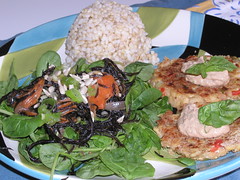
The new cookbook from Eric and Sanae (Love, Eric and Sanae) has some really yummy looking food in it, so this was an additional recipe that I experimented with over the weekend. The topping is a sundried tomato and basil aioli sauce. I put my hijiki dish over fresh tatsoi from the Saturday Farmer's Market at Kapi'olani Community College drizzled with some shiitake vinaigrette.
cinnamon rolls
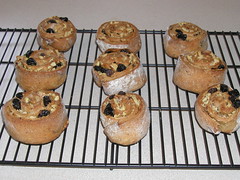
So the raisins I had sitting on my counter fermented into this bubbly stuff. Very fascinating to watch!! I kneaded the dough and let it rise overnight, but it may have needed a warmer spot so that it could have risen a bit more. I also forgot to add the cinnamon (ha ha) and may have left them in the oven a pinch too long, but they still tasted good. It's always good to try something new and then next time around, I will make them better!
Thursday, September 13, 2007
Trying some fermentation
When I went to the KI this summer, I finally purchased this great book about fermenting (Wild Fermentation I think it's called) that everyone raves about, with recipes for things like honey wine, kimchee, amazake, and much more. I also received this amazing book called Macrobiotic Breads and Sweets as a gift from a Japanese friend last summer that I decided to finally delve into. Deco Nakajima, the author, provides the recipes in English as well as Japanese, and many of the breads are started with traditional starters. So I have a bottle of raisins and water sitting on my counter that I open once a day for 2 to 4 days, and then I will make it either into a raisin loaf (hard crusty bread baked in the oven with a brick) or perhaps some azuki bean and raisin cinnamon rolls. We'll see. I'm excited to try these new methods that I've not yet explored. Hopefully, I can post a picture if it's successful!! There is also a recipe for mugwort and azuki bean bagles. That sounds soooo good. Not sure where to buy powdered mugwort around Hawaii though.
Tuesday, September 11, 2007
plum perfect
I was messing around with new recipes and this was the result. I spiced it with cinnamon, nutmeg, and cloves. YUMMY! It was delicious for breakfast.

Saturday, August 25, 2007
Butterflies on the echinacea
When I was looking at all the flowers on the Kushi Institute grounds, I was amazed to see the butterflies on the echinacea. Sometimes, nature just grabs you and doesn't let you go, holding you in her mystery. I love that feeling of wonder and how such simple pleasures tug on your heart and make you feel so happy to be alive.

Flowers at the KI
When you arrive at the grounds of the Kushi Institute, you see all the summer flowers in bloom. Living in Hawaii, we don't get to see all these varieties, and it made me feel nostalgic for growing up in Idaho.

Lunch at the KI
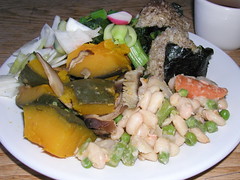
Before I left the KI for the Summer Conference, I managed to take a photo of one of the meals that was very yummy. This was a white bean salad, nishime kabocha squash, brown rice onigiri, greens, and some fantastic pickles. Their home made pickles there totally rocked my world.
Tuesday, July 31, 2007
Breakfast with Sanae
On this final morning before heading off to get ready for the summer conference, I had a wonderfully simple and satisfying breakfast of brown rice and quinoa hot cereal, greens, apple sauce and miso soup. I shared the table with Sanae (of the incredible cookbooks Love, Eric and Love, Eric and Sanae) and heard about her retreat that they do in Yosemite. I'm planning to check it out. She's the sweetest person!! Her husband, Eric, sometimes cooks for Sting and Madonna. They also have a cafe in their home on an occasional basis (once a week, or once a month?? I forgot what she said) where they prepare the meal for people and eat by candlelight as a way to protect the environment. I'll post their website info soon so people can go and look at it.
Monday, July 30, 2007
Greetings from the Kushi Institute
I have been up at the KI now for a few days enjoying a little bit of R and R before the summer conference begins. I'm getting lots of rest, eating 3 gorgeous meals a day, going for walks through the forested roads, taking in the fresh mtn air, and trying to do yoga when I can. Level 4 is going on, and I do wish I could take this level while here!
Tonight's dinner was marinated tempeh with carrot sauce, hijiki with sauteed onions, greens, two types of homemade daikon pickles, and a brown rice salad with vegetables. It was so satisying.
I'll be off to set up for the conference on Tuesday and to check out the Boston area. Hopefully I can post pictures of some things soon.
Tonight's dinner was marinated tempeh with carrot sauce, hijiki with sauteed onions, greens, two types of homemade daikon pickles, and a brown rice salad with vegetables. It was so satisying.
I'll be off to set up for the conference on Tuesday and to check out the Boston area. Hopefully I can post pictures of some things soon.
Monday, July 23, 2007

Tuesday, July 17, 2007
Bharadvajasana 1
Yoga students Sarah Myhre, left, and Leslie Ashburn show Bharadvajasana 1, Stage 1.
(Pose Dedicated to a Sage) » This sitting twist relieves lower back pain and increases the spine's suppleness. Regular practice helps tone the kidneys and increases the range of movement in the shoulders. Here, we present the first stage of the pose. People who are unable to sit on the floor can do the chair twists we have shown in earlier exercises.
1. Sit on the floor with the legs straight (dandasana).
2. Fold your legs to the left with the front of your left ankle resting in the arch of the right foot.
3. Keep your knees close to each other and sit the left buttock on the right heel. If your pelvis tilts down to the right, raise the right buttock on a folded blanket or two. The pelvis should be level.
4. Keeping your buttocks down, lift your trunk as you inhale, then exhale and turn to the right. Hold your right knee with your left hand and take the right hand onto the floor behind your left buttock.
5. Use your arms to help you turn your trunk to the right. Use the breath. As you inhale, lift your trunk, exhale and turn. Keep your chest open and your shoulder blades down and into the back. Gaze over your right shoulder. Stay for up to a minute then return to the center. Straighten your legs and repeat to the other side, reversing the directions.
Ray Madigan and Shelley Choy are certified Iyengar Yoga teachers and co-direct the Manoa Yoga Center at Manoa Marketplace. Visit www.manoayoga.com or call 382-3910. Manoa Yoga Center, the authors, and the Star-Bulletin take no responsibility for any injury arising from the practice of these yoga postures. Readers should seek a doctor's approval before commencing this yoga practice.
starbulletin.com/2007/07/15/features/yoga.html

(Pose Dedicated to a Sage) » This sitting twist relieves lower back pain and increases the spine's suppleness. Regular practice helps tone the kidneys and increases the range of movement in the shoulders. Here, we present the first stage of the pose. People who are unable to sit on the floor can do the chair twists we have shown in earlier exercises.
1. Sit on the floor with the legs straight (dandasana).
2. Fold your legs to the left with the front of your left ankle resting in the arch of the right foot.
3. Keep your knees close to each other and sit the left buttock on the right heel. If your pelvis tilts down to the right, raise the right buttock on a folded blanket or two. The pelvis should be level.
4. Keeping your buttocks down, lift your trunk as you inhale, then exhale and turn to the right. Hold your right knee with your left hand and take the right hand onto the floor behind your left buttock.
5. Use your arms to help you turn your trunk to the right. Use the breath. As you inhale, lift your trunk, exhale and turn. Keep your chest open and your shoulder blades down and into the back. Gaze over your right shoulder. Stay for up to a minute then return to the center. Straighten your legs and repeat to the other side, reversing the directions.
Ray Madigan and Shelley Choy are certified Iyengar Yoga teachers and co-direct the Manoa Yoga Center at Manoa Marketplace. Visit www.manoayoga.com or call 382-3910. Manoa Yoga Center, the authors, and the Star-Bulletin take no responsibility for any injury arising from the practice of these yoga postures. Readers should seek a doctor's approval before commencing this yoga practice.
starbulletin.com/2007/07/15/features/yoga.html
Thursday, July 12, 2007
Fertility and Diet
Low-Fat Dairy Products Linked to Increased Infertility Risk
A new study found low-fat dairy product consumption is linked to an increased risk of infertility. A total of 18,555 premenopausal women from the Nurses’ Health Study II who attempted a
pregnancy or became pregnant between 1991 and 1999 were evaluated for the association between dairy products and infertility. Women who consumed two or more servings per day of low-fat dairy products had 1.85 times the risk for infertility. While total dairy product intake
was not associated with an increased risk of infertility, the majority of fat in dairy products is saturated fat, which is linked to increased cholesterol, insulin resistance, overweight and obesity, and other health problems.
Chavarro JE, Rich-Edwards JW, Rosner B, Willet WC. A prospective study of dairy foods intake and anovulatory infertility. Hum Reprod. 2007;22(5):1340-1347.
Meat-Eating Moms Have Less-Fertile Sons
A new study in Human Reproduction finds that a pregnant woman’s meat consumption can reduce her future son’s sperm count. Researchers at the University of Rochester in New York analyzed the relationship between various sperm parameters of 387 men and the eating
habits of their mothers from the Study for Future Families. The more beef a mother consumed, the lower her son’s sperm concentration. Sperm count was 24 percent higher in men whose mothers consumed less beef. The difference may be due to steroid hormones found in animal products. Six hormones are commonly used in the United States to induce increased growth and development in cows, and measurable levels are routinely present in the animals’ muscle,
fat, liver, kidneys, and other organs. Cattle raised without extra hormones still have significant hormone levels in their tissues because of endogenous hormone production, and the nutrient profile of animal products tends to elevate hormone levels in the human body.
Swan SH, Liu F, Overstreet JW, Brazil C, Skakkebaek NE. Semen quality of fertile US males in relation to their mothers’ beef consumption during pregnancy. Hum Reprod. Advance access published on March 28, 2007
A new study found low-fat dairy product consumption is linked to an increased risk of infertility. A total of 18,555 premenopausal women from the Nurses’ Health Study II who attempted a
pregnancy or became pregnant between 1991 and 1999 were evaluated for the association between dairy products and infertility. Women who consumed two or more servings per day of low-fat dairy products had 1.85 times the risk for infertility. While total dairy product intake
was not associated with an increased risk of infertility, the majority of fat in dairy products is saturated fat, which is linked to increased cholesterol, insulin resistance, overweight and obesity, and other health problems.
Chavarro JE, Rich-Edwards JW, Rosner B, Willet WC. A prospective study of dairy foods intake and anovulatory infertility. Hum Reprod. 2007;22(5):1340-1347.
Meat-Eating Moms Have Less-Fertile Sons
A new study in Human Reproduction finds that a pregnant woman’s meat consumption can reduce her future son’s sperm count. Researchers at the University of Rochester in New York analyzed the relationship between various sperm parameters of 387 men and the eating
habits of their mothers from the Study for Future Families. The more beef a mother consumed, the lower her son’s sperm concentration. Sperm count was 24 percent higher in men whose mothers consumed less beef. The difference may be due to steroid hormones found in animal products. Six hormones are commonly used in the United States to induce increased growth and development in cows, and measurable levels are routinely present in the animals’ muscle,
fat, liver, kidneys, and other organs. Cattle raised without extra hormones still have significant hormone levels in their tissues because of endogenous hormone production, and the nutrient profile of animal products tends to elevate hormone levels in the human body.
Swan SH, Liu F, Overstreet JW, Brazil C, Skakkebaek NE. Semen quality of fertile US males in relation to their mothers’ beef consumption during pregnancy. Hum Reprod. Advance access published on March 28, 2007
Friday, July 06, 2007
Benefits of Sea Vegetables
Sea vegetables are virtually fat-free, low calorie and one of the richest sources of minerals in the vegetable kingdom as they have ready access to the abundance of minerals found in the ocean. Sea water and human blood contain many of the same minerals in very similar concentrations. Sea vegetables contain high amounts of calcium and phosphorous and are extremely high in magnesium, iron, iodine and sodium. One of seaweed's most prominent health benefits is its ability to remove radioactive substances and other heavy metals from our bodies. Components of the sea vegetables bind with the toxins in the intestines rendering them indigestible and carry them out of the system. Nori is exceptionally high in vitamin A and protein. Types of sea vegetables include arame, hijiki, agar-agar, wakame, kombu, nori, sea palm, and dulse.
Thursday, July 05, 2007
yoga weekend
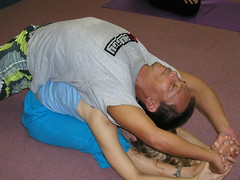
spent this past weekend doing a yoga workshop at Manoa Yoga taught by John Leebold from Australia. It was really fun, and I'm a bit sore! Good challenge.
Tuesday, July 03, 2007

Tuesday, June 05, 2007
The baby making grain
Quinoa (pronounced keen-wa) is an amino acid-rich (protein) seed that has a fluffy, creamy, slightly crunchy texture and a somewhat nutty flavor when cooked. Quinoa is available in your local health food stores throughout the year. Most commonly considered a grain, quinoa is actually a relative of leafy green vegetables like spinach and Swiss chard. It is a recently rediscovered ancient "grain" once considered "the gold of the Incas." Not only is quinoa high in protein, but the protein it supplies is complete protein, meaning that it includes all nine essential amino acids. Quinoa's amino acid profile well-balanced, making it a good choice for vegans concerned about adequate protein intake. Quinoa is especially well-endowed with the amino acid lysine, which is essential for tissue growth and repair. In addition to protein, quinoa features a host of other health-building nutrients. Because it's a very good source of manganese as well as a good source of magnesium, iron, copper and phosphorous, this "grain" may be especially valuable for persons with migraine headaches, diabetes and atherosclerosis.
While teaching a cooking class about health and vitality about a year ago, this woman told me a GREAT story about her father who was in his 70's at the time this happened. They are Chilean, and the father was coming into the US. He had just fathered a baby and was trying to bring the baby with him into the US, but Customs denied permission saying he couldn't possibly be the father due to his age. He told them, "I am not like Americans. I do not eat hamburgers. I'm from CHILE. We eat QUINOA!"
While teaching a cooking class about health and vitality about a year ago, this woman told me a GREAT story about her father who was in his 70's at the time this happened. They are Chilean, and the father was coming into the US. He had just fathered a baby and was trying to bring the baby with him into the US, but Customs denied permission saying he couldn't possibly be the father due to his age. He told them, "I am not like Americans. I do not eat hamburgers. I'm from CHILE. We eat QUINOA!"
Monday, June 04, 2007
The Four Directions
My expression of gratitude goes out to SM at Rainbow Healing Hawaii for a reminder about the Great Spirit. The practice below is something that I will enjoy incorporating more of in my life.
When a Native American prays to the four directions, it is a prayer to the spirits of the world, to life and the Great Spirit that encompasses the four directions and everything that is. The Medicine Wheel is a symbol that incorporates the four directions. Its spokes point east, south, west, and north. The four quarters are colored red, yellow, black, and white representing the races of man, the seasons, and the stages of life from childhood to old age. The circle is the earth, the moon and the planets. It is the circle of life and all creation.
The simplicity of the symbol is profound. It is four directions. One could divide the world into 8 points of a compass, 360 degrees, or an infinite number of directions, but four is perfect. We humans KNOW four directions. We see forward, but not back, and facing forward we have two sides. Four directions are part of our biology and our psychology. They are archetypes of the highest order. As such they are powerful carriers of symbolic meaning.
Native American traditions may vary somewhat in the terms they use to describe the meaning of the four directions, but the sources of the meaning are the same.
East is where the sun rises. The eastern spirit of sun or fire brings warmth and light. It is the place of beginnings. Its light brings wisdom. It is the power of knowledge.
South is the sun at its highest point. It is the direction from where warm winds blow. South is the spirit of earth, the power of life. It represents peace and renewal.
West is the spirit of water. It is the direction from which darkness comes. It is the power of change, the place of dreams, introspection and the unknown. The west signifies purity and strength.
North is the spirit of wind. The cold wind blows from the north. It is the power of wisdom. Here we take time to reflect on what we began in the east, in the morning, in our youth.
Practice:
Take time to make the world your sacred place. Stand in the middle of the circle of life and give thanks to the four directions. Take your time and attune to the spirit and power of each direction. Look at the gifts each direction gives you. Learn and appreciate the symbols for each direction, but then move out of the abstraction of the symbols and make it personal. Deepen your relationship with the four directions and with the whole of life they form together.Face east and give thanks for the warmth of the sun and the coming new day. Pray for the power of knowledge.
Face south and give thanks for the gift of life on this moist earth. Pray for the power to grow. Pray for peace in the world.
Face west and give thanks for the water of life. Pray for purity and strength. Pray for self understanding.
Face north and give thanks for the great white cleansing wind. Pray for the wisdom of experience.
from http://www.interluderetreat.com/meditate/4direct.htm
The Seven Types of Chewing
Sometimes people ask about how many times you should chew your food, especially when you're dining with others... The following information comes from Chewing Made Easy: 42 Benefits, Tips, and Techniques by Alex and Gale Jack
1. Basic Situation in the home, office, restaurant, in conversation = 25-50 chews per mouthful
2. Party in a restaurant, club, stadium, with loud noise = 0 to 60
3. Travel in a plane, car, train with conversation going on around or high decibel noise = 25-50
4. Medicinal at home, in a medical center, or other where it's silent or semi-conversational = 50-100
5. Ecological in a natural setting, especially with other socially aware people eating plant-quality foods = 50-100
6. Spiritual where you are alone or with others; silent or semi-conversational = 100 to 300+
7. Free in any and all situations and noise levels = less than 25 to a thousand or more
1. Basic Situation in the home, office, restaurant, in conversation = 25-50 chews per mouthful
2. Party in a restaurant, club, stadium, with loud noise = 0 to 60
3. Travel in a plane, car, train with conversation going on around or high decibel noise = 25-50
4. Medicinal at home, in a medical center, or other where it's silent or semi-conversational = 50-100
5. Ecological in a natural setting, especially with other socially aware people eating plant-quality foods = 50-100
6. Spiritual where you are alone or with others; silent or semi-conversational = 100 to 300+
7. Free in any and all situations and noise levels = less than 25 to a thousand or more
Sunday, February 04, 2007
Friday, January 12, 2007
Maximize Daily Bliss
1. Commit acts of kindness
Plan 5 things you can do everyday for another person. Let someone merge in front of you a the freeway, for example.
2. Cultivate gratitude.
a)Think about 3 things that went well today and why.
b) Write a thank you letterto the people who have made a difference in your life
3. See your life in 10 years as being the best possible life you can imagine.
4. Maintain strong relationships with others
Find things that you appreciate about others, even when they might make you frustrated
5. See the good side of life
There are always at least two ways to see a situation. When you start to feel angry, frustrated, impatient, etc., try to find something good out of whatever is going on.
Plan 5 things you can do everyday for another person. Let someone merge in front of you a the freeway, for example.
2. Cultivate gratitude.
a)Think about 3 things that went well today and why.
b) Write a thank you letterto the people who have made a difference in your life
3. See your life in 10 years as being the best possible life you can imagine.
4. Maintain strong relationships with others
Find things that you appreciate about others, even when they might make you frustrated
5. See the good side of life
There are always at least two ways to see a situation. When you start to feel angry, frustrated, impatient, etc., try to find something good out of whatever is going on.
Monday, January 08, 2007
Effects of extreme foods on the body
Fat and Cholesterol (hamburgers, pizza, fried foods, dairy products, meat, eggs, snack foods)
Hard body, inflexible, clog blood vessels, and inhibit body functions. Skin looks tired, pores get blocked, and we look dull, can’t take in moisture, or release toxins. Get dry, dead cells, scaly shins, heels, elbows, lines between the brows, dark circles under the eyes, tight, dry skin, oily skin.
Sugar including maple syrup, high fructose corn syrup, fructose, sucrose, molasses, honey, organic cane juice, turbinado, brown sugar, white sugar, white flour, white rice, potatoes (think of candies, chocolates, soft drinks, snack foods, bread, pasta, cereal, salad dressing, sauces, and other processed foods)
Highs and lows in blood sugar, affecting energy levels and moods. Stresses adrenal glands, and over time, wears us down. It steals essential minerals from bones, teeth, and skin. Causes skin discoloration (red, broken capillaries, freckles, age spots). We get puffy and weak, overweight and lethargic.
Salt including processed, refined, in potato chips, popcorn, nuts, processed foods and meats.
When using sodium chloride, or natural, unprocessed, sun dried sea salt, traditionally processed miso, or tamari in small amounts it is beneficial to the body. However, the other types cause tightening and constriction, inhibiting blood flow to the organs. We grow stiff and hard. Our skin dries and wrinkles, bones degenerate, growing brittle, and we are then unable to stand straight and tall.
Liquid including too much water, coffee, tea, soft drinks, fruit juices, alcohol.
Expands or loosens the body, weakening us. Overworks the heart, kidneys, bladder, and
sweat glands. Gives us a ‘washed out’ look, as well as loose skin. We grow flaccid, get
puffy, get wrinkles in the forehead and under the eyes, or instead, puffy bags. Avoid
eating too much dry foods, animal protein and fat, sweets, salt, and baked foods.
Hard body, inflexible, clog blood vessels, and inhibit body functions. Skin looks tired, pores get blocked, and we look dull, can’t take in moisture, or release toxins. Get dry, dead cells, scaly shins, heels, elbows, lines between the brows, dark circles under the eyes, tight, dry skin, oily skin.
Sugar including maple syrup, high fructose corn syrup, fructose, sucrose, molasses, honey, organic cane juice, turbinado, brown sugar, white sugar, white flour, white rice, potatoes (think of candies, chocolates, soft drinks, snack foods, bread, pasta, cereal, salad dressing, sauces, and other processed foods)
Highs and lows in blood sugar, affecting energy levels and moods. Stresses adrenal glands, and over time, wears us down. It steals essential minerals from bones, teeth, and skin. Causes skin discoloration (red, broken capillaries, freckles, age spots). We get puffy and weak, overweight and lethargic.
Salt including processed, refined, in potato chips, popcorn, nuts, processed foods and meats.
When using sodium chloride, or natural, unprocessed, sun dried sea salt, traditionally processed miso, or tamari in small amounts it is beneficial to the body. However, the other types cause tightening and constriction, inhibiting blood flow to the organs. We grow stiff and hard. Our skin dries and wrinkles, bones degenerate, growing brittle, and we are then unable to stand straight and tall.
Liquid including too much water, coffee, tea, soft drinks, fruit juices, alcohol.
Expands or loosens the body, weakening us. Overworks the heart, kidneys, bladder, and
sweat glands. Gives us a ‘washed out’ look, as well as loose skin. We grow flaccid, get
puffy, get wrinkles in the forehead and under the eyes, or instead, puffy bags. Avoid
eating too much dry foods, animal protein and fat, sweets, salt, and baked foods.
Urdhva Prasarita Padasana Part 1
Article URL: http://starbulletin.com/2006/10/29/features/yoga.html
© 19962006
The Honolulu StarBulletin
| www.starbulletin.com
Vol. 11, Issue 302 Sunday,
October 29, 2006
Yoga For You
Ray Madigan and Shelley Choy
Urdhva Prasarita Padasana
Stage 1 (Upward Expanded Leg Pose) » In this pose, the abdominal muscles are strengthened, and fat around the abdomen is reduced. The abdominal organs become toned and the back muscles are strengthened. This pose helps relieve gastric problems and flatulence.
1. Lie on the floor on your back with feet together and body straight.
2. Bend your knees and bring the feet close to the buttocks.
3. Use your hands to lengthen the buttock flesh toward the heels so the lower back feels long.
4. Stretch your arms overhead in line with the shoulders. Keep them straight and flat against the floor with your palms up. Stretch your arms so that your trunk is lengthened toward the arms.
5. Now, slowly extend the left heel along the floor, maintaining that stretch in the back until the leg is straight. Extend the other leg. Both legs should now be straight against the floor.
6. Stretch the arms and legs away from the body and feel the length in the trunk. Do not let your lower back arch.
7. Keep this stretch in the trunk as you bend your knees and take your thighs toward the abdomen. Do not lift your buttocks off the floor or allow your the back to round.
8. Now, keeping this extended spine, slowly straighten the legs until they are vertical.
9. To stretch the spine, extend the arms and press the leg bones away from the trunk. You should try and feel the same extension as you did when the legs were on the floor. Do not let the legs
move away from the vertical position.
10. Hold for up to 30 seconds without strain. To come out of the pose, bend the legs, folding the knees to the abdomen, then take your feet to the floor. Rest and repeat. With practice you will be
able to hold this pose in comfort, then you will be ready for Stage 2, which we will show next week.
Remember, do not let your face or eyes get tense while in this pose and breathe softly. Learn to focus on the symmetrical performance of the pose so that your mind becomes absorbed in the moment.
Ray Madigan and Shelley Choy are certified Iyengar Yoga teachers and codirect the Manoa Yoga Center at Manoa Marketplace. Visit www.manoayoga.com or call 3823910.
Manoa Yoga Center, the authors and the StarBulletin take no responsibility for any injury arising from the practice of these yoga postures. Readers should seek a doctor's approval before commencing this yoga practice.

© 19962006
The Honolulu StarBulletin
| www.starbulletin.com
Vol. 11, Issue 302 Sunday,
October 29, 2006
Yoga For You
Ray Madigan and Shelley Choy
Urdhva Prasarita Padasana
Stage 1 (Upward Expanded Leg Pose) » In this pose, the abdominal muscles are strengthened, and fat around the abdomen is reduced. The abdominal organs become toned and the back muscles are strengthened. This pose helps relieve gastric problems and flatulence.
1. Lie on the floor on your back with feet together and body straight.
2. Bend your knees and bring the feet close to the buttocks.
3. Use your hands to lengthen the buttock flesh toward the heels so the lower back feels long.
4. Stretch your arms overhead in line with the shoulders. Keep them straight and flat against the floor with your palms up. Stretch your arms so that your trunk is lengthened toward the arms.
5. Now, slowly extend the left heel along the floor, maintaining that stretch in the back until the leg is straight. Extend the other leg. Both legs should now be straight against the floor.
6. Stretch the arms and legs away from the body and feel the length in the trunk. Do not let your lower back arch.
7. Keep this stretch in the trunk as you bend your knees and take your thighs toward the abdomen. Do not lift your buttocks off the floor or allow your the back to round.
8. Now, keeping this extended spine, slowly straighten the legs until they are vertical.
9. To stretch the spine, extend the arms and press the leg bones away from the trunk. You should try and feel the same extension as you did when the legs were on the floor. Do not let the legs
move away from the vertical position.
10. Hold for up to 30 seconds without strain. To come out of the pose, bend the legs, folding the knees to the abdomen, then take your feet to the floor. Rest and repeat. With practice you will be
able to hold this pose in comfort, then you will be ready for Stage 2, which we will show next week.
Remember, do not let your face or eyes get tense while in this pose and breathe softly. Learn to focus on the symmetrical performance of the pose so that your mind becomes absorbed in the moment.
Ray Madigan and Shelley Choy are certified Iyengar Yoga teachers and codirect the Manoa Yoga Center at Manoa Marketplace. Visit www.manoayoga.com or call 3823910.
Manoa Yoga Center, the authors and the StarBulletin take no responsibility for any injury arising from the practice of these yoga postures. Readers should seek a doctor's approval before commencing this yoga practice.
Urdhva Prasarita Padasana Part 2

Article URL: http://starbulletin.com/2006/11/05/features/yoga.html
© 19962006
The Honolulu StarBulletin
www.starbulletin.com
Vol. 11, Issue 309 Sunday,
November 5, 2006
Yoga For You
Ray Madigan and Shelley Choy
Urdhva Prasarita Padasana
Upward Expanded Leg Pose, Stage 2 »
Last week we presented the first stage of this pose, in
which the legs are held up vertically with the trunk long and extended. In Stage 2, the legs are
taken lower and the effects are greater. In this pose, the abdominal muscles are strengthened
and fat around the abdomen is reduced. The abdominal organs become toned and the back
muscles are strengthened. Urdhva Prasarita Padasana helps relieve gastric problems and
flatulence.
1. Lie on the floor on your back with the feet together and body straight.
2. Come into Stage 1 of Urdhva Prasarita Padasana. Hold your legs tightly with the thigh
muscles. Keeping your legs straight and vertical, stretch your legs and arms away from each
other to extend the trunk. Roll your outer thighs inward so your kneecaps face directly toward
you.
3. As you stay here, observe as the action of your arms and legs create the feeling of expansion
in the trunk, bringing your lower back closer to the floor. If the lower back arches, extend your
arms and legs with equal effort to lengthen the back and take out the arch.
4. Keep this extension in the trunk by stretching arms and legs as you lower your legs 30 degrees toward the floor. Lower your legs by pushing out through the heels, maintaining firmness in your thigh muscles. Continue to roll your outer thighs inward. Hold briefly, then bring your legs to a vertical position, bend your knees, place your feet on the floor and relax.
5. Repeat this sequence several times without losing the extension in your back. Keep your legs
tight and knees gripped. Keep your arms actively extending. Do not hold your breath or tighten
your face, but stay calm and breathe softly through your nose. Your mind should stay completely focused and quiet and absorbed in maintaining an even extension throughout the limbs and trunk. As you gain the ability to perform this pose without strain, you will become ready to take the legs to 60 degrees. Then lower the legs to just above the floor.
Ray Madigan and Shelley Choy are certified Iyengar Yoga teachers and codirect
the Manoa Yoga Center at Manoa Marketplace. Visit www.manoayoga.com or call 3823910.
Manoa Yoga Center, the authors and the StarBulletin take no responsibility for any injury arising from the practice of these yoga postures. Readers should seek a doctor's approval before commencing this yoga practice.
Monday, October 30, 2006
Party Tricks
http://www.yogajournal.com/dailyinsight/103006.html
You’ve may have heard the saying, "Calories don't count when you're with friends." That may be a wonderful reminder to let loose and have fun while you're visiting friends. Unfortunately, however, the calories, fat, and sugar you take in during that time count just as much as they do during your lonely digressions.
A little indulgence is natural at friendly gatherings and parties. But get carried away and you'll end up bloated, tired, and bummed-out. According to Ayurvedic principles, there's a physiological reason for this: When you eat in moderation, your body and mind are happy. But when you eat too much, you overwhelm your agni (digestive fire), creating chaos in your belly and inviting unpleasant imbalances such as gas, weight gain, and depression.
The key to making sure you're not eating too much in the company of friends—or anywhere else your attention is diverted—is to bring your awareness back to the task at hand, your food. As a rule of thumb, any time you're ready to sit down to eat, remove yourself from distractions. Turn off the television, step away from your computer, hang up the phone, or step away from your friends so you can really focus on what you're taking into your body. That way you'll be able to savor the flavors, and you'll be able to tell when you've had enough. When you're done, you can rejoin the party feeling nourished, but not weighed down.
An Ancient Cure for Modern Life
http://www.yogajournal.com/health/647_1.cfm?ctsrc=nldn
Choice Eats
http://www.yogajournal.com/health/2022_1.cfm?ctsrc=nldn
Eat, Drink, and Be Healthy
http://www.yogajournal.com/health/1925_1.cfm?ctsrc=nldn
Yoga Journal
You’ve may have heard the saying, "Calories don't count when you're with friends." That may be a wonderful reminder to let loose and have fun while you're visiting friends. Unfortunately, however, the calories, fat, and sugar you take in during that time count just as much as they do during your lonely digressions.
A little indulgence is natural at friendly gatherings and parties. But get carried away and you'll end up bloated, tired, and bummed-out. According to Ayurvedic principles, there's a physiological reason for this: When you eat in moderation, your body and mind are happy. But when you eat too much, you overwhelm your agni (digestive fire), creating chaos in your belly and inviting unpleasant imbalances such as gas, weight gain, and depression.
The key to making sure you're not eating too much in the company of friends—or anywhere else your attention is diverted—is to bring your awareness back to the task at hand, your food. As a rule of thumb, any time you're ready to sit down to eat, remove yourself from distractions. Turn off the television, step away from your computer, hang up the phone, or step away from your friends so you can really focus on what you're taking into your body. That way you'll be able to savor the flavors, and you'll be able to tell when you've had enough. When you're done, you can rejoin the party feeling nourished, but not weighed down.
An Ancient Cure for Modern Life
http://www.yogajournal.com/health/647_1.cfm?ctsrc=nldn
Choice Eats
http://www.yogajournal.com/health/2022_1.cfm?ctsrc=nldn
Eat, Drink, and Be Healthy
http://www.yogajournal.com/health/1925_1.cfm?ctsrc=nldn
Yoga Journal
Thursday, October 12, 2006
Macro Beauty Cutie!
Q: What is beauty?
A: Beauty is your birthright to be your best natural self (not covering up the truth with cosmetics or plastic surgery). Beauty reflects your day-to-day life, and when a person is in balance, it comes from deep within, radiating your deepest spiritual self. Beauty is being in harmony with nature.
Q: What creates your appearance from day to day?
A: Daily life, food choices, exercise, activity, environment, attitudes, emotions
Q: What factors most influence your beauty?
A: Clean air, water (drinking, bathing, cooking), sunlight, lush green vegetation, peaceful setting, and daily diet. Food creates your cells, muscles, tissues, and bodily fluids!
Q: What factors do you have control over? What can you do?
A: Follow some type of whole foods diet such as the Standard Macrobiotic Diet (see handouts), avoiding extreme foods in particular, live a healthier lifestyle, and do a body scrub daily, if possible.
Q: What tools are there for creating your beauty?
A: Balanced diet, exercise, daily grooming, natural body care, positive attitude
Check out the book Glow, by Christina Pirello, for more information and great recipes.
A: Beauty is your birthright to be your best natural self (not covering up the truth with cosmetics or plastic surgery). Beauty reflects your day-to-day life, and when a person is in balance, it comes from deep within, radiating your deepest spiritual self. Beauty is being in harmony with nature.
Q: What creates your appearance from day to day?
A: Daily life, food choices, exercise, activity, environment, attitudes, emotions
Q: What factors most influence your beauty?
A: Clean air, water (drinking, bathing, cooking), sunlight, lush green vegetation, peaceful setting, and daily diet. Food creates your cells, muscles, tissues, and bodily fluids!
Q: What factors do you have control over? What can you do?
A: Follow some type of whole foods diet such as the Standard Macrobiotic Diet (see handouts), avoiding extreme foods in particular, live a healthier lifestyle, and do a body scrub daily, if possible.
Q: What tools are there for creating your beauty?
A: Balanced diet, exercise, daily grooming, natural body care, positive attitude
Check out the book Glow, by Christina Pirello, for more information and great recipes.
check out this rare film clip
Chuck Berry, John Lennon, Yoko Ono make macrobiotic food
http://www.youtube.com/watch?v=1u63Q4pCfKg
http://www.youtube.com/watch?v=1u63Q4pCfKg
Tuesday, October 10, 2006
Think and Grow Rich, by Napoleon Hill
Self Confidence Formula
First. I know that I have the ability to achieve the object of my Definite Purpose in life; therefore, I DEMAND of myself persistent, continuous action toward its attainment, and I here and now promise to render such action.
Second. I realize that the dominating thoughts of my mind will eventually reproduce themselves in outward, physical action, and gradually transform themselves into physical reality; therefore, I will concentrate my thoughts for 30 minutes daily upon the task of thinking of the person I intend to become, thereby creating in my mind a clear mental picture of that person.
Third. I know that through the principle of autosuggestion that any desire that I persistently hold in my mind will eventually seek expression through some practical means of attaining the object back of it; therefore, I will devote ten minutes daily to demanding of myself the development of SELF-CONFIDENCE.
Fourth. I have clearly written down a description of my DEFINITE CHIEF AIM in life, and I will never stop trying until I shall have developed sufficient self-confidence for the attainment.
Fifth. I fully realize that no wealth or position can long endure unless built upon truth and justice; therefore, I will engage in no transaction that does not benefit all whom it affects. I will succeed by attracting to myself the forces I wish to use and the cooperation of other people. I will induce others to serve me because of my willingness to serve others. I will eliminate hatred, envy, jealousy, selfishness, and cynicism by developing love for all humanity – because I know that a negative attitude toward others can never bring me success. I will cause others to believe in me because I will believe in them and in myself.
Sixth. I will sign my name to this formula, commit it to memory, and repeat it aloud once a day, with full FAITH that it will gradually influence my THOUGHTS and ACTIONS so that I will become a self-reliant and successful person.
First. I know that I have the ability to achieve the object of my Definite Purpose in life; therefore, I DEMAND of myself persistent, continuous action toward its attainment, and I here and now promise to render such action.
Second. I realize that the dominating thoughts of my mind will eventually reproduce themselves in outward, physical action, and gradually transform themselves into physical reality; therefore, I will concentrate my thoughts for 30 minutes daily upon the task of thinking of the person I intend to become, thereby creating in my mind a clear mental picture of that person.
Third. I know that through the principle of autosuggestion that any desire that I persistently hold in my mind will eventually seek expression through some practical means of attaining the object back of it; therefore, I will devote ten minutes daily to demanding of myself the development of SELF-CONFIDENCE.
Fourth. I have clearly written down a description of my DEFINITE CHIEF AIM in life, and I will never stop trying until I shall have developed sufficient self-confidence for the attainment.
Fifth. I fully realize that no wealth or position can long endure unless built upon truth and justice; therefore, I will engage in no transaction that does not benefit all whom it affects. I will succeed by attracting to myself the forces I wish to use and the cooperation of other people. I will induce others to serve me because of my willingness to serve others. I will eliminate hatred, envy, jealousy, selfishness, and cynicism by developing love for all humanity – because I know that a negative attitude toward others can never bring me success. I will cause others to believe in me because I will believe in them and in myself.
Sixth. I will sign my name to this formula, commit it to memory, and repeat it aloud once a day, with full FAITH that it will gradually influence my THOUGHTS and ACTIONS so that I will become a self-reliant and successful person.
Friday, October 06, 2006
Rise and Shine
The starting point for your healthier lifestyle can be your breakfast. Your brain and body need healthy fuel to function efficiently. Eating a healthy breakfast has many benefits, such as increased energy and concentration.
Naturally, as the sun rises in the morning, so do you. Eating foods that contribute to that fresh, uplifting, energized time of day are the most beneficial. In contrast, loading your body with heavy, greasy, salty, and dry foods common in the Standard American Diet can create sluggishness and mental fogginess, as well as hunger and cravings as your body attempts to balance these extremes.
Enjoying warm, whole grain cereals made from tasty grains such as millet, brown rice, quinoa, or oatmeal, and a variety of lightly blanched or steamed vegetables in the morning, will start your day off right!
When I started eating vegetables in the morning, and stopped eating granola with soymilk, I was less hungry throughout the day, lost weight, and decreased symptoms such as bloating and gas (ICK!). Those were wonderful unexpected improvements in my own health.
On weekends, (especially in the fall) I enjoy a heartier breakfast, such as a tofu scramble and some kind of muffin recipe. The smell of muffins baking is so cozy.
Here is my recipe for the scramble:
Tofu Scramble
1 package firm tofu
1 carrot, diced
1 celery stalk, diced
1 onion, diced
1/2 cup organic corn
1/2 cup mushrooms
1 tsp sesame oil
shoyu
scallions, as garnish
Heat a frying pan and saute the vegetables in the following order: onion, carrot, mushroom, celery, corn. Crumble the tofu into the pan, add shoyu, cover, and simmer for about 5 minutes. Take off the lid and toss in some chopped scallions. If you'd like fresh scallions, sprinkle on top.
Vegetables can be varied according to your personal taste, and you might also want to top it with some kind of roasted seeds or nuts.
Naturally, as the sun rises in the morning, so do you. Eating foods that contribute to that fresh, uplifting, energized time of day are the most beneficial. In contrast, loading your body with heavy, greasy, salty, and dry foods common in the Standard American Diet can create sluggishness and mental fogginess, as well as hunger and cravings as your body attempts to balance these extremes.
Enjoying warm, whole grain cereals made from tasty grains such as millet, brown rice, quinoa, or oatmeal, and a variety of lightly blanched or steamed vegetables in the morning, will start your day off right!
When I started eating vegetables in the morning, and stopped eating granola with soymilk, I was less hungry throughout the day, lost weight, and decreased symptoms such as bloating and gas (ICK!). Those were wonderful unexpected improvements in my own health.
On weekends, (especially in the fall) I enjoy a heartier breakfast, such as a tofu scramble and some kind of muffin recipe. The smell of muffins baking is so cozy.
Here is my recipe for the scramble:
Tofu Scramble
1 package firm tofu
1 carrot, diced
1 celery stalk, diced
1 onion, diced
1/2 cup organic corn
1/2 cup mushrooms
1 tsp sesame oil
shoyu
scallions, as garnish
Heat a frying pan and saute the vegetables in the following order: onion, carrot, mushroom, celery, corn. Crumble the tofu into the pan, add shoyu, cover, and simmer for about 5 minutes. Take off the lid and toss in some chopped scallions. If you'd like fresh scallions, sprinkle on top.
Vegetables can be varied according to your personal taste, and you might also want to top it with some kind of roasted seeds or nuts.
Yoga Journal's Daily Insight
I thought this was interesting. Don't know if it's true or not.
Cured with Candy
Tutankhamen was buried with it to guard him from evil spirits in the underworld. Greek and Roman legionnaires chewed it to quench their thirst as they marched through the desert. Even the Kama Sutra recommended drinking it with milk and sugar as an aphrodisiac. Far from being an ancient nutritional fad, the root of Glycyrrhiza glabra—more widely known as licorice—remains one of today's most extensively used and scientifically investigated herbal substances.
Licorice has been shown to soothe bowel and kidney irritations, cleanse the colon, and strengthen the liver. It provides a mild laxative effect and expels mucous from the lungs, making it helpful in the treatment of bronchitis, laryngitis, and sore throats—especially when taken as a tea.
Learn more about the healing powers of licorice.
Come Clean
http://www.yogajournal.com/health/660_1.cfm?ctsrc=nldn
A Candy and a Cure
http://www.yogajournal.com/health/71_1.cfm?ctsrc=nldn
Cured with Candy
Tutankhamen was buried with it to guard him from evil spirits in the underworld. Greek and Roman legionnaires chewed it to quench their thirst as they marched through the desert. Even the Kama Sutra recommended drinking it with milk and sugar as an aphrodisiac. Far from being an ancient nutritional fad, the root of Glycyrrhiza glabra—more widely known as licorice—remains one of today's most extensively used and scientifically investigated herbal substances.
Licorice has been shown to soothe bowel and kidney irritations, cleanse the colon, and strengthen the liver. It provides a mild laxative effect and expels mucous from the lungs, making it helpful in the treatment of bronchitis, laryngitis, and sore throats—especially when taken as a tea.
Learn more about the healing powers of licorice.
Come Clean
http://www.yogajournal.com/health/660_1.cfm?ctsrc=nldn
A Candy and a Cure
http://www.yogajournal.com/health/71_1.cfm?ctsrc=nldn
Monday, August 14, 2006
Tumors Use ‘Hijacking’ Trick to Evade Attack by Immune Cells
The following release about gene activity pattern discovery was
sent to reporters under embargo on Wednesday. The embargo
lifted today:
Department of Health and Human Services
National Institutes of Health
National Cancer Institute
CONTACT:
NCI Media Relations Branch
(301) 496-6641
ncipressofficers@mail.nih.gov
Monday, August 14, 2006
5 pm EDT
Tumors Use ‘Hijacking’ Trick to Evade Attack by Immune Cells
Researchers have identified a potential mechanism by which tumors
in miceescape attack from antitumor immune cells. This escape is
facilitated when tumors produce a molecule called adenosine that
inactivates antitumor immune cells by binding to receptors on
their cell surfaces, the researchers found. Consequently, the
immune cells behave as though the tumors are normal tissue, and
an attack is averted. This research was conducted by scientists
at the National Cancer Institute (NCI) and the National Institute
of Allergy and Infectious Diseases (NIAID), both part of the
National Institutes of Health (NIH), and their collaborators.
Theresults are reported in the August 14, 2006, online issue of
Proceedings of the National Academy of Sciences*.
“This work may be complementary to efforts of cancer
immunologists who have developed many clever ways to improve the
development of antitumor T cells,” said NIH Director Elias A.
Zerhouni, M.D. “The cross-fertilization of research between the
field of immunology and cancer is a fruitful one that is paying
dividends with this new finding.”
“Tumors have hijacked a mechanism that evolved to protect
normal tissues from collateral damage that occurs when the body
mounts a defense against infection,” said lead researcher Misha
Sitkovsky, Ph.D., who until recently was at NIAID. Sitkovsky is
now at the New England Inflammation and Tissue Protection Institute,
a consortium at Northeastern University in Boston, Mass.
The findings extend research published in Nature in 2001 by
Sitkovsky and colleagues into the role of adenosine in regulating
inflammation. Inflammatory chemicals produced by the immune
system in response to infection or injury must eventually be
switched off so that excessive tissue damage can be avoided.
Sitkovsky and his colleagues have shown that one consequence of
inflammation -- a drop in oxygen levels in the inflamed
tissues -- triggers the release of adenosine from surrounding
cells and serves as atissue-protecting stop signal. This is because
when adenosine binds to so-called A2A adenosine receptors on
immune cells in the inflamed region, the production of
damaging inflammatory molecules is slowed.
In the new study, the researchers tested whether the same
mechanism protects cancerous tissues from antitumor T cells
by evaluating the effects of genetically deleting A2A adenosine
receptors in mice. The experiments showed that antitumor T cells
that lack A2A adenosine receptors can overcome tumor defenses and
eradicate tumor cells.
“We showed that if antitumor T cells do not express A2A
adenosine receptors due to a genetic deletion, then these antitumor
T cells can overcome adenosine-based tumor defense mechanisms.
As a result, the majority of these mice rejected their tumors and
survived significantly longer,” said co-researcher Scott Abrams,
Ph.D., of NCI’s Center for Cancer Research. By comparison, normal
mice that had antitumor T cells with intact A2A adenosine receptors
experienced uncontrolled tumor growth and died. Abrams added,
“These proof-of-concept experiments also raise the idea that this
type of tumor escape mechanism may serve as a target for
therapeutic intervention.”
To begin to explore that idea, the researchers pharmacologically
inactivated the A2A adenosine receptor using substances such as
caffeine and others to make antitumor T cells less susceptible
to inhibition by tumor-produced adenosine. The majority of mice
in these experiments had much better antitumor immune responses
and delayed tumor growth.
The genetic inactivation strategy was not effective in about 40
percent of the mice, however. The researchers suggest that one
reason may be the existence of other adenosine receptors in these
mice, and identifying these molecules will be a focus of future
research.
“Now we may be able to prevent a hostile tumor microenvironment
from inhibiting the antitumor T cells. I have been extremely
fascinated and puzzled by the paradoxical coexistence of tumors
and anti-tumor immune cells in the same cancer patient,” added
Sitkovsky. “I have been considering this contradiction for the
past 30 years.”
“Greater understanding of the tumor microenvironment and its
relationship to other cells in the body is not just enhancing
our knowledge of cancer; it could eventually lead to new treatments
and better ways to monitor those treatments,” said NCI Acting
Director John E. Niederhuber, M.D.
###
* Ohta A, Gorelik E, Ronchese F, Lukashev D, Prasad SJ, Wong MKK,
Huan X, Caldwell S, Liu K, Smith P, Chen JF, Jackson EK, Apasov S,
Abrams S, and Sitkovsky M. A2A adenosine receptor protects tumors
from anti-tumor T cells. PNAS. Online August 14, 2006.
The NIH -- The Nation's Medical Research Agency -- includes
27 Institutes and Centers and is a component of the U.S. Department
of Health and Human Services. It is the primary federal agency for
conducting and supporting basic, clinical and translational medical
research, and it investigates the causes, treatments, and cures
for both common and rare diseases. For more information about NIH
and its programs, visit www.nih.gov.
For more information about cancer, please visit the NCI Web site at
http://www.cancer.gov, or call NCI’s Cancer Information Service at
1-800-4-CANCER (1-800-422-6237).
NIAID supports basic and applied research to prevent, diagnose
and treat infectious diseases such as HIV/AIDS and other sexually
transmitted infections, influenza, tuberculosis, malaria and
illness from potential agents of bioterrorism. NIAID also supports
research on basic immunology, transplantation and immune-related
disorders, including autoimmune diseases, asthma and allergies.
sent to reporters under embargo on Wednesday. The embargo
lifted today:
Department of Health and Human Services
National Institutes of Health
National Cancer Institute
CONTACT:
NCI Media Relations Branch
(301) 496-6641
ncipressofficers@mail.nih.gov
Monday, August 14, 2006
5 pm EDT
Tumors Use ‘Hijacking’ Trick to Evade Attack by Immune Cells
Researchers have identified a potential mechanism by which tumors
in miceescape attack from antitumor immune cells. This escape is
facilitated when tumors produce a molecule called adenosine that
inactivates antitumor immune cells by binding to receptors on
their cell surfaces, the researchers found. Consequently, the
immune cells behave as though the tumors are normal tissue, and
an attack is averted. This research was conducted by scientists
at the National Cancer Institute (NCI) and the National Institute
of Allergy and Infectious Diseases (NIAID), both part of the
National Institutes of Health (NIH), and their collaborators.
Theresults are reported in the August 14, 2006, online issue of
Proceedings of the National Academy of Sciences*.
“This work may be complementary to efforts of cancer
immunologists who have developed many clever ways to improve the
development of antitumor T cells,” said NIH Director Elias A.
Zerhouni, M.D. “The cross-fertilization of research between the
field of immunology and cancer is a fruitful one that is paying
dividends with this new finding.”
“Tumors have hijacked a mechanism that evolved to protect
normal tissues from collateral damage that occurs when the body
mounts a defense against infection,” said lead researcher Misha
Sitkovsky, Ph.D., who until recently was at NIAID. Sitkovsky is
now at the New England Inflammation and Tissue Protection Institute,
a consortium at Northeastern University in Boston, Mass.
The findings extend research published in Nature in 2001 by
Sitkovsky and colleagues into the role of adenosine in regulating
inflammation. Inflammatory chemicals produced by the immune
system in response to infection or injury must eventually be
switched off so that excessive tissue damage can be avoided.
Sitkovsky and his colleagues have shown that one consequence of
inflammation -- a drop in oxygen levels in the inflamed
tissues -- triggers the release of adenosine from surrounding
cells and serves as atissue-protecting stop signal. This is because
when adenosine binds to so-called A2A adenosine receptors on
immune cells in the inflamed region, the production of
damaging inflammatory molecules is slowed.
In the new study, the researchers tested whether the same
mechanism protects cancerous tissues from antitumor T cells
by evaluating the effects of genetically deleting A2A adenosine
receptors in mice. The experiments showed that antitumor T cells
that lack A2A adenosine receptors can overcome tumor defenses and
eradicate tumor cells.
“We showed that if antitumor T cells do not express A2A
adenosine receptors due to a genetic deletion, then these antitumor
T cells can overcome adenosine-based tumor defense mechanisms.
As a result, the majority of these mice rejected their tumors and
survived significantly longer,” said co-researcher Scott Abrams,
Ph.D., of NCI’s Center for Cancer Research. By comparison, normal
mice that had antitumor T cells with intact A2A adenosine receptors
experienced uncontrolled tumor growth and died. Abrams added,
“These proof-of-concept experiments also raise the idea that this
type of tumor escape mechanism may serve as a target for
therapeutic intervention.”
To begin to explore that idea, the researchers pharmacologically
inactivated the A2A adenosine receptor using substances such as
caffeine and others to make antitumor T cells less susceptible
to inhibition by tumor-produced adenosine. The majority of mice
in these experiments had much better antitumor immune responses
and delayed tumor growth.
The genetic inactivation strategy was not effective in about 40
percent of the mice, however. The researchers suggest that one
reason may be the existence of other adenosine receptors in these
mice, and identifying these molecules will be a focus of future
research.
“Now we may be able to prevent a hostile tumor microenvironment
from inhibiting the antitumor T cells. I have been extremely
fascinated and puzzled by the paradoxical coexistence of tumors
and anti-tumor immune cells in the same cancer patient,” added
Sitkovsky. “I have been considering this contradiction for the
past 30 years.”
“Greater understanding of the tumor microenvironment and its
relationship to other cells in the body is not just enhancing
our knowledge of cancer; it could eventually lead to new treatments
and better ways to monitor those treatments,” said NCI Acting
Director John E. Niederhuber, M.D.
###
* Ohta A, Gorelik E, Ronchese F, Lukashev D, Prasad SJ, Wong MKK,
Huan X, Caldwell S, Liu K, Smith P, Chen JF, Jackson EK, Apasov S,
Abrams S, and Sitkovsky M. A2A adenosine receptor protects tumors
from anti-tumor T cells. PNAS. Online August 14, 2006.
The NIH -- The Nation's Medical Research Agency -- includes
27 Institutes and Centers and is a component of the U.S. Department
of Health and Human Services. It is the primary federal agency for
conducting and supporting basic, clinical and translational medical
research, and it investigates the causes, treatments, and cures
for both common and rare diseases. For more information about NIH
and its programs, visit www.nih.gov.
For more information about cancer, please visit the NCI Web site at
http://www.cancer.gov, or call NCI’s Cancer Information Service at
1-800-4-CANCER (1-800-422-6237).
NIAID supports basic and applied research to prevent, diagnose
and treat infectious diseases such as HIV/AIDS and other sexually
transmitted infections, influenza, tuberculosis, malaria and
illness from potential agents of bioterrorism. NIAID also supports
research on basic immunology, transplantation and immune-related
disorders, including autoimmune diseases, asthma and allergies.
Thursday, August 10, 2006
Dessert! Yum!
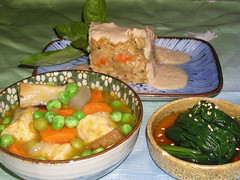
This picture shows a cous cous cake with a blueberry topping, a green tea mousse with an azuki bean topping and mochi dumplings, and a strawberry parfait with tofu whipped cream.


Recent meals
Here are some of the things I've cooked lately: red lentil loaf with sesame gravy, tempeh stew, and spinach ohitashi
Tuesday, August 08, 2006
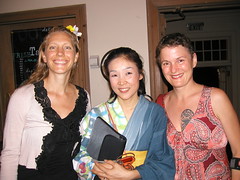
Leslie, Mie, and Reni
Reni and I got to see our respected teachers Mie and Hiroyuki Naka at the KI Summer Conference. Here's beautiful and talented Mie. Does she look about 16 years old? She's 43!
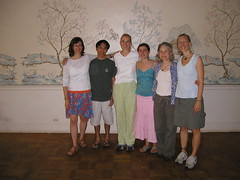
Reni, Leslie, Paige
I'm so lucky to have two such wonderful macrobiotic friends. Thanks, Reni, for coming to visit, and thanks, Paige, for all the time we worked together!

Cooking Class Team
Paige (left) and I (right) co-managed a team of 8 cooking class volunteers. These were a few of our great team members, Kevin, Ceri, Barbara, and Anita. They helped us a lot doing a really demanding job.
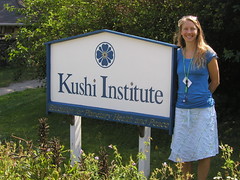
Leslie at the Kushi Institute in Becket
This was my first ever trip to the KI. I was super exhausted after a week of working 12 to 17 hour days non-stop as the KI Summer Conference Cooking Class Team Leader. The reason for going up was to help put away the cooking utensils and food from the 5-day conference. It was great to be in Becket and to finally see what the KI is like. The food is sooo yummy!
A message from the KI Summer Conference
“Macrobios Global”
spoken by Michio Kushi on 7/29/2006 at the Kushi Institute Summer Conference
Michio’s Goals
1) Health recovery in the next 2 years. His ascending colon was 98% blocked which caused a water control problem for him. Since they removed part of the upward colon, where it was attached to his small intestine and appendix, this has been causing trembling and weakness in his legs. Left untreated, his condition could have led to a heart attack. His B-12 synthesis has been reduced and sometimes he requires shots. In the next couple of years, he’ll remain on a reduced schedule and try to recover his health. He said he’s been getting better and better all the time.
2) He’d like a comprehensive book of “Macrobios Whole View” or infinity from beginning of time to the end
3) He’d like a World Macrobiotic Federation with about 100 senior macrobiotic leaders from all over the world. The goals of this WMF would be to:
a. have 2 – 3 days of special studies with group tours between countries
b. hold more international events
c. have the countries/centers do their events (e.g., summer conferences) at different times to enable people to attend everything
d. make borders obsolete
e. create a world Constitution (i.e., Declaration of Independence-like document) and present to current world leaders in 2 to 3 years.
4) He’d like the current form of energy to change or to have another Industrial Revolution. At the moment, we’re using too much energy, digging too many minerals and oil, and burning too much oil, causing extensive pollution. The additional developing countries are now adding to this pollution. We need to avoid more global warming, and he makes this a 10-year goal. We need a new energy source such as:
a. the energy of Earth’s rotation
b. the transmutation of atoms from the 8 light elements into heavier elements
5) We need to recognize our ultimate purpose of having a spiritual and peaceful human kind, and practice self-love and love towards others. Religion, in his estimation, is not making a definite contribution to peace. The focus should be removed from the physical and instead should be refocused on more developed spiritual and mental states. He estimates this will take approximately 2000 years to accomplish. Health should overcome violence, sickness, and conflict, creating a new civilization.
While Michio is still alive, he plans to teach more. One example of this would be to teach a new type of visual diagnosis. For example, currently, each part of the face represents a different organ. Another way to do this is to take the whole face to read each organ. Specifically, if you’re looking at a woman’s face and wanting to diagnose the reproductive system, the eyes represent the ovaries, and the area around the eye represents the fallopian tubes. The nose is the uterus, and just below the nose is the cervix, the lips the vagina, and around the mouth is the endometrium. Another example is the lungs; the right side of the face is the right lung, and the left side the left lung, respectively. He’d like to be able to teach several styles of visual diagnosis to us all.
He wants a teacher’s health curriculum.
He thanks everyone for the work they have been doing and though he may not remember names, he remembers faces.
spoken by Michio Kushi on 7/29/2006 at the Kushi Institute Summer Conference
Michio’s Goals
1) Health recovery in the next 2 years. His ascending colon was 98% blocked which caused a water control problem for him. Since they removed part of the upward colon, where it was attached to his small intestine and appendix, this has been causing trembling and weakness in his legs. Left untreated, his condition could have led to a heart attack. His B-12 synthesis has been reduced and sometimes he requires shots. In the next couple of years, he’ll remain on a reduced schedule and try to recover his health. He said he’s been getting better and better all the time.
2) He’d like a comprehensive book of “Macrobios Whole View” or infinity from beginning of time to the end
3) He’d like a World Macrobiotic Federation with about 100 senior macrobiotic leaders from all over the world. The goals of this WMF would be to:
a. have 2 – 3 days of special studies with group tours between countries
b. hold more international events
c. have the countries/centers do their events (e.g., summer conferences) at different times to enable people to attend everything
d. make borders obsolete
e. create a world Constitution (i.e., Declaration of Independence-like document) and present to current world leaders in 2 to 3 years.
4) He’d like the current form of energy to change or to have another Industrial Revolution. At the moment, we’re using too much energy, digging too many minerals and oil, and burning too much oil, causing extensive pollution. The additional developing countries are now adding to this pollution. We need to avoid more global warming, and he makes this a 10-year goal. We need a new energy source such as:
a. the energy of Earth’s rotation
b. the transmutation of atoms from the 8 light elements into heavier elements
5) We need to recognize our ultimate purpose of having a spiritual and peaceful human kind, and practice self-love and love towards others. Religion, in his estimation, is not making a definite contribution to peace. The focus should be removed from the physical and instead should be refocused on more developed spiritual and mental states. He estimates this will take approximately 2000 years to accomplish. Health should overcome violence, sickness, and conflict, creating a new civilization.
While Michio is still alive, he plans to teach more. One example of this would be to teach a new type of visual diagnosis. For example, currently, each part of the face represents a different organ. Another way to do this is to take the whole face to read each organ. Specifically, if you’re looking at a woman’s face and wanting to diagnose the reproductive system, the eyes represent the ovaries, and the area around the eye represents the fallopian tubes. The nose is the uterus, and just below the nose is the cervix, the lips the vagina, and around the mouth is the endometrium. Another example is the lungs; the right side of the face is the right lung, and the left side the left lung, respectively. He’d like to be able to teach several styles of visual diagnosis to us all.
He wants a teacher’s health curriculum.
He thanks everyone for the work they have been doing and though he may not remember names, he remembers faces.
Tuesday, June 27, 2006
An Inconvenient Truth
Roger Ebert, perhaps the country's premier movie reviewer,
said in his review of this film [An Inconvenient Truth]:
"In 39 years, I have never written these
words in a movie review, but here they are: You owe it to yourself to
see this film. If you do not, and you have grandchildren, you should
explain to them why you decided not to."
This is one of the most powerful and well-made movies to come along in a while. It's deeply profound and frightening to see what Al Gore presents. Please see this movie, and go to www.climatecrisis.net so that you can find out what you can do to reduce your carbon footprint on the earth.
Macrobiotic people are already doing some of these things, but we can always do more.
said in his review of this film [An Inconvenient Truth]:
"In 39 years, I have never written these
words in a movie review, but here they are: You owe it to yourself to
see this film. If you do not, and you have grandchildren, you should
explain to them why you decided not to."
This is one of the most powerful and well-made movies to come along in a while. It's deeply profound and frightening to see what Al Gore presents. Please see this movie, and go to www.climatecrisis.net so that you can find out what you can do to reduce your carbon footprint on the earth.
Macrobiotic people are already doing some of these things, but we can always do more.
Thursday, June 15, 2006
Macrobiotic "yajna": eco spirituality
Whenever I read my yoga magazines, I find so much overlap with what I learned in my macrobiotic studies. I loved this excerpt from Yoga International's March 2006 issue called Re-enchantment by Sandra Anderson. It said:
The Ritual of Life
"Yajna is ritual fire sacrifice on the one hand, but it's more general meaning is that which contributes to the beauty and well-being of creation. Yajna is that which sustains and nourishes the matrix of life. Swami Rama writes in his translation of the Bhagavad Gita, "In the universe, every action is a ritual, and the ritual is performed for the sake of sacrifice. The raindrop sacrifices itself to become part of the plant, the sun gives up its energy to give light and life to all beings." He was fond of saying "Giving is the law of the universe." Selfless actions, he would tell us, unconditional love, the offering of inner vitalities to the Lord of Life, working with less attachment to the outcome and more attention to our highest values -- these are yajnas."
Fragrant yajna offerings are burnt and the smoke ascends to the subtle realms "to nourish and propitiate the forces of nature. Acknowledging this interdependent matrix of life, the Bhagavad Gita says, "Beings are born from food; food is produced from the rain; rain is produced from sacrifice (yajna), and yajna arises from action." The actions of humans living in harmony with the environment nourish the atmosphere, keeping the rain in balance, and protecting the soil, plants, and entire food chain."
I feel good knowing that my dietary choices attempt to realign with nature and that somehow I am doing what I can to help nourish not just myself and the people that I cook for, but also the planet. Practicing macrobiotics is a form of yajna. I have a choice not to eat meat, dairy, sugar, and other extreme foods that would not only hurt my health, but in doing so also harm others.
The Ritual of Life
"Yajna is ritual fire sacrifice on the one hand, but it's more general meaning is that which contributes to the beauty and well-being of creation. Yajna is that which sustains and nourishes the matrix of life. Swami Rama writes in his translation of the Bhagavad Gita, "In the universe, every action is a ritual, and the ritual is performed for the sake of sacrifice. The raindrop sacrifices itself to become part of the plant, the sun gives up its energy to give light and life to all beings." He was fond of saying "Giving is the law of the universe." Selfless actions, he would tell us, unconditional love, the offering of inner vitalities to the Lord of Life, working with less attachment to the outcome and more attention to our highest values -- these are yajnas."
Fragrant yajna offerings are burnt and the smoke ascends to the subtle realms "to nourish and propitiate the forces of nature. Acknowledging this interdependent matrix of life, the Bhagavad Gita says, "Beings are born from food; food is produced from the rain; rain is produced from sacrifice (yajna), and yajna arises from action." The actions of humans living in harmony with the environment nourish the atmosphere, keeping the rain in balance, and protecting the soil, plants, and entire food chain."
I feel good knowing that my dietary choices attempt to realign with nature and that somehow I am doing what I can to help nourish not just myself and the people that I cook for, but also the planet. Practicing macrobiotics is a form of yajna. I have a choice not to eat meat, dairy, sugar, and other extreme foods that would not only hurt my health, but in doing so also harm others.
Monday, May 29, 2006
Quinoa, cranberry, and pecan pilaf
I LOVE quinoa. How did life get so far along without knowing about this? I tried it for the first time about 3 years ago. It's becoming more popular these days, and I often read about this being a good grain for people who want to lose weight because it's so high in protein so it's satisying and gives you energy. One of my students told me that her 70ish uncle fathered two children in his sunset years, and the US made him take a paternity test to enter the US. They thought he was lying, but he told them, "What do you think I eat? I'm not like Americans eating hamburgers. I'm CHILEAN. I eat QUINOA."
Grain pilafs with tart fruit, pungent green onions, crunchy nuts and veges, and a lemon dressing really turn me on!
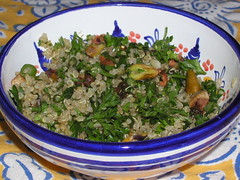
Grain pilafs with tart fruit, pungent green onions, crunchy nuts and veges, and a lemon dressing really turn me on!
Tempeh curry
I've been looking for macro things to make for non-macro people and this was one of the yummy ones. It's great with brown rice.

Delcious dinner
Let's see, what did we have...? It was lentil loaf, millet mashed potatoes and gravy, arame with apple juice, brown rice, and steamed carrots and squash. Yum!
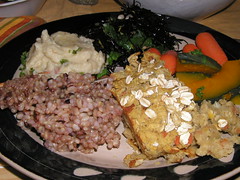
Azuki Bean Face Lift
If you read Macrobiotics Today, then you might have seen Ilanit Tof's recipe for the Azuki Bean Scrub. Well, I want to tell you that if you haven't tried it yet, you SHOULD. It's really amazing. I went out to buy a coffee grinder especially for this, and it was worth it. Your face feels super soft and even after doing it just once, it seems to improve you complexion. You can purchase Ilanit's entire full colour kitchen friendly book of great vegan macrobiotic healing recipes here:
https://littletree.securehost3.com/seasonal_variation.htm or at cybermacro.com
if you live in the USA
I purchased her book, and am excited to try the recipes :-)
Here's the azuki bean recipe:
Oriental Skin Polishing Pore Refresher
Ingredients
✓ ¼ - ½ cup raw adzuki beans
✓ 1 clean strong coffee bean grinder
Procedure
❦ Grind 1- 2 tablespoons of raw adzuki beans at a time
❦ If the grinder has a pulse mechanism you may like to use this
❦ Wait 20 - 30 seconds before opening lid to allow to settle and prevent a face-full of adzuki bean powder dust
❦ Place powder in an airtight glass jar
❦ Transfer several tablespoons into a small plastic container with a good seal for use in the bathroom/shower
Variations
• use chickpeas for a more moistening mix
Usage Suggestions
• mix with water to a paste after cleansing face
• use as a scrub and rinse off immediately (good for daily – 3 times a week use)
• or allow to remain on face until it dries and rinse off in the shower (use once a week and follow with a few drops of pure jojoba or rosehip oil on damp skin or leave skin bare overnight to rejuvenate and cleanse)
• can be used as a whole body scrub
All About Adzuki Beans
✱ Revered as an indispensable beauty aid both internally and externally in the Orient
✱ Powerfully rejuvenate the kidneys and heart when eaten or made into a kidney tonifying tea
✱ The bean’s astringent action is heightened in the raw state which is utilised in this pore refining treatment that will beat expensive lotions and potions hands down!
Ms Ilanit Tof
B.A. (Psychophysiology/Psychology)
Advanced Diploma Healing with Wholefoods
PhD Holistic Nutrition (candidate)
Little Tree Oriental Healing Arts
Helping you grow to new heights of wellbeing
with Oriental Traditions and Modern Nutrition
ilanit@littletree.com.au
www.littletree.com.au
https://littletree.securehost3.com/seasonal_variation.htm or at cybermacro.com
if you live in the USA
I purchased her book, and am excited to try the recipes :-)
Here's the azuki bean recipe:
Oriental Skin Polishing Pore Refresher
Ingredients
✓ ¼ - ½ cup raw adzuki beans
✓ 1 clean strong coffee bean grinder
Procedure
❦ Grind 1- 2 tablespoons of raw adzuki beans at a time
❦ If the grinder has a pulse mechanism you may like to use this
❦ Wait 20 - 30 seconds before opening lid to allow to settle and prevent a face-full of adzuki bean powder dust
❦ Place powder in an airtight glass jar
❦ Transfer several tablespoons into a small plastic container with a good seal for use in the bathroom/shower
Variations
• use chickpeas for a more moistening mix
Usage Suggestions
• mix with water to a paste after cleansing face
• use as a scrub and rinse off immediately (good for daily – 3 times a week use)
• or allow to remain on face until it dries and rinse off in the shower (use once a week and follow with a few drops of pure jojoba or rosehip oil on damp skin or leave skin bare overnight to rejuvenate and cleanse)
• can be used as a whole body scrub
All About Adzuki Beans
✱ Revered as an indispensable beauty aid both internally and externally in the Orient
✱ Powerfully rejuvenate the kidneys and heart when eaten or made into a kidney tonifying tea
✱ The bean’s astringent action is heightened in the raw state which is utilised in this pore refining treatment that will beat expensive lotions and potions hands down!
Ms Ilanit Tof
B.A. (Psychophysiology/Psychology)
Advanced Diploma Healing with Wholefoods
PhD Holistic Nutrition (candidate)
Little Tree Oriental Healing Arts
Helping you grow to new heights of wellbeing
with Oriental Traditions and Modern Nutrition
ilanit@littletree.com.au
www.littletree.com.au
Tuesday, May 02, 2006
Emotions in and out of balance
Healthy conditions of the liver and gallbladder are connected with patience and endurance, while unhealthy conditions produce short temper and anger
Healthy conditions of the heart and small intestine are connected with gentleness,
tranquility, intuitive comprehension, spiritual oneness, and merry, humorous expression, while unhealthy conditions produce separateness excitement, and excessive laughter
Healthy conditions of the spleen, pancreas, and stomach, are connected with sympathy
wisdom, consideration, and understanding, while unhealthy conditions produce irritability skepticism, criticism, and worry
Healthy conditions of the lungs and large intestine are connected with a feeling of happiness, security, and wholeness, while unhealthy conditions produce sadness, depression, and melancholy
Healthy conditions of the kidneys and bladder are connected with confidence, courage
and inspiration while their unhealthy conditions produce fear, lack of self- esteem, and hopelessness
Healthy conditions of the heart and small intestine are connected with gentleness,
tranquility, intuitive comprehension, spiritual oneness, and merry, humorous expression, while unhealthy conditions produce separateness excitement, and excessive laughter
Healthy conditions of the spleen, pancreas, and stomach, are connected with sympathy
wisdom, consideration, and understanding, while unhealthy conditions produce irritability skepticism, criticism, and worry
Healthy conditions of the lungs and large intestine are connected with a feeling of happiness, security, and wholeness, while unhealthy conditions produce sadness, depression, and melancholy
Healthy conditions of the kidneys and bladder are connected with confidence, courage
and inspiration while their unhealthy conditions produce fear, lack of self- esteem, and hopelessness
Thursday, March 16, 2006
Environmental and Health News
CONGRESS BLINDFOLDS CONSUMERS- REMOVING RIGHT TO KNOW WHAT'S IN YOUR FOOD
On March 8, despite massive public opposition, including 50,000 calls and letters from supporters of the Organic Consumers Association, the House of Representatives passed the controversial "national food uniformity" labeling law, which would eliminate over 200 state food safety labeling laws. The law basically takes away local government and states' power to require food safety labels such as those required in California and other states on foods or beverages that are likely to cause cancer, birth defects, allergic reactions, or mercury poisoning. The bill would also prevent local municipalities and states from passing laws requiring that genetically engineered foods and ingredients be labeled. Under the bill, hundreds of state laws and regulations would be eliminated, including those relating to the safety of milk, fish, and shellfish. In order to become law, the bill will now have to go to the Senate for a vote. Because of the enormous public backlash against the bill, Washington analysts believe the bill will have great difficulty passing in the Senate. OCA and other public interest organizations have vowed to go "all out" to stop this anti-democratic, anti-consumer bill in the Senate. Take action here: http://www.organicconsumers.org/rd/labeling.cfm
FACT OF THE WEEK
In the 2006 election cycle, big agribusiness has already given $14,562,681 in campaign contributions to members of Congress. Source: http://www.opensecrets.org/industries/indus.asp?Ind=A
__________________________________
U.S. VOTES AGAINST 132 NATIONS ON GENETICALLY ENGINEERED FOOD
Biotech corporations are facing off against developing nations and most of the world this week in Brazil in a debate over the United Nation's Biosafety Protocol. The precedent-setting treaty is an international agreement signed in January 2000 by 132 of the world's nations. But the three main countries that grow genetically modified crops (the United States, Argentina and Canada) refuse to sign it, because the international law would require that countries be notified if the grains they are importing are genetically modified. Biotech companies want that language removed from the treaty, saying that developing nations and anti-GMO consumers in industrialized nations are not entitled to know whether their food is genetically engineered or not.
http://www.organicconsumers.org/ge/goliath060313.cfm
CANCER CAUSING CHEMICAL FOUND IN SOME SOFT DRINKS
The U.S., U.K. and China have launched investigations into benzene in soft drinks. Results of independent laboratory tests in New York, show a couple of soft drinks in the U.S. contain as much as four times above the legal benzene limit for drinking water. Benzene, a known carcinogen, is formed when two ingredients in the beverage react with each other: sodium benzoate (a preservative) and ascorbic acid (vitamin C). The FDA will not released the names of the beverages with high benzene levels but says the companies are being asked to change their ingredients. http://www.organicconsumers.org/foodsafety/benzene060303.cfm
On March 8, despite massive public opposition, including 50,000 calls and letters from supporters of the Organic Consumers Association, the House of Representatives passed the controversial "national food uniformity" labeling law, which would eliminate over 200 state food safety labeling laws. The law basically takes away local government and states' power to require food safety labels such as those required in California and other states on foods or beverages that are likely to cause cancer, birth defects, allergic reactions, or mercury poisoning. The bill would also prevent local municipalities and states from passing laws requiring that genetically engineered foods and ingredients be labeled. Under the bill, hundreds of state laws and regulations would be eliminated, including those relating to the safety of milk, fish, and shellfish. In order to become law, the bill will now have to go to the Senate for a vote. Because of the enormous public backlash against the bill, Washington analysts believe the bill will have great difficulty passing in the Senate. OCA and other public interest organizations have vowed to go "all out" to stop this anti-democratic, anti-consumer bill in the Senate. Take action here: http://www.organicconsumers.org/rd/labeling.cfm
FACT OF THE WEEK
In the 2006 election cycle, big agribusiness has already given $14,562,681 in campaign contributions to members of Congress. Source: http://www.opensecrets.org/industries/indus.asp?Ind=A
__________________________________
U.S. VOTES AGAINST 132 NATIONS ON GENETICALLY ENGINEERED FOOD
Biotech corporations are facing off against developing nations and most of the world this week in Brazil in a debate over the United Nation's Biosafety Protocol. The precedent-setting treaty is an international agreement signed in January 2000 by 132 of the world's nations. But the three main countries that grow genetically modified crops (the United States, Argentina and Canada) refuse to sign it, because the international law would require that countries be notified if the grains they are importing are genetically modified. Biotech companies want that language removed from the treaty, saying that developing nations and anti-GMO consumers in industrialized nations are not entitled to know whether their food is genetically engineered or not.
http://www.organicconsumers.org/ge/goliath060313.cfm
CANCER CAUSING CHEMICAL FOUND IN SOME SOFT DRINKS
The U.S., U.K. and China have launched investigations into benzene in soft drinks. Results of independent laboratory tests in New York, show a couple of soft drinks in the U.S. contain as much as four times above the legal benzene limit for drinking water. Benzene, a known carcinogen, is formed when two ingredients in the beverage react with each other: sodium benzoate (a preservative) and ascorbic acid (vitamin C). The FDA will not released the names of the beverages with high benzene levels but says the companies are being asked to change their ingredients. http://www.organicconsumers.org/foodsafety/benzene060303.cfm
Wednesday, February 22, 2006
Emoto Party
Here are many of the people who attended the party the night that I got to meet Dr. Emoto. They are all invested in alternative health, healing, and spreading love and aloha in their own ways.

Sunday, February 12, 2006
Leslie and Dr. Emoto
I was so blessed to be able to meet Dr. Emoto when he was in Honolulu. We enjoyed a wonderful party at Dr. Sandra Rose Michael's house (check out her Energy Enhancement System based on scalar waves on the web) filled with healers from all over Hawaii, China, and Japan. It was thrilling to have him stamp my book "Messages From Water" with "Love and Two Parts Gratitude" in Japanese.
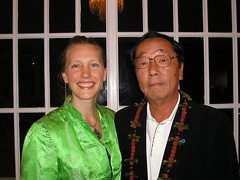
Tuesday, January 24, 2006
Macrobiotic Cooking for Relationships and Sex
The energies of earth's force (yin) and heaven's force (yang) naturally seek balance. When couples make love, they find oneness and balance. The degree or quality of each determines attraction, love, repulsion, or dislike. Learn about what foods create a smooth flow of energy through the body and contribute to healthy and vital partners creating soulful, mindful, and loving sex. You won't hear "Not tonight honey, I'm too tired" any more!
February 11th 2006 Kapiolani Community College, $45 808-734-9211
February 18th, 2006 University of Hawaii, Hemenway Leisure Center, Hemenway Hall Rm 101, 956-6468 $45 students, $50 community
February 11th 2006 Kapiolani Community College, $45 808-734-9211
February 18th, 2006 University of Hawaii, Hemenway Leisure Center, Hemenway Hall Rm 101, 956-6468 $45 students, $50 community
Veg News about American "choice"
From Jan/Feb Veg News
Big Vegan Business
another reason to avoid processed foods is that many vegan companies
have been bought out by mega corporations that have less than
stellar reputations. Here are a few examples that might surprise
you:
Lightlife:
owned by ConAgra who is one of the nations top beef producers. In
2002, the company recalled almost 19 million pounds of beef due to
potential E.coli contamination. Also ConAgra is the parent company
of numerous meat-containing brands including: Hebrew National Beef
Franks, Chef Boyardee, Butterball Turkey, Hunt's Manwich and Slim
Jim.
Cascadian Farms and Muir Glen
Owned by General Mills who makes many nutritionally-deficient
cereals aimed at children. Also, the company's main shareholders
include Phillip Morris, Exxon-Mobil, General Electric, Chevron,
Nike, McDondald's, Monsanto, Dow Chemical and PepsiCo
Boca owned by Kraft. Kraft is owned by Altria, formerly known as
Phillip Morris. Do you really wnat your food dollars supporting
such a notoriously deceptive tobacco company? Also, most Boca
burgers are made with genetically-modified soy.
Odwala owned by Coca-Cola is notorious for contaminating the water
supply in developing countries such as India. Coca-Cola has also
been implicated in the murder of labor activists in Colombia. If
that's not enough, the company hooks children on its sugary,
nutrionally deficient beverages by forming exclusive contracts with
desperate school districts.
White Wave (Silk soy products) owned by Dean Foods. Dean Foods is
one of the nation's largest dairy companies and makes several
misleading claims about the health benefits of dairy, including
extolling its weight-loss benefits. Also, Dean Foods' main
investors include Pfizer, Phillip Morris, Exxon-Mobil, Coca-Cola,
Wal-Mart and PepsiCo
Finally, quite a few vegan products are now under the umbrella group
called "The Hain Celestial Group" including Terra Chips, Garden of
Eatin' Health Vally, WestSoy, Earth's Best, Westbrae Natural,
Imagine (Soy and Rice Dream) and Yves Veggie Cuisine. H.J. Heinz
owns about 20% of Hain, and other investors include Phillip Morris,
Monsanto, Exxon-Mobil and Wal-Mart.
In contrast, when you purchase organic, locally grown whole foods,
you support your local markets and farmers, thereby contributing to
the health and wellbeing of yourself, the environment and the local
economy all at once.
Big Vegan Business
another reason to avoid processed foods is that many vegan companies
have been bought out by mega corporations that have less than
stellar reputations. Here are a few examples that might surprise
you:
Lightlife:
owned by ConAgra who is one of the nations top beef producers. In
2002, the company recalled almost 19 million pounds of beef due to
potential E.coli contamination. Also ConAgra is the parent company
of numerous meat-containing brands including: Hebrew National Beef
Franks, Chef Boyardee, Butterball Turkey, Hunt's Manwich and Slim
Jim.
Cascadian Farms and Muir Glen
Owned by General Mills who makes many nutritionally-deficient
cereals aimed at children. Also, the company's main shareholders
include Phillip Morris, Exxon-Mobil, General Electric, Chevron,
Nike, McDondald's, Monsanto, Dow Chemical and PepsiCo
Boca owned by Kraft. Kraft is owned by Altria, formerly known as
Phillip Morris. Do you really wnat your food dollars supporting
such a notoriously deceptive tobacco company? Also, most Boca
burgers are made with genetically-modified soy.
Odwala owned by Coca-Cola is notorious for contaminating the water
supply in developing countries such as India. Coca-Cola has also
been implicated in the murder of labor activists in Colombia. If
that's not enough, the company hooks children on its sugary,
nutrionally deficient beverages by forming exclusive contracts with
desperate school districts.
White Wave (Silk soy products) owned by Dean Foods. Dean Foods is
one of the nation's largest dairy companies and makes several
misleading claims about the health benefits of dairy, including
extolling its weight-loss benefits. Also, Dean Foods' main
investors include Pfizer, Phillip Morris, Exxon-Mobil, Coca-Cola,
Wal-Mart and PepsiCo
Finally, quite a few vegan products are now under the umbrella group
called "The Hain Celestial Group" including Terra Chips, Garden of
Eatin' Health Vally, WestSoy, Earth's Best, Westbrae Natural,
Imagine (Soy and Rice Dream) and Yves Veggie Cuisine. H.J. Heinz
owns about 20% of Hain, and other investors include Phillip Morris,
Monsanto, Exxon-Mobil and Wal-Mart.
In contrast, when you purchase organic, locally grown whole foods,
you support your local markets and farmers, thereby contributing to
the health and wellbeing of yourself, the environment and the local
economy all at once.
Tuesday, January 17, 2006
Macrobiotic Guilt-Free Dessert Class in Honolulu
Jan 21st, 2006
Guilt-Free Desserts
When we eat a good diet, we take the frontline to prevent disease, improve vitality, enjoy deeper sleep, support a healthy weight, and enable our brain to function smoothly. In short, we have a deep sense of well-being. Americans are reported to eat up to 20 teaspoons of sugar every day, and 150 pounds of sugar every year. Refined foods such as white flour and sugar in modern desserts take a tremendous toll on us. These simple sugars enter our bloodstream immediately and are metabolized quickly raising blood glucose levels and overworking our pancreas in an attempt to rebalance. Simple sugars equal quick energy followed by exhaustion. Whole grains support our health.
We'll discuss:
Effects of sugar and refined foods on the body
Why we have sugar and fat cravings
How to promote good health
Standard Macrobiotic Diet – what is it?
Balancing yin and yang in our diet – avoiding extremes
We'll make:
Cous Cous Chocolate Cake
Chocolate Mousse Parfait
Apple Compote with Almond Cream Sauce.
University of Hawaii, Hemenway Leisure Center, Hemenway Hall Rm 111, 956-6468 $45 students, $50 community
Guilt-Free Desserts
When we eat a good diet, we take the frontline to prevent disease, improve vitality, enjoy deeper sleep, support a healthy weight, and enable our brain to function smoothly. In short, we have a deep sense of well-being. Americans are reported to eat up to 20 teaspoons of sugar every day, and 150 pounds of sugar every year. Refined foods such as white flour and sugar in modern desserts take a tremendous toll on us. These simple sugars enter our bloodstream immediately and are metabolized quickly raising blood glucose levels and overworking our pancreas in an attempt to rebalance. Simple sugars equal quick energy followed by exhaustion. Whole grains support our health.
We'll discuss:
Effects of sugar and refined foods on the body
Why we have sugar and fat cravings
How to promote good health
Standard Macrobiotic Diet – what is it?
Balancing yin and yang in our diet – avoiding extremes
We'll make:
Cous Cous Chocolate Cake
Chocolate Mousse Parfait
Apple Compote with Almond Cream Sauce.
University of Hawaii, Hemenway Leisure Center, Hemenway Hall Rm 111, 956-6468 $45 students, $50 community
Tuesday, January 10, 2006
Ura Ura Rolls from Macro Seminar
Look at these luscious brown rice sushi rolls! Our dinner was soooo delicious!
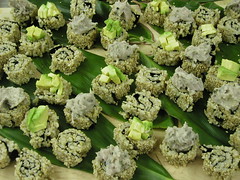
Krishna Das and Kirtan
On Dec. 17th, Krishna Das was in Honolulu. I've been reading about him in Yoga Journal, and was thrilled to find out about his being here. He does "kirtan" which is a sing and response type of chanting. Every time I've read about it, it sounds like the whole group connects and great levels of joy and meditation are reached. During one chant, I was overcome with emotion and started to cry. I looked around at everyone chanting, and saw in them the same desire I have: a peaceful and happy world. They all seemed to care about the future of the planet and the people on it. It was a great way to celebrate the holiday season. I felt relieved and resolved to be in a spiritual place for the holidays, rather than one in the material realm going to parties, drinking alcohol, and eating sweets. There are other more important things in the world to attend to.
Invisible worlds, friends and enemies
This weekend, Hiroyuki and Mie Naka were in Honolulu to do a seminar about macrobiotic cooking and they gave some amazing lectures as well. Hiroyuki was talking extensively about the invisible world. I'm still reflecting on their visit, their lectures, and my talks with them. Meanwhile, I've also just downloaded the current version of Macrobiotic Today, and Carl Ferre has a wonderful article in it about friends and enemies being examples of yin and yang. He replaces yin and yang with these two words and then explains them in some detail. Friends and enemies all originate from the same source: infinity, and are first nurtured in the invisible world before they manifest in the visible. I started again thinking about our invisible world and how a person can nuture it, if this is possible? Meditating? Praying? I put on a CD that my great friend Reni gave to me -- it has she and several friends chanting in a samurai shinto temple in the foothills of Fukuyama, Japan. It felt like she was sitting next to me in my car as I drove to work.... I got out, and as I walked to my destination, I could hear the same sound in my ears (om), as though it was coming from everywhere at once. I am resolved to thinking more about the invisible world and energy.
Interesting quote about $
I finished reading a book called "Secrets of the Millionaire Mind" by T Harv Eker. He's (not?) macrobiotic per say, but his text describes macrobiotic principles of energy in relation to money and business. It's an excellent read, with exercises to do. The point is that before something in one's life can change, one must change ones thoughts. Here is one tidbit:
If you want to change the fruits, you will first have to change the roots. If you want to change the visible, you must first change the invisible.
T Harv Eker
If you want to change the fruits, you will first have to change the roots. If you want to change the visible, you must first change the invisible.
T Harv Eker
Sunday, January 08, 2006
Macrobiotic Seminar
Our macrobiotic seminar was sooo much fun. The Naka's are really incredible people. We had so much support from the students, and Mie and Hiroyuki mentioned that all the students were all really nice people and very interested, so they were so happy. All the meals that we cooked were extremely delicious. We're looking forward to doing a lot more in the future, and they plan to come back every 6 months or so.
My mission
My mission is to make the world a better place in some way by teaching macrobiotic principles. I'd like to share a sense of hope with students and tools to achieve how the body and mind can heal without surgeries and drugs. In addition, I'd like to share that we can gain radiant health, beauty and well-being by changing our diets. Long term health is a daily journey integrating spiritual values, diet, and lifestyle. Changing one's diet can change one's life and destiny for the positive, helping us seek and discover the divinity and oneness within and to feel this in all facets of our lives and in the world around us. In doing so, we'll build a community in the Honolulu area sharing similar goals, values, and dreams.
Friday, December 16, 2005
Daily Insight
I was reading Yoga Journal's special daily insight. This seems true
not just of yoga, but also with one's macrobiotic practice too. It's
one thing I love about staying true to eating a healthy diet. If
you don't do yoga, just insert the word macrobiotics for yoga!
In much of conventional medicine, patients are passive recipients of
care. In yoga, it's what you do for yourself that matters. Yoga gives
you the tools to help you change, and you might start to feel better
the first time you try practicing. You may also notice that the more
you commit to practice, the more you benefit. This results in three
things: You get involved in your own care, you discover that your
involvement gives you the power to effect change, and seeing that you
can effect change gives you hope. And hope itself can be healing.
not just of yoga, but also with one's macrobiotic practice too. It's
one thing I love about staying true to eating a healthy diet. If
you don't do yoga, just insert the word macrobiotics for yoga!
In much of conventional medicine, patients are passive recipients of
care. In yoga, it's what you do for yourself that matters. Yoga gives
you the tools to help you change, and you might start to feel better
the first time you try practicing. You may also notice that the more
you commit to practice, the more you benefit. This results in three
things: You get involved in your own care, you discover that your
involvement gives you the power to effect change, and seeing that you
can effect change gives you hope. And hope itself can be healing.
Monday, November 28, 2005
Kevin -- stroganoff for you!
Seitan Stroganoff over Udon Noodles
1 c onions, cut into crescents
2 cups mushrooms, sliced
2 cups water or broth (from shiitake, kombu, or seitan cooking broth)
1 to 2 cups seitan, sliced
2 or 3 T nut butter (such as almond or tahini)
2 to 3 T kuzu or arrowroot diluted in cold water
Shoyu or sea salt to taste
2 tsp sesame oil for sautéing
1 to 1 ½ cups tofu sour cream (recipe follows)
Parsley, to garnish
1 package of udon noodles
Cook noodles according to package directions. Drain and set aside. Sauté onions in a small amount of sesame oil until they are limp and smell sweet (approximately 5 to 8 minutes on medium low heat). Push the onion to the side and add mushrooms. Sauté until the juice comes out, approximately 3 to 5 minutes. Place lid on the pan and simmer for 5 to 10 minutes, or until the onions and mushrooms are limp. Add seitan and broth or water and adjust the seasoning. Simmer for 20 minutes. Add nut butter and kuzu/arrowroot. Cook for 1 to 2 more minutes. Add 1 to 1 ½ cups tofu sour cream just before serving.
Tofu Sour Cream
1 block tofu
3 T lemon juice, umeboshi vinegar OR brown rice vinegar
1 to 2 T umeboshi paste
Minced chives or parsley, optional
Boil a pot of water. Take the tofu out of the package and blanch for 2 to 3 minutes. Drain well. Add the juice or vinegar, and the umeboshi paste. Blend well. Place tofu mixture into a bowl. Mince the chives or parsley and gently fold into the tofu mixture.
1 c onions, cut into crescents
2 cups mushrooms, sliced
2 cups water or broth (from shiitake, kombu, or seitan cooking broth)
1 to 2 cups seitan, sliced
2 or 3 T nut butter (such as almond or tahini)
2 to 3 T kuzu or arrowroot diluted in cold water
Shoyu or sea salt to taste
2 tsp sesame oil for sautéing
1 to 1 ½ cups tofu sour cream (recipe follows)
Parsley, to garnish
1 package of udon noodles
Cook noodles according to package directions. Drain and set aside. Sauté onions in a small amount of sesame oil until they are limp and smell sweet (approximately 5 to 8 minutes on medium low heat). Push the onion to the side and add mushrooms. Sauté until the juice comes out, approximately 3 to 5 minutes. Place lid on the pan and simmer for 5 to 10 minutes, or until the onions and mushrooms are limp. Add seitan and broth or water and adjust the seasoning. Simmer for 20 minutes. Add nut butter and kuzu/arrowroot. Cook for 1 to 2 more minutes. Add 1 to 1 ½ cups tofu sour cream just before serving.
Tofu Sour Cream
1 block tofu
3 T lemon juice, umeboshi vinegar OR brown rice vinegar
1 to 2 T umeboshi paste
Minced chives or parsley, optional
Boil a pot of water. Take the tofu out of the package and blanch for 2 to 3 minutes. Drain well. Add the juice or vinegar, and the umeboshi paste. Blend well. Place tofu mixture into a bowl. Mince the chives or parsley and gently fold into the tofu mixture.
Saturday, November 26, 2005
Special Macrobiotic Event in Honolulu
RECOVERING YOUR NATURAL ABILITY AND ENHANCING HAWAIIAN CULTURE THROUGH MACROBIOTICS
FAMOUS JAPANESE HEALERS AND MACROBIOTIC TEACHERS COMING TO HAWAII: HIROYUKI AND MIE NAKA FROM MACROBI GARDEN IN OSAKA, JAPAN ARE MAKING A SPECIAL TRIP TO HONOLULU ONLY, JANUARY 5-7, TO TEACH MACROBIOTIC COOKING CLASSES AND SEMINARS, AND TO PROVIDE CONSULTATIONS. SPECIAL GOURMET DINNER SERVED ON SATURDAY NIGHT. HELD AT CHURCH OF THE CROSSROADS ON UNIVERSITY AVE.
Following a macrobiotic way of life brings us back into harmony with nature, with oneself, with other people on the islands, and helps restore the vitality and beauty of the culture. Eating foods grown for this climate achieves these goals.
Learn more about macrobiotic theory during lectures, taste Polynesian, Asian, and American-fusion recipes during cooking demonstrations, and receive private consultations specific to your own health goals.
WHO: HIROYUKI AND MIE NAKA, PREMIER MACROBIOTIC SENIOR INSTRUCTORS AND HEALERS FROM OSAKA, JAPAN DIRECTLY UNDERNEATH MICHIO KUSHI COMING ONLY TO HONOLULU FOR A SPECIAL SEMINAR.
WHAT: LECTURES, COOKING CLASSES, GOURMET DINNER
WHEN: JANUARY 5-7
THURSDAY LECTURE, 7 TO 9 PM, $20
FRIDAY COOKING CLASS, 6 TO 9 PM, $35
SATURDAY COOKING CLASS 9 AM TO 12 PM $35
SATURDAY LECTURE 1 TO 3 PM $20
SATURDAY CONSULTATIONS 3 TO 6 PM, $200/HR
SATURDAY GOURMET DINNER 6:30 TO ~ $35 ADULTS, $25 STUDENTS
OTHER DAYS OPEN FOR CLASSES OR CONSULTATIONS BY APPOINTMENT
Please call to register now.
Prices subject to change. Please check for most current information.
WHERE:
Church of the Crossroads
1212 University Avenue
Honolulu, Hawaii
URL: WWW.MACROBIOTICHAWAII.BRAVEHOST.COM
CONTACT: LESLIE ASHBURN
808-398-2695
MACROBIOTICHAWAII@HOTMAIL.COM
FAMOUS JAPANESE HEALERS AND MACROBIOTIC TEACHERS COMING TO HAWAII: HIROYUKI AND MIE NAKA FROM MACROBI GARDEN IN OSAKA, JAPAN ARE MAKING A SPECIAL TRIP TO HONOLULU ONLY, JANUARY 5-7, TO TEACH MACROBIOTIC COOKING CLASSES AND SEMINARS, AND TO PROVIDE CONSULTATIONS. SPECIAL GOURMET DINNER SERVED ON SATURDAY NIGHT. HELD AT CHURCH OF THE CROSSROADS ON UNIVERSITY AVE.
Following a macrobiotic way of life brings us back into harmony with nature, with oneself, with other people on the islands, and helps restore the vitality and beauty of the culture. Eating foods grown for this climate achieves these goals.
Learn more about macrobiotic theory during lectures, taste Polynesian, Asian, and American-fusion recipes during cooking demonstrations, and receive private consultations specific to your own health goals.
WHO: HIROYUKI AND MIE NAKA, PREMIER MACROBIOTIC SENIOR INSTRUCTORS AND HEALERS FROM OSAKA, JAPAN DIRECTLY UNDERNEATH MICHIO KUSHI COMING ONLY TO HONOLULU FOR A SPECIAL SEMINAR.
WHAT: LECTURES, COOKING CLASSES, GOURMET DINNER
WHEN: JANUARY 5-7
THURSDAY LECTURE, 7 TO 9 PM, $20
FRIDAY COOKING CLASS, 6 TO 9 PM, $35
SATURDAY COOKING CLASS 9 AM TO 12 PM $35
SATURDAY LECTURE 1 TO 3 PM $20
SATURDAY CONSULTATIONS 3 TO 6 PM, $200/HR
SATURDAY GOURMET DINNER 6:30 TO ~ $35 ADULTS, $25 STUDENTS
OTHER DAYS OPEN FOR CLASSES OR CONSULTATIONS BY APPOINTMENT
Please call to register now.
Prices subject to change. Please check for most current information.
WHERE:
Church of the Crossroads
1212 University Avenue
Honolulu, Hawaii
URL: WWW.MACROBIOTICHAWAII.BRAVEHOST.COM
CONTACT: LESLIE ASHBURN
808-398-2695
MACROBIOTICHAWAII@HOTMAIL.COM
Friday, November 11, 2005
10 Steps to a Healthier Holiday
From the Natural Epicurean Website:
>> 10 TIPS FOR STAYING HEALTHY FOR THE HOLIDAYS <<
-------------------------------------------------------
1. Take a healthy and delicious dish to share with everyone at holiday
gatherings.
2. Stop eating when you are 80% full. There are always plenty of
leftovers during the holidays. You'll probably get a chance to taste it again.
3. Fill your plate with smaller portions of each dish. Overeating is one
of the culprits of holiday sluggishness and extra holiday pounds.
4. CHEW each bite 20-25 times or more (no matter what you eat). This can
keep you from overeating and give you more time to enjoy mealtimes
with friends and family. It also leaves you more satisfied with what you
eat.
5. Eat a healthy meal before going to holiday parties, and take a
healthy dessert with you. It makes all that decadent (and fattening) holiday
food easier to resist. (Have you seen that Casa now offers take-out
items?)
4. If you eat snacks at parties, SIT DOWN to eat your food. Our bodies process and digest food better when we are sitting down.
5. Use rice syrup, barley malt, maple syrup or agave nectar to replace
the sugar in your holiday desserts.
6. Set holiday GOALS for your health with a friend or family member. It
is always easier to resist temptations when you have a buddy and someone
to whom you can be accountable.
7. Take time to tell someone how much you appreciate them.
8. Holidays are usually busy and stressful. Treat yourself to a shiatsu or healing massage to help you relax.
9. Make a list of things for which you are thankful.
10. Take time to reflect on what is really important to you in your
life. (And make sure you are spending at least some time doing these
things)
Enjoy your holidays! And remember the rule:
If you eat something that you know is not the best for you....
SAVOR and ENJOY every bite, and leave the guilt out of it.
>> 10 TIPS FOR STAYING HEALTHY FOR THE HOLIDAYS <<
-------------------------------------------------------
1. Take a healthy and delicious dish to share with everyone at holiday
gatherings.
2. Stop eating when you are 80% full. There are always plenty of
leftovers during the holidays. You'll probably get a chance to taste it again.
3. Fill your plate with smaller portions of each dish. Overeating is one
of the culprits of holiday sluggishness and extra holiday pounds.
4. CHEW each bite 20-25 times or more (no matter what you eat). This can
keep you from overeating and give you more time to enjoy mealtimes
with friends and family. It also leaves you more satisfied with what you
eat.
5. Eat a healthy meal before going to holiday parties, and take a
healthy dessert with you. It makes all that decadent (and fattening) holiday
food easier to resist. (Have you seen that Casa now offers take-out
items?)
4. If you eat snacks at parties, SIT DOWN to eat your food. Our bodies process and digest food better when we are sitting down.
5. Use rice syrup, barley malt, maple syrup or agave nectar to replace
the sugar in your holiday desserts.
6. Set holiday GOALS for your health with a friend or family member. It
is always easier to resist temptations when you have a buddy and someone
to whom you can be accountable.
7. Take time to tell someone how much you appreciate them.
8. Holidays are usually busy and stressful. Treat yourself to a shiatsu or healing massage to help you relax.
9. Make a list of things for which you are thankful.
10. Take time to reflect on what is really important to you in your
life. (And make sure you are spending at least some time doing these
things)
Enjoy your holidays! And remember the rule:
If you eat something that you know is not the best for you....
SAVOR and ENJOY every bite, and leave the guilt out of it.
Yummy Yams
This is a recipe from The Natural Epicurean. I tried it the other night, and our knees got wobbly because it was so unbelievably delicious. I used the least amount of sweetener called for in the recipe, and it still was succulently sweet.
SWEET POTATO CASSEROLE WITH MAPLE PECAN TOPPING
by Dawn Pallavi Serves: 8–10
When making my Thanksgiving menu, I can’t forget the Sweet Potato
Casserole. This traditional Thanksgiving dish is a favorite that you can
make more or less sweet depending on the amount of sweetener you use. I
find that for my taste, the casserole is sweet enough without the extra
barley malt. If you are cooking for family or friends who are used to a
lot of brown sugar, follow the recipe exactly, and you may even want to
double the pecans for the topping. This is a recipe that even my
meat-eating relatives ask me to bring for our annual family Thanksgiving
feast.
— Filling —
4 organic yams or sweet potatoes
1 cup spring or filtered water
1 pinch unrefined sea salt, SI brand recommended
3/4 cup organic barley malt or agave nectar
(optional for a sweeter casserole)
2 tablespoons organic kuzu, dissolved in the apple juice
3 tablespoons organic apple juice
zest of 1 organic orange or tangerine
1 teaspoon organic vanilla extract
1 teaspoon organic cinnamon
.
— Topping —
1 cup whole organic pecans
1/4–1/2 cup organic maple syrup
Directions
Filling
Preheat oven to 375° F. Cut sweet potatoes into 1-inch squares. Bring to
a boil in spring water with sea salt, turn flame to medium low, and cook
until tender. Place cooked sweet potatoes in a blender or food
processor, or mash with a potato masher. Dissolve the kuzu in room
temperature apple juice. Add dissolved kuzu, barley malt (if desired),
and blend until smooth. Stir in orange zest, cinnamon and vanilla. Pour
mixture into casserole dish.
Topping
Prepare topping by mixing pecans and maple syrup together in a bowl.
Pour over casserole or arrange pecan halves on top of the casserole and
bake at 375° F for 1 hour.
SWEET POTATO CASSEROLE WITH MAPLE PECAN TOPPING
by Dawn Pallavi Serves: 8–10
When making my Thanksgiving menu, I can’t forget the Sweet Potato
Casserole. This traditional Thanksgiving dish is a favorite that you can
make more or less sweet depending on the amount of sweetener you use. I
find that for my taste, the casserole is sweet enough without the extra
barley malt. If you are cooking for family or friends who are used to a
lot of brown sugar, follow the recipe exactly, and you may even want to
double the pecans for the topping. This is a recipe that even my
meat-eating relatives ask me to bring for our annual family Thanksgiving
feast.
— Filling —
4 organic yams or sweet potatoes
1 cup spring or filtered water
1 pinch unrefined sea salt, SI brand recommended
3/4 cup organic barley malt or agave nectar
(optional for a sweeter casserole)
2 tablespoons organic kuzu, dissolved in the apple juice
3 tablespoons organic apple juice
zest of 1 organic orange or tangerine
1 teaspoon organic vanilla extract
1 teaspoon organic cinnamon
.
— Topping —
1 cup whole organic pecans
1/4–1/2 cup organic maple syrup
Directions
Filling
Preheat oven to 375° F. Cut sweet potatoes into 1-inch squares. Bring to
a boil in spring water with sea salt, turn flame to medium low, and cook
until tender. Place cooked sweet potatoes in a blender or food
processor, or mash with a potato masher. Dissolve the kuzu in room
temperature apple juice. Add dissolved kuzu, barley malt (if desired),
and blend until smooth. Stir in orange zest, cinnamon and vanilla. Pour
mixture into casserole dish.
Topping
Prepare topping by mixing pecans and maple syrup together in a bowl.
Pour over casserole or arrange pecan halves on top of the casserole and
bake at 375° F for 1 hour.
Wednesday, November 02, 2005
Current Goals
My current goals are to:
1) Get more sleep. I've set a goal to be in bed by 10:30 to 11:00 pm every night. I've been burning the candle at both ends and paying for it. It's amazing how much better I feel with 8 as opposed to 6 hours of sleep, and I don't feel as hungry all the time too.
2) Exercise more. I've been putting aside taking care of my own needs to meet the needs of others. I plan to recommit myself to my yoga practice (which has been going well) and to manage my time better so I can go for a walk, go to the gym and take a kick boxing class, or to spend time in my living room stretching to a yoga DVD.
3) Take what I have developed thus far with macrobiotic classes, and to improve upon it in whatever way possible. Now more people in Honolulu have learned about macrobiotics, and I'd love to bring more classes to them in better locations. I've been enjoying all the classes at both Kaiser Highschool and also at UH in particular for different reasons. The main thing I love is that the classes are affordable for adults in the community and for students at UH.
4) Learn more about macrobiotics. While in Japan, I had lots of time to study, but I have had less time to study here. I guess I'm learning other aspects of things surrounding macrobiotics, such as figuring food costs, interacting with organizations, brainstorming creative ways to bring more into the community, and in believing that anything is possible.
5) On a practical level, I'd love to get back to my body scrub. In Japan, I had a regular practice since the showers there are so high tech. I could dry off, and then reset the temperature for my water to a higher level, and in about 2 minutes, refill my bucket. Here, I have to get out of the shower, and boil water to get it hot enough. For some reason, I haven't felt totally comfortable working out a new system. It's a goal to recommit to that, since I feel so much better.
6) Eat less. I have such a powerful appetite! Geez!
This should be enough to keep my working for a while.
1) Get more sleep. I've set a goal to be in bed by 10:30 to 11:00 pm every night. I've been burning the candle at both ends and paying for it. It's amazing how much better I feel with 8 as opposed to 6 hours of sleep, and I don't feel as hungry all the time too.
2) Exercise more. I've been putting aside taking care of my own needs to meet the needs of others. I plan to recommit myself to my yoga practice (which has been going well) and to manage my time better so I can go for a walk, go to the gym and take a kick boxing class, or to spend time in my living room stretching to a yoga DVD.
3) Take what I have developed thus far with macrobiotic classes, and to improve upon it in whatever way possible. Now more people in Honolulu have learned about macrobiotics, and I'd love to bring more classes to them in better locations. I've been enjoying all the classes at both Kaiser Highschool and also at UH in particular for different reasons. The main thing I love is that the classes are affordable for adults in the community and for students at UH.
4) Learn more about macrobiotics. While in Japan, I had lots of time to study, but I have had less time to study here. I guess I'm learning other aspects of things surrounding macrobiotics, such as figuring food costs, interacting with organizations, brainstorming creative ways to bring more into the community, and in believing that anything is possible.
5) On a practical level, I'd love to get back to my body scrub. In Japan, I had a regular practice since the showers there are so high tech. I could dry off, and then reset the temperature for my water to a higher level, and in about 2 minutes, refill my bucket. Here, I have to get out of the shower, and boil water to get it hot enough. For some reason, I haven't felt totally comfortable working out a new system. It's a goal to recommit to that, since I feel so much better.
6) Eat less. I have such a powerful appetite! Geez!
This should be enough to keep my working for a while.
Subscribe to:
Posts (Atom)
